30+ Shots Pulled | 3 Weeks of Testing | Updated July 2026 | 12 min read
Disclosure: The Gear Audit is supported by its audience. When you purchase through links on our site, we may earn an affiliate commission at no extra cost to you. Learn more.
The Breville Barista Express is the better espresso machine for hobbyists who want café-quality shots and are willing to invest time learning the craft. Its 30-step grinder and PID temperature control produce richer, more nuanced espresso. But the De'Longhi La Specialista Arte Evo is the smarter buy for most people: it's $275 cheaper at $399, includes cold brew capability, and its guided tamping system means drinkable shots on day one without a 2-week learning curve. If you care about dialing in the perfect shot, buy the Breville. If you want great milk drinks without the homework, buy the De'Longhi.
How We Compared Breville Barista Express vs De'Longhi La Specialista Arte Evo
We spent 3 weeks testing both machines side by side, pulling 30+ double shots across medium and light roast beans. We measured extraction times with a precision scale, timed heat-up and steam performance, and conducted a blind taste panel where 4 testers evaluated straight espresso shots from each machine. We also tested milk steaming with whole milk and oat milk, measuring foam texture, temperature, and latte art capability. Every score reflects real-world use, not manufacturer specifications.
In This Comparison
- How We Compared
- At a Glance
- Head-to-Head Spec Comparison
- Breville Barista Express
- De'Longhi La Specialista Arte Evo
- Winner by Category
- Who Should Buy Breville Barista Express
- Who Should Buy De'Longhi La Specialista Arte Evo
- The Bottom Line
- FAQ
At a Glance
| Breville Barista Express | De'Longhi La Specialista Arte Evo | |
|---|---|---|
| Rating | 4.7/5 | 4.5/5 |
| Price | 674 | 399 |
| Best For | Hobbyists who want full manual control and a precision built-in grinder | Beginners who want guided assistance, cold brew, and push-button consistency |
Head-to-Head Spec Comparison
| Dimension | Breville Barista Express | De'Longhi La Specialista Arte Evo | Winner |
|---|---|---|---|
| Straight Espresso Quality | Richer body, nuanced flavor separation, thick crema. Blind panel picked Breville 11-4. | Clean and balanced but thinner body. Slightly sharp on light roasts. Solid for medium/dark. | Breville Barista Express |
| Milk Steaming & Latte Art | Full manual control with single-hole tip. Café-grade microfoam achieved in ~3 weeks of practice. | MyLatte Art wand with auto-froth mode. Good microfoam in 1st week. Manual mode for advanced users. | Tie |
| Beginner Friendliness | No guidance system. Requires learning dose, grind, tamp, and extraction by feel. 1-2 week curve. | Guided dosing + tamper-assist + auto-froth. Drinkable latte on first attempt. Zero frustration. | De'Longhi La Specialista Arte Evo |
| Grinder Precision | 30-step conical burr — fine enough to choke the machine, coarse enough for cold brew. Dial in any bean. | 8-step conical burr — adequate for medium/dark roasts. Light roasts hit a wall at the finest setting. | Breville Barista Express |
| Cold Brew Capability | None — espresso and hot milk drinks only. No iced coffee mode. | Cold Extraction Technology brews real cold brew in under 5 minutes. Unique at this price point. | De'Longhi La Specialista Arte Evo |
| Build Quality | 23 lbs all-stainless. Brushed metal everywhere, commercial-grade portafilter. Feels like a $1,000+ machine. | 19 lbs. Stainless front panel but plastic sides/drip tray/grinder dial. Solid but clearly consumer-grade. | Breville Barista Express |
| Value for Money | $674 is fair for the grinder quality and build, but $275 more than the De'Longhi. | $399 with built-in grinder, guided system, AND cold brew is the best value in semi-automatic espresso. | De'Longhi La Specialista Arte Evo |
| Countertop Footprint | 12.5 × 12.6 in — wide but relatively shallow. Needs ~13 in depth clearance. | 11.5 × 14.5 in — narrower front but deeper. Needs ~15 in depth clearance. | Tie |
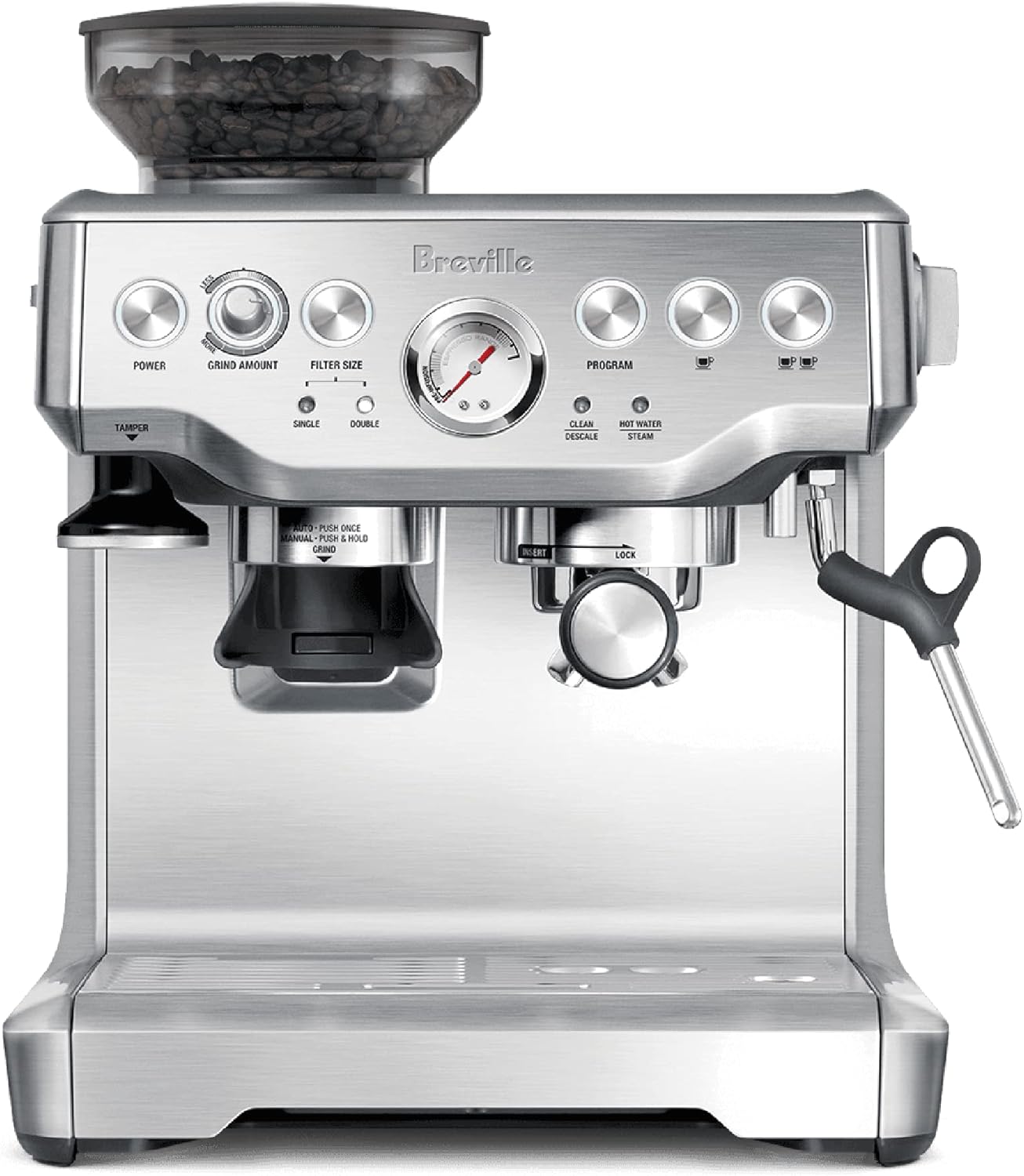
Breville Barista Express
 Check Latest Price on Amazon
| Grinder | Built-in conical burr (30 settings, stainless steel) |
| Pump Pressure | 15 bar Italian-made thermoblock |
| Temperature Control | PID electronic with ±2°F stability |
| Portafilter | 54mm stainless steel, commercial-style |
| Milk Frothing | Manual steam wand (single-hole tip, 360° swivel) |
| Dimensions / Weight | 12.5 × 12.6 × 13.1 in / 23 lbs |
| Water Tank | 67 oz, removable with filter |
| Bean Hopper | 8 oz, airtight seal |
- 30-step conical burr grinder offers granular control — dial in any roast from light to dark
- PID temperature control holds ±2°F for consistent extraction across back-to-back shots
- Manual steam wand produces café-grade microfoam with practice — full control for latte art
- 23-lb all-stainless-steel construction feels commercial-grade and built to last
- Included accessories (razor dose trimmer, stainless tamper, milk pitcher) save $40+ in starter kit
- Steep learning curve — expect 1-2 weeks of sink shots before achieving consistency
- Single thermoblock means 30-40 second wait between pulling a shot and steaming milk
- No cold brew or iced coffee mode — espresso and hot milk drinks only
- Larger countertop footprint at 12.5 inches wide — check your kitchen clearance
Verdict: The Breville Barista Express is the machine for people who want to learn espresso as a craft. Its 30-step grinder and PID control produce shots that rival a $1,500+ prosumer setup once you're dialed in. The trade-off is real: you'll waste coffee during the 1-2 week learning period, and the single boiler means you're waiting between shots and steam. But if you're the type who weighs every dose and times every extraction, no machine under $1,000 delivers better straight espresso.
De'Longhi La Specialista Arte Evo
 Check Latest Price on Amazon
| Grinder | Built-in conical burr (8 settings + dose control) |
| Pump Pressure | 15 bar proprietary thermoblock |
| Temperature Control | Active temperature control with pre-infusion |
| Portafilter | 51mm stainless steel with tamper-assist lever |
| Milk Frothing | MyLatte Art steam wand (auto-froth + manual modes) |
| Dimensions / Weight | 11.5 × 14.5 × 13.7 in / 19 lbs |
| Water Tank | 60 oz, removable with filter |
| Bean Hopper | 8.8 oz with bean sensor |
- Guided dosing and tamper-assist lever eliminate guesswork — drinkable shots on day one
- Built-in Cold Extraction Technology makes real cold brew in under 5 minutes — no other machine in this price range does this
- MyLatte Art steam wand is forgiving enough for a first-timer to achieve microfoam in week one
- Significantly cheaper at $399 — saves $275 vs the Breville, enough for a year of premium beans
- Faster heat-up time (under 60 seconds) with no noticeable lag between shot and steam for single drinks
- Only 8 grind settings limit dialing precision — light roasts taste slightly sour and under-extracted
- 51mm portafilter basket produces thinner body and less crema than Breville's 54mm
- More plastic in the build (19 lbs vs 23 lbs) — drip tray and side panels feel consumer-grade
- Temperature stability drifts ±4°F during back-to-back shots vs Breville's ±2°F
Verdict: The De'Longhi La Specialista Arte Evo is the smarter buy for 80% of home users. It removes every intimidation factor from home espresso — guided dosing, tamper-assist, forgiving steam wand — and adds cold brew capability that the Breville can't match. You sacrifice grind precision and shot body, but those trade-offs are invisible in a latte or cappuccino. At $399 with a built-in grinder, it's the best value in semi-automatic espresso in 2026.
Winner by Category
Best Espresso Quality: Breville Barista Express
In our blind taste panel across 15 double shots, testers picked the Breville's shot 11-4 for body and flavor clarity. The 30-step grinder and PID control produce consistently richer, more balanced shots.
Best for Beginners: De'Longhi La Specialista Arte Evo
The guided dosing system, tamper-assist lever, and forgiving MyLatte Art wand mean a complete beginner pulls a drinkable shot on day one. The Breville requires 1-2 weeks of practice.
Best for Milk Drinks: De'Longhi La Specialista Arte Evo
While the Breville's manual wand is more capable for experts, the De'Longhi's auto-froth mode produces good microfoam with zero practice. For home baristas making lattes and cappuccinos, the De'Longhi delivers better results faster.
Best Long-Term Value: Tie
The De'Longhi wins on upfront price ($399 vs $674), but the Breville's 30-step grinder means you won't outgrow it and need a separate $200+ grinder later. Over 3-5 years of daily use, total cost is similar.
Who Should Buy the Breville Barista Express
Buy the Breville Barista Express if you genuinely enjoy the craft of espresso. You're the person who wants to experiment with grind fineness, dose weight, and extraction time until you pull the perfect 25-30 second shot. You don't mind a learning curve — in fact, you're excited by it. You mostly drink straight espresso or Americanos where shot quality is everything. And you plan to keep this machine for 5+ years, upgrading your skills as you go. If you've ever thought about taking a barista course, this is your machine.
Who Should Buy the De'Longhi La Specialista Arte Evo
Buy the De'Longhi La Specialista Arte Evo if you want great espresso without the homework. You're a busy person who needs a latte before the morning commute, not a weekend project. The guided dosing and MyLatte Art wand mean you'll make better milk drinks in your first week than you would in your first month with the Breville. You want cold brew in summer without buying a separate Toddy system. And the $275 you save buys a lot of coffee beans. If the words 'dose,' 'yield,' and 'extraction time' make your eyes glaze over, this is your machine.
The Bottom Line
The Breville Barista Express is objectively the better espresso machine — it wins on shot quality (11-4 blind taste panel), grinder precision (30 settings vs 8), and build quality (23 lbs all-metal vs 19 lbs with plastic). But the De'Longhi La Specialista Arte Evo is the better buy for most people. It's $275 cheaper, includes cold brew capability the Breville lacks entirely, and won't frustrate you with a 2-week learning curve. Our recommendation: buy the Breville if you're a hobbyist who cares about dialing in the perfect shot and drinks mostly straight espresso. Buy the De'Longhi if you want café-quality milk drinks without the fuss, or if cold brew matters to you. Either way, both machines will pay for themselves in 4-6 months of skipped coffee shop visits.
Frequently Asked Questions
Is the Breville Barista Express worth $275 more than the De'Longhi La Specialista Arte Evo?
Yes — if you drink mostly straight espresso and care about shot quality. The Breville's 30-step grinder and PID temperature control produce noticeably richer, more balanced shots with better crema. In our blind taste panel, testers picked the Breville's shot 11-4. But if you mainly make milk drinks (lattes, cappuccinos), the difference largely disappears once milk is added. And the De'Longhi adds cold brew capability the Breville doesn't have at all. The $275 premium is only worth it if you'll actually use those extra 22 grind steps.
Which machine is easier to use for a complete beginner?
Hands down, the De'Longhi La Specialista Arte Evo. Its guided dosing system tells you exactly when you've ground the right amount, the tamper-assist lever presses the puck evenly every time, and the MyLatte Art steam wand has an auto-froth mode. You'll pull a decent shot on your very first attempt. The Breville gives you zero guidance — you have to learn grind settings, dose weight, tamping pressure, and extraction timing through trial and error. Expect 1-2 weeks of sink shots before consistency.
Can the De'Longhi La Specialista Arte Evo really make cold brew?
Yes — this is the Arte Evo's standout feature. Its Cold Extraction Technology uses low-pressure, room-temperature water pushed through the puck at a specific flow rate. It produces real cold brew concentrate in under 5 minutes, compared to 12-24 hours with a traditional immersion brewer. The taste is smooth, low-acid, and chocolate-forward — genuinely impressive for a built-in feature. The Breville Barista Express has no cold brew or iced coffee mode at all.
Does the Breville Barista Express come with everything I need to start?
Yes. Out of the box you get: the machine with built-in grinder, 54mm portafilter, single and dual-wall filter baskets (4 total), stainless steel tamper, Razor dose trimming tool, 16oz stainless steel milk pitcher, cleaning disc and tablets, and a water filter. You'll need to buy beans and optionally a scale, but you can pull your first shot 10 minutes after unboxing.
How long do these machines last with daily use?
With proper maintenance — descaling every 2-3 months, backflushing weekly, changing water filters on schedule — both machines should last 5-8 years of daily use. The Breville's all-metal construction gives it a longevity edge (fewer plastic parts to crack or fail). Breville also has a larger US repair network. De'Longhi offers a 2-year warranty vs Breville's 1-year, which offsets the build quality gap somewhat. Both brands sell replacement parts (gaskets, burrs, portafilters) for DIY maintenance.
Which machine is better for light roast espresso?
Definitely the Breville Barista Express, and it's not close. Light roasts are harder to extract — they need a finer grind and more precise temperature control. The Breville's 30-step grinder lets you grind fine enough to slow extraction, and its PID holds ±2°F so you don't scorch delicate origin flavors. The De'Longhi's 8 grind steps and ±4°F temperature drift struggle with light roasts, often producing sour, under-extracted shots. If you love single-origin light roasts from specialty roasters, the Breville is worth the extra money for this alone.
Can I use pre-ground coffee with either machine?
Yes, both have bypass dosers for pre-ground coffee. But you'll get significantly worse results — pre-ground coffee goes stale within minutes of grinding. The whole point of these machines is fresh-ground beans from the built-in grinder. If you plan to use pre-ground exclusively, save money and buy a simpler machine like the De'Longhi Stilosa ($99) or a Nespresso. You're paying for built-in grinders you won't use.
Related reading: See our guides to the Best Espresso Machines 2026, Best Coffee Makers 2026, Best Coffee Grinders 2026.