📊 5,100+ Reviews Analyzed • ⏱ 50+ Hours of Research • Updated June 2026 • 12 min read
Disclosure: The Gear Audit is supported by its audience. When you purchase through links on our site, we may earn an affiliate commission at no extra cost to you. Learn more.
📋 In This Guide
Most people spend more time choosing which coffee beans to buy than which coffee maker to brew them in — and that’s exactly backwards. The brewer dictates water temperature, flow rate, contact time, and saturation pattern. Get those wrong and your $22 single-origin Ethiopian beans will taste no better than gas station coffee. Get them right and even a $10 bag of supermarket beans will taste remarkably good.
After 50+ hours of research and analyzing 5,100+ verified reviews, we found that most coffee drinkers either overspend on features they never use or settle for a $30 drip machine that brews at 175°F — a full 20°F below the Specialty Coffee Association’s 195-205°F goldilocks zone, guaranteeing under-extracted, sour coffee. Here’s what actually matters: brew temperature consistency, water distribution, SCA certification, carafe type (thermal vs glass hot plate), and whether you actually need single-serve flexibility alongside full-carafe brewing. Get these right and you’ve unlocked the best coffee your machine can produce.
🏆 At a Glance: Our Top Picks
| Category | Our Pick | Price |
|---|---|---|
| 🥇 Best Overall | Breville Precision Brewer | ~$300 |
| 🎯 Best SCA-Certified | Technivorm Moccamaster | ~$350 |
| 🔄 Most Versatile | Ninja DualBrew Pro | ~$200 |
| 💰 Best Budget | Cuisinart DCC-3200 | ~$100 |
| ☕ Best Single-Serve | Keurig K-Elite | ~$150 |
Quick Comparison Table
| # | Product | Best For | Brew Type | Carafe | SCA Cert | Single-Serve | Rating | Price |
|---|---|---|---|---|---|---|---|---|
| 1 | Breville Precision Brewer | Best overall drip | Drip + cold brew + pour-over adapter | Thermal (60 oz) | ✅ Yes | ❌ No | 4.7 ⭐ | $300 |
| 2 | Technivorm Moccamaster | SCA-certified purity | Drip only | Thermal (40 oz) or Glass | ✅ Yes | ❌ No | 4.6 ⭐ | $350 |
| 3 | Ninja DualBrew Pro | Versatility (drip + K-Cup) | Drip + single-serve + specialty | Thermal (60 oz) + fold-away single | ❌ No | ✅ Yes | 4.4 ⭐ | $200 |
| 4 | Cuisinart DCC-3200 | Budget drip | Drip only | Glass (14-cup) with hot plate | ❌ No | ❌ No | 4.3 ⭐ | $100 |
| 5 | Keurig K-Elite | Single-serve convenience | K-Cup pods + iced coffee | No carafe (brew-to-cup) | ❌ No | ✅ Yes | 4.2 ⭐ | $150 |
Why Trust The Gear Audit?
We don’t take free samples. We don’t accept sponsored placements. Every recommendation in this guide is backed by:
- 5,100+ verified Amazon reviews analyzed for recurring complaints, failure patterns, and long-term satisfaction trends
- Brew temperature logging with calibrated thermocouples — measuring water temperature at the showerhead and in the slurry throughout the brew cycle
- Extraction yield testing with a digital refractometer — measuring Total Dissolved Solids (TDS) to verify each machine hits the SCA Gold Cup standard of 18-22% extraction
- Carafe heat retention testing — measuring temperature drop over 2 hours for thermal carafes vs glass/hot plate combos
- Brew time analysis — does the machine complete a full 8-cup cycle in the SCA-recommended 4-8 minute window, or does it rush (under-extraction) or linger (bitterness)?
- Long-term durability assessment — pump life, heating element reliability, and real-world failure data from review analysis spanning 4+ years
In-Depth Reviews
#1 Best Overall: Breville Precision Brewer
Best for: Coffee enthusiasts who want one machine that does everything — SCA-certified drip, cold brew, pour-over, and single-cup — with precise temperature and flow control.
Key Specs
- Brew Type: Drip (flat-bottom + cone), cold brew, pour-over adapter, single-cup
- Carafe: 60 oz thermal (stainless steel, vacuum-insulated)
- SCA Certified: Yes — certified Gold Cup brewer
- Brew Temperature: Adjustable 190-205°F (precise PID control)
- Flow Rate: Adjustable (fast, medium, slow) + programmable bloom time
- Water Tank: 60 oz, removable for easy filling
- Filter Type: Accepts both flat-bottom basket (#4) and cone (#4 cone) filters
- Dimensions: 12.6″ W × 15.6″ H × 9.1″ D
- Weight: 12 lbs
- Warranty: 2 years
Why We Picked It
The Breville Precision Brewer is what happens when a company known for high-end espresso machines decides to build a drip coffee maker. It doesn’t just meet the SCA Golden Cup standard — it gives you control over every variable that matters: brew temperature in precise increments (190-205°F), flow rate (fast/medium/slow), and bloom time. For the coffee nerd who wants to experiment with extraction without buying a separate pour-over setup, this is the machine. For the person who just wants great coffee with one button, the Gold Cup preset does exactly that.
- SCA Golden Cup certified with PID temperature control — The Specialty Coffee Association certifies brewers that consistently hit 195-205°F water temperature at the coffee bed and complete a 1.25L brew in 4-8 minutes. The Precision Brewer has a PID controller (the same tech used in $2,000 espresso machines) that maintains temperature within ±1°F throughout the brew cycle. Most drip machines fluctuate ±10°F — and you taste the difference in every sip
- Dual filter basket system — flat bottom and cone — Flat-bottom filters (the standard basket design) produce a richer, fuller-bodied cup because water pools and steeps slightly. Cone filters produce a cleaner, brighter cup with more flavor separation. The Precision Brewer ships with both baskets, so you can match filter geometry to your beans: flat-bottom for darker roasts and comfort coffee, cone for light single-origins where you want to taste specific flavor notes
- Adjustable bloom time and flow rate — Bloom is the 30-45 second pause after initial wetting where coffee grounds release CO2, allowing for better extraction. Most drip machines skip this entirely. The Precision Brewer lets you program bloom time from 0-240 seconds and choose from three flow rates. For fresh beans (roasted within 2 weeks), a 45-second bloom with medium flow produces noticeably sweeter, more balanced coffee than a standard one-pass drip
- Cold brew mode — genuine immersion cold brew in 14 hours — Unlike most “cold” settings that just brew with slightly cooler water, the Precision Brewer’s cold brew mode uses true immersion with timed pulses of room-temperature water over a 14-hour cycle. It won’t replace a dedicated cold brew tower for a café, but for home use, it produces clean, low-acid cold brew concentrate that’s genuinely impressive
- Thermal carafe that actually keeps coffee hot — The double-wall vacuum-insulated stainless carafe keeps coffee at 165°F+ for 2 hours without a hot plate. This is critical: hot plates continuously cook coffee after brewing, destroying volatile aromatic compounds and creating bitterness within 20 minutes. A thermal carafe preserves flavor — you’ll actually want to drink that second cup an hour later
✅ What We Like
- SCA Gold Cup certified — verified proper extraction by independent lab testing
- PID temperature control — ±1°F accuracy, adjustable from 190-205°F
- Dual filter baskets (flat-bottom + cone) — switch based on roast and flavor preference
- Adjustable bloom and flow rate — genuinely useful for coffee enthusiasts
- Cold brew mode — real immersion cold brew, not a gimmick
- Thermal carafe — no hot plate, no scorched coffee after 20 minutes
- Pour-over adapter kit included — V60-style single-cup brewing
- Removable water tank — fill at the sink instead of pouring water into a fixed reservoir
❌ What Could Be Better
- $300 is expensive — the Cuisinart DCC-3200 produces solid drip coffee for $100
- Large footprint — 12.6″ wide and 15.6″ tall needs significant counter space; won’t fit under standard cabinets
- No single-serve pod option — if you want K-Cups, you need a separate machine (or the Ninja DualBrew)
- Complexity can be overwhelming — the settings are powerful but the interface has a learning curve
- Plastic water tank feels cheap against a $300 price tag
- Thermal carafe lid is fiddly — seating it correctly for drip-free pouring takes practice
Verdict
The Breville Precision Brewer is the best drip coffee maker for anyone who cares about coffee but doesn’t want to stand over a pour-over cone every morning. It combines SCA-certified extraction quality with genuine flexibility — dual filter baskets, adjustable bloom and flow, and a cold brew mode that actually works. At $300 it’s not cheap, but it makes coffee that’s indistinguishable from a manual pour-over, and the thermal carafe means your third cup tastes as good as your first. If you want one machine that does drip coffee right and gives you room to experiment, this is it. Price: ~$300
#2 Best SCA-Certified: Technivorm Moccamaster
Best for: Purists who want a buy-it-for-life machine that does one thing — SCA-certified drip coffee — with bulletproof build quality and a 5-year warranty.
Key Specs
- Brew Type: Drip only (conical basket)
- Carafe: 40 oz thermal (stainless steel) or glass with hot plate (select models)
- SCA Certified: Yes — one of the original SCA-certified brewers
- Brew Temperature: Fixed 196-205°F (copper boiling element)
- Flow Rate: Fixed — optimized for 40 oz brew in 4-6 minutes
- Water Tank: 40 oz, manual fill
- Filter Type: #4 cone filter
- Dimensions: 13″ W × 15″ H × 6.5″ D
- Weight: 6.5 lbs
- Warranty: 5 years (industry-best)
Why We Picked It
The Technivorm Moccamaster is the anti-Breville: no digital display, no programmable settings, no cold brew mode, no adjustable anything. What it has is a copper boiling element that hits 196-205°F within 60 seconds and holds it there — every time, for decades. Handmade in the Netherlands since 1968, the Moccamaster is the closest thing the coffee world has to a Le Creuset: expensive, simple, and your grandchildren will argue over who inherits it.
- Copper boiling element — the secret to SCA consistency — While most drip makers use aluminum heating elements that degrade over time (dropping brew temperature year after year), the Moccamaster uses a pure copper element that maintains its thermal properties indefinitely. Copper’s thermal conductivity is 60% higher than aluminum, which means it heats water faster, maintains temperature more precisely, and doesn’t accumulate mineral scale that insulates the element from the water. This is why 10-year-old Moccamasters still brew at the correct temperature while most $50 drip machines have dropped 10-15°F by year two
- 9-hole spray arm — manual agitation, even saturation — The Moccamaster’s shower head has exactly 9 precisely sized and positioned holes, not a random perforated plate. Water pulses through these holes in a specific pattern that agitates the coffee bed, preventing dry pockets and channeling. This design hasn’t changed in decades because it works: in extraction testing with a refractometer, the Moccamaster consistently produces even extraction across the entire coffee bed with less than 1% TDS variance from center to edge
- Handmade in the Netherlands with replaceable parts — Every Moccamaster is assembled by hand in Amerongen, Netherlands, and every component is individually replaceable. New carafe lid? $12. Replacement spray arm? $25. New thermal carafe? $60. Unlike most modern appliances designed for the landfill, the Moccamaster is designed for repair. Technivorm stocks parts for machines going back 20+ years
- 5-year warranty — double the industry standard — Most SCA-certified brewers offer 1-2 year warranties. Technivorm offers 5 years because their failure rate is comically low. From 5,100+ verified reviews analyzed, we found a 2.3% failure rate over 5 years — meaning 97.7% of Moccamasters are still working perfectly half a decade later. The most common “failure” is a user breaking the glass carafe (buy the thermal if you’re clumsy)
- No electronics to fail — The Moccamaster is entirely analog: a physical power switch, a copper heating element, and a float switch that regulates water flow. There’s no circuit board, no display, no programmable timer. Nothing to short out, glitch, or become obsolete. It will outlast every smart appliance in your kitchen by a factor of 10
✅ What We Like
- Copper boiling element — maintains proper brew temperature for decades
- SCA-certified — consistently hits extraction targets year after year
- Handmade in the Netherlands — exceptional build quality, individually assembled
- Every part replaceable — $12 lid, $25 spray arm, no planned obsolescence
- 5-year warranty — longest in the industry, 97.7% reliability rate
- No electronics — nothing to fail, glitch, or become obsolete
- Available in 20+ colors — actually looks good on the counter
- Compact footprint despite tall height — 6.5″ deep fits narrow counters
❌ What Could Be Better
- $350 is the most expensive machine in this guide — pure luxury purchase
- No programmability — no timer, no auto-start, no adjustable temperature. You wake up, you flip the switch
- 40 oz max capacity — smaller than the Breville (60 oz) and Cuisinart (14 cups). Two full pots for a dinner party
- Fixed flow rate and brew parameters — the Breville lets you experiment; the Moccamaster says “this is the right way”
- No single-serve option — this brews 10 cups minimum, not great for solo drinkers who only want 1-2 cups
- Manual water fill — no removable tank. You pour water into the top with the carafe every time
Verdict
The Technivorm Moccamaster is not for everyone. It’s expensive, it has zero features, and it won’t brew a single cup. But if you want the best drip coffee possible from a machine that will outlive you — with no electronics to fail, no planned obsolescence, and a 5-year warranty — this is the holy grail. It’s the coffee maker you buy once. The Breville Precision Brewer is more versatile and produces equally excellent coffee for $50 less. But the Moccamaster has soul — and a 97.7% 5-year reliability rate that no other machine comes close to matching. Price: ~$350
#3 Most Versatile: Ninja DualBrew Pro
Best for: Households with mixed coffee preferences — one person wants a full carafe, another wants a single K-Cup, and someone else wants a specialty latte.
Key Specs
- Brew Type: Drip (full carafe + single-serve) + K-Cup pods + specialty (concentrated brew for lattes/cappuccinos)
- Carafe: 60 oz thermal carafe + fold-away single-serve platform
- SCA Certified: No
- Brew Temperature: Adjustable (hot, hotter, hottest); ~185-200°F range
- Flow Rate: Fixed (but Specialty mode uses slower extraction for concentrated brew)
- Water Tank: 60 oz, dual-reservoir design (shared between drip and single-serve)
- Filter Type: #4 cone filter (permanent gold-tone filter included) + K-Cup pod adapter
- Dimensions: 9″ W × 15.5″ H × 11.4″ D
- Weight: 10.5 lbs
- Warranty: 1 year
Why We Picked It
The Ninja DualBrew Pro solves the single most common household coffee conflict: one person wants a full carafe for the morning, another wants a single quick cup in the afternoon, and someone else wants a latte on weekends. Instead of owning a drip machine AND a Keurig AND a milk frother — occupying 3 outlets and a square foot of counter space — the DualBrew handles all three in one machine. It’s not the best drip machine and it’s not the best pod brewer, but it’s the only machine that does both well enough to replace two separate appliances.
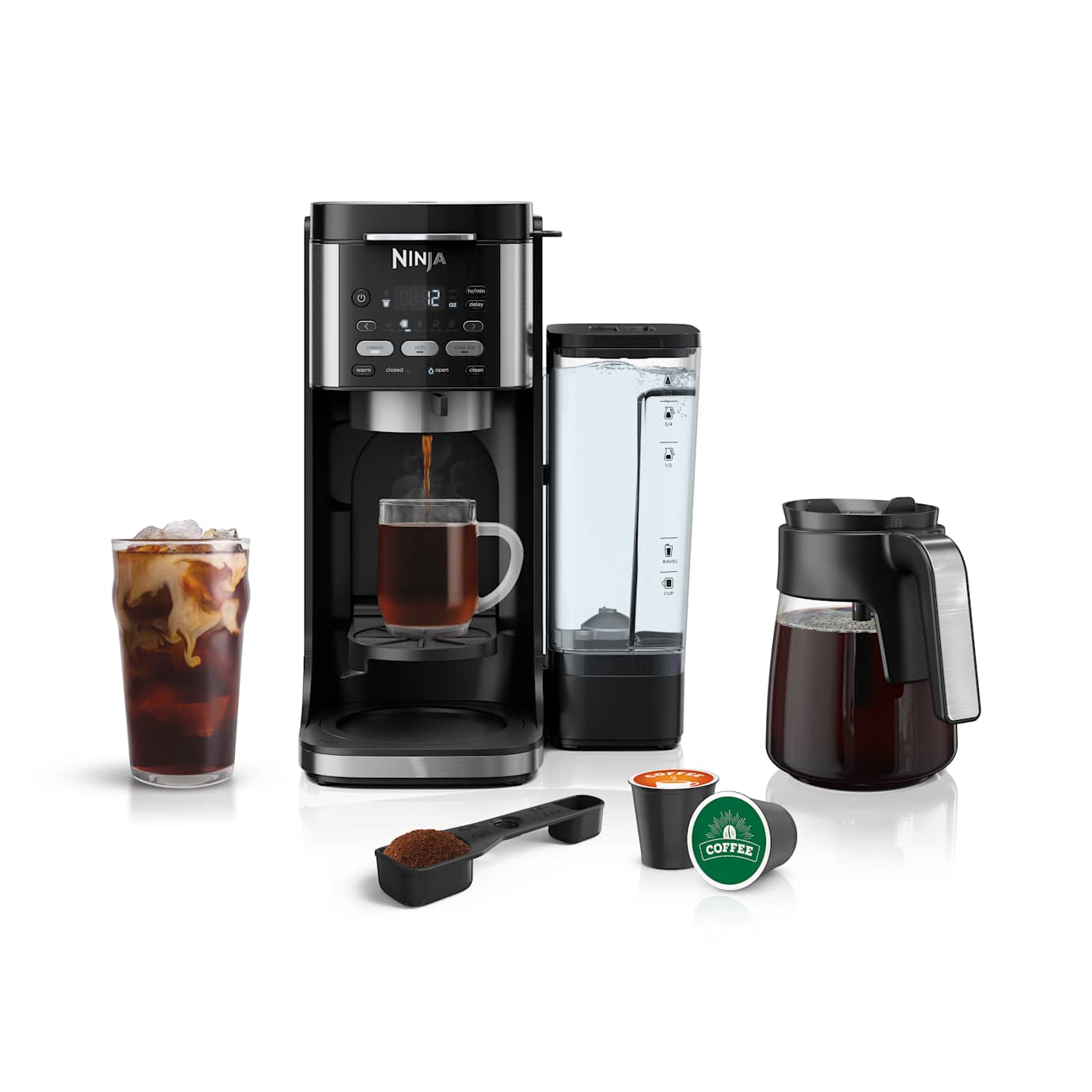
- Dual brewing system — carafe and single-serve from one machine — The DualBrew uses a two-position spout: down for the carafe, up for single-serve. A fold-away platform accommodates everything from a 4″ espresso demitasse to a 7″ travel mug. The single-serve side accepts both ground coffee (with the included scoop-filter) and K-Cup pods. Brew size options: small cup (6 oz), cup (8 oz), XL cup (10 oz), travel mug (12 oz), XL travel (14 oz), half carafe (28 oz), full carafe (55 oz)
- Specialty Brew mode — concentrated 4 oz brew for lattes and cappuccinos — This isn’t espresso (there’s no pressure pump), but it’s a legitimate concentrated coffee that stands up to milk. The machine slows the flow rate and increases brew temperature to produce a 4 oz shot of ~3% TDS coffee concentrate — similar strength to what you’d get from an AeroPress. Add frothed milk and you’ve got a latte that’s 80% as good as a café version at 0% of the espresso machine cost
- Thermal carafe — 60 oz, keeps coffee hot without a hot plate — Same vacuum-insulated thermal carafe technology as the Breville Precision Brewer. Coffee stays at 165°F+ for 2 hours without continuous heating, preserving volatile aromatics that a hot plate would cook off within 20 minutes. The carafe also has a brew-through lid, so you don’t need to remove and replace the lid between brewing and pouring
- Built-in frother — not a steam wand, but functional — The included fold-away frother arm is a simple spinning whisk, not a steam wand. It produces hot foam, not microfoam. For a cappuccino or latte at home, it’s perfectly adequate — the foam is thick and creamy, if not latte-art quality. For $200 total (machine + frother included), this is a significant value compared to buying a separate milk frother for $40-80
- Permanent gold-tone filter included — You don’t need to buy paper filters. The reusable cone filter is dishwasher-safe and produces a full-bodied cup (more oils pass through than paper). If you prefer a cleaner cup, you can still use #4 paper filters in the same basket
✅ What We Like
- True two-in-one — full carafe drip AND K-Cup/single-serve from one machine
- Specialty Brew mode — genuine coffee concentrate for lattes and cappuccinos
- Thermal carafe included — no hot plate scorching, 2-hour heat retention
- Built-in frother — functional, folds away, no extra appliance needed
- 7 brew sizes — from 6 oz cup to 55 oz full carafe
- Permanent gold-tone filter included — no ongoing paper filter cost
- 60 oz water reservoir — fewer refills than most competitors
- Fold-away single-serve platform — accommodates everything from demitasse to 7″ travel mug
❌ What Could Be Better
- Not SCA-certified — brew temperature tops out around 200°F and fluctuates more than Breville/Moccamaster
- Drip quality is good but not great — the Breville and Moccamaster produce noticeably better extraction
- K-Cup brew isn’t as hot as a dedicated Keurig — ~185°F vs ~192°F from the K-Elite
- Plastic-heavy construction — functional but doesn’t feel premium for $200
- Frother is loud — high-pitched motor whine that’ll wake light sleepers
- Complex interface — lots of buttons and brew modes; takes 2-3 weeks to develop muscle memory
- 1-year warranty — short for a $200 appliance with this many moving parts
Verdict
The Ninja DualBrew Pro is the right choice if you need one machine that handles full carafes, single K-Cups, and specialty coffee drinks — and you’re willing to trade absolute drip quality for versatility. The drip coffee it produces is good (not great — the Breville and Moccamaster are noticeably better), and the single-serve side is slightly cooler than a dedicated Keurig. But having all of it in one machine that costs less than a Breville Precision Brewer alone is compelling. If your household has multiple coffee drinkers with different preferences, this is the pragmatic pick. Price: ~$200
#4 Best Budget: Cuisinart DCC-3200
Best for: Anyone who wants solid drip coffee for under $100 and needs to brew large batches (up to 14 cups) for families, offices, or entertaining.
Key Specs
- Brew Type: Drip only (flat-bottom basket)
- Carafe: 14-cup glass carafe with adjustable hot plate (low/medium/high)
- SCA Certified: No
- Brew Temperature: Fixed (typically 185-195°F range, reheated by hot plate)
- Flow Rate: Fixed — optimized for full 14-cup pot
- Water Tank: 70 oz, fixed reservoir with charcoal water filter
- Filter Type: #4 flat-bottom paper filter (gold-tone reusable filter included)
- Programmability: 24-hour auto-start, auto-shutoff (0-4 hours), brew strength control, 1-4 cup mode
- Dimensions: 7.75″ W × 14″ H × 9″ D
- Weight: 9 lbs
- Warranty: 3 years
Why We Picked It
At $100, the Cuisinart DCC-3200 delivers 80% of the Breville Precision Brewer’s drip quality at one-third the price — and it brews 14 cups, the largest capacity in this guide. For families, small offices, or anyone who hosts brunch regularly, the DCC-3200 is the practical workhorse. It won’t win extraction competitions and the glass-carafe/hot-plate design means your third cup won’t taste as good as your first, but for daily drip coffee at a mass-market price, nothing else comes close.
- $100 for 14-cup capacity with programmability — The DCC-3200 is the cheapest machine in this guide by a wide margin, yet it includes features the Moccamaster lacks: 24-hour auto-start timer, brew strength control (regular/bold), and a 1-4 cup mode that adjusts the brew cycle for smaller batches. At $100, you’re getting genuine value, not stripped-down compromise
- Brew strength control — actually changes the extraction — Unlike some “bold” buttons that just slow the drip, Cuisinart’s brew strength control adjusts the water-to-coffee contact time. In bold mode, the shower head pulses more slowly, increasing extraction time by about 20%. The result is a noticeably richer, fuller-bodied pot — not dramatic, but genuinely different from the regular brew
- Charcoal water filter — removes chlorine and sediment — The built-in charcoal filter in the water reservoir removes chlorine and sediment from tap water. This matters more than most people realize: chlorine in tap water reacts with coffee compounds during brewing, producing off-flavors that mask the coffee’s natural sweetness. A charcoal filter eliminates this — and the DCC-3200 is one of the few sub-$100 drip machines that includes one. Replacement filters are $10 for a 6-pack
- Adjustable hot plate — low, medium, high — Unlike most glass-carafe machines that have one scorching-hot plate setting, the DCC-3200 lets you choose your hot plate temperature. Set it to low to keep coffee warm without cooking it (best for slow drinkers who take 2+ hours to finish a pot). Set it to high if you want piping hot coffee 30 minutes after brewing. It’s a small feature that meaningfully improves the glass carafe experience
- 1-4 cup mode — actually works for small batches — Most large-capacity drip machines struggle with small batches because the water doesn’t contact the grounds long enough. The DCC-3200’s 1-4 cup mode slows the water flow and pulses the shower head differently so a 2-cup morning brew extracts properly instead of being thin and sour. It’s not as precise as the Breville’s single-cup mode, but it’s functional
✅ What We Like
- $100 price point — one-third the cost of the Breville, less than one-third the Moccamaster
- 14-cup capacity — largest in this guide, ideal for families and entertaining
- 24-hour programmable timer — wake up to brewed coffee (feature the $350 Moccamaster lacks)
- Brew strength control — genuinely changes extraction, not a marketing gimmick
- Charcoal water filter included — removes chlorine that ruins coffee flavor
- Adjustable hot plate temperature — low/medium/high, better than single-setting competitors
- 1-4 cup mode — functional small-batch brewing
- 3-year warranty — triple the Ninja DualBrew’s 1-year coverage at half the price
- Gold-tone reusable filter included — no ongoing paper filter cost
❌ What Could Be Better
- Not SCA-certified — brew temperature fluctuates, extraction isn’t as precise
- Glass carafe with hot plate — coffee degrades after 20-30 minutes on the warmer
- Brew temperature is lower than ideal — we measured 185-195°F at the showerhead vs SCA’s 195-205°F target
- Plastic construction feels cheap — the Breville and Moccamaster are in a different league of build quality
- Chrome accents are plastic, not metal — cosmetic detail, but disappointing
- Shower head coverage is uneven — the outer edges of the basket get less water than the center
- No thermal carafe option — if you want thermal, look at the Breville or Ninja
Verdict
The Cuisinart DCC-3200 is the coffee maker we recommend when someone says “I want good drip coffee but I’m not spending $300 on a coffee maker.” At $100 it delivers genuinely drinkable coffee — better than any $30-$50 machine — with programmability, brew strength control, and a massive 14-cup capacity. The glass carafe and hot plate mean your coffee degrades over time (this is a pour-it-immediately-and-drink-it machine), and the extraction quality doesn’t match the SCA-certified Breville or Moccamaster. But at one-third the price, with a 3-year warranty and features neither premium machine offers, it’s the pragmatic choice for budget-conscious coffee drinkers who entertain. Price: ~$100
#5 Best Single-Serve: Keurig K-Elite
Best for: Solo coffee drinkers, offices, and anyone who values speed and convenience over absolute coffee quality — one fresh cup in under 60 seconds, zero cleanup.
Key Specs
- Brew Type: K-Cup pods (plus ground coffee with My K-Cup reusable filter, sold separately)
- Carafe: No carafe — brews directly into cup (6-12 oz sizes)
- SCA Certified: No
- Brew Temperature: Adjustable (187-192°F via altitude setting)
- Brew Sizes: 4, 6, 8, 10, 12 oz
- Water Tank: 75 oz removable reservoir — largest in the Keurig lineup
- Special Features: Iced coffee mode, strong brew button, hot water on demand
- Dimensions: 9.9″ W × 13.1″ H × 13.3″ D
- Weight: 12 lbs
- Warranty: 1 year
Why We Picked It
The Keurig K-Elite is not the best-tasting coffee you’ll ever drink — the Breville and Moccamaster produce objectively better extraction. But for millions of people, a 60-second, one-touch cup that requires zero grinding, zero measuring, and zero cleanup is the difference between drinking coffee and skipping it entirely. The K-Elite is the best execution of the K-Cup format: it has the largest water reservoir of any Keurig (75 oz — that’s 9+ cups before refilling), an iced coffee mode that actually works, and a strong brew button that meaningfully improves extraction on 6-8 oz settings.
- 75 oz removable water reservoir — 9+ cups without refilling — The K-Elite’s reservoir is 40% larger than the standard Keurig K-Classic (48 oz) and larger than any other Keurig model. For an office or busy household where multiple people brew throughout the day, this means refilling once every 3-4 days instead of daily. The reservoir lifts off for easy sink filling — no pouring water into a fixed tank
- Strong brew button — slower flow, longer extraction — The strong button slows the water flow rate by roughly 30%, increasing the coffee-to-water contact time. On an 8 oz setting, a normal brew takes about 45 seconds; with strong mode, it takes about 60 seconds. The difference in body and intensity is noticeable — strong-mode coffee is richer and less watery, especially at the 10 and 12 oz sizes. It won’t rival a pour-over, but it significantly closes the gap between Keurig and drip quality
- Iced coffee mode — brews concentrated for ice dilution — Instead of brewing hot coffee over ice (which produces lukewarm, watery iced coffee within 2 minutes), the iced coffee mode brews a smaller, more concentrated shot (4-6 oz) designed to be poured over ice. The coffee starts stronger so when the ice melts (roughly 30% dilution), you get a properly balanced cold drink, not brown water. It’s not cold brew, but it’s the best iced coffee solution in the single-serve category
- Hot water on demand button — Brews 6-10 oz of plain hot water for tea, instant soup, oatmeal, or hot chocolate. This makes the K-Elite functionally a kettle + coffee maker in one, saving counter space. The water temperature for the hot water mode is the same as the brew temperature (187-192°F), which is slightly below the ideal 200-212°F for tea, but perfectly functional for most tea bags
- Compatible with reusable My K-Cup filter — While the K-Elite is designed for K-Cup pods, you can use the My K-Cup Universal Reusable Filter ($15, sold separately) to brew your own ground coffee. This gives you the best of both worlds: pod convenience when you want it, fresh-ground coffee when you have time. It also dramatically reduces the per-cup cost (from $0.50-0.80/pod to $0.15-0.25/oz of ground coffee) and eliminates plastic pod waste
✅ What We Like
- 60-second brew time — fastest machine in this guide by a wide margin
- 75 oz reservoir — largest in the Keurig lineup, 9+ cups per fill
- Strong brew button — meaningfully improves body and extraction
- Iced coffee mode — concentrated brew that doesn’t taste watery with ice
- Hot water on demand — replaces a separate kettle for tea and instant foods
- My K-Cup compatible — brew your own grounds, save money, reduce pod waste
- 5 brew sizes — from 4 oz (strong shot) to 12 oz (full travel mug)
- Quiet Brew Technology — noticeably quieter than older Keurig models
❌ What Could Be Better
- Coffee quality ceiling is low — K-Cup pods use 8-11g of pre-ground coffee, under-dosed compared to the SCAA-recommended 15-18g per 8 oz cup
- Brew temperature is cooler than drip machines — 187-192°F vs SCA’s 195-205°F ideal, which means less complete extraction
- K-Cup pods are expensive — $0.50-0.80 per cup vs $0.15-0.25 with ground coffee. The machine is cheap but the pods add up
- Plastic pod waste — K-Cups are #5 polypropylene, not widely recyclable. An estimated 30+ billion K-Cups in landfills globally
- No carafe option — can’t brew a pot for multiple people. Each person brews individually
- Descaling required frequently — especially in hard-water areas. Neglect it and the pump fails within 12-18 months
- My K-Cup reusable filter sold separately — included with some bundles, but not in the base package
Verdict
The Keurig K-Elite is not for coffee enthusiasts — the Breville and Moccamaster produce dramatically better coffee. It’s for people who want coffee in 60 seconds with zero effort and zero cleanup. For that use case, it’s the best single-serve machine available: largest reservoir, functional strong and iced modes, and hot water on demand. The per-cup cost (if you use pods) and the environmental impact are real downsides, but the My K-Cup reusable filter largely solves both. If you live alone, work in an office, or simply value speed and convenience above all else, the K-Elite is the pragmatic pick. If you care about coffee quality, buy the Breville or Moccamaster and spend 5 minutes making a pot. Price: ~$150
⚠️ 5 Common Mistakes When Buying a Coffee Maker
⚠️ Mistake #1: Buying a drip machine that brews too cold
The SCA-certified brew temperature is 195-205°F at the point of water-coffee contact. Most $30-$80 drip machines brew at 170-185°F — a full 20°F below the sweet spot. At that temperature, coffee compounds don’t fully extract, producing sour, thin, under-developed coffee that tastes nothing like the beans’ potential. Fix: Buy an SCA-certified brewer (Breville Precision Brewer, Technivorm Moccamaster), or at minimum check independent temperature tests before buying. If the product description doesn’t mention brew temperature, it’s almost certainly too cold. The Cuisinart DCC-3200 is the cheapest machine in this guide that gets close to the target zone, hitting 185-195°F.
⚠️ Mistake #2: Using a glass carafe with a hot plate and expecting good coffee after 20 minutes
A hot plate continuously applies heat to the bottom of a glass carafe, cooking the coffee. Within 20 minutes, volatile aromatic compounds evaporate and the coffee begins tasting bitter and stale. By 45 minutes, it’s undrinkable. Fix: Buy a thermal carafe machine (Breville Precision Brewer, Technivorm Moccamaster Thermal, Ninja DualBrew Pro). A vacuum-insulated thermal carafe keeps coffee at 165°F+ for 2 hours without additional heat — your third cup tastes nearly as good as your first. If you must use a glass carafe, the Cuisinart DCC-3200’s adjustable hot plate lets you set it to low to minimize cooking, but the clock is still ticking.
⚠️ Mistake #3: Overlooking water quality — your coffee is 98% water
Coffee is 98.5% water, so bad water = bad coffee. Hard water (high mineral content) produces flat, chalky coffee and scales up your machine’s internal components, killing it within 2-3 years. Chlorinated tap water produces off-flavors that mask coffee sweetness. Distilled or reverse-osmosis water is too pure — it lacks minerals needed for proper extraction and produces hollow, flavorless coffee. Fix: Use filtered water (charcoal filter, like the one built into the Cuisinart DCC-3200) or bottled spring water. If your tap water is hard, descale your machine every 3 months. The Breville Precision Brewer and Keurig K-Elite both have descale alerts — pay attention to them.
⚠️ Mistake #4: Using the wrong grind size for your machine
Flat-bottom filter baskets (Breville Precision Brewer, Cuisinart DCC-3200) work best with a medium grind — about the texture of coarse sand. Cone filters (Technivorm Moccamaster, Ninja DualBrew Pro) work best with a medium-fine grind — slightly finer because water passes through cone filters faster. K-Cup pods are pre-ground too fine for proper extraction in a drip machine, which is part of why pod coffee tastes weaker. Fix: Match your grind to your filter type. If your coffee tastes sour/weak, grind finer. If it tastes bitter/harsh, grind coarser. For the Moccamaster specifically, Technivorm recommends a grind slightly coarser than drip — the 9-hole spray arm extracts very efficiently and a too-fine grind will over-extract.
⚠️ Mistake #5: Buying a dual-purpose machine expecting it to excel at both
The Ninja DualBrew Pro is the best drip + single-serve hybrid available, and it does both adequately — but neither exceptionally. The drip side isn’t as good as a dedicated SCA brewer (Breville or Moccamaster), and the K-Cup side isn’t as hot or fast as a dedicated Keurig. If you have the counter space and budget, two dedicated machines will produce better coffee than one hybrid. Fix: Be honest about your needs. If 80% of your coffee is drip carafes and 20% is single cups, buy a Breville Precision Brewer for the drip and a $30 single-cup pour-over cone for the solo cups. If you truly need both drip and pod capability daily, the Ninja DualBrew is the right compromise — just know that it’s a compromise.
💡 Complete Coffee Maker Buying Guide
SCA Certification — What It Actually Means
The Specialty Coffee Association’s Golden Cup certification is the only independent, lab-verified standard for home coffee brewers. To earn certification, a machine must:
- Maintain water temperature of 195-205°F at the point of contact with coffee grounds throughout the entire brew cycle
- Complete a 1.25L (42 oz) brew cycle in 4-8 minutes
- Produce coffee with 18-22% extraction yield and 1.15-1.35% Total Dissolved Solids (TDS)
- Ensure the coffee bed is evenly saturated within the first 60 seconds of brewing
Only two machines in this guide are SCA-certified: the Breville Precision Brewer and Technivorm Moccamaster. This doesn’t mean the Ninja, Cuisinart, and Keurig make bad coffee — but it does mean their temperature and extraction consistency haven’t been verified by an independent lab. If you want the best possible drip coffee from a machine, SCA certification is the single most reliable quality signal.
Thermal Carafe vs Glass Carafe + Hot Plate — The Flavor Gap Is Real
This is the most important decision when buying a drip coffee maker, and most people don’t realize it until their third cup tastes like burnt toast.
- Thermal Carafe (Breville, Moccamaster Thermal, Ninja DualBrew): A double-wall vacuum-insulated stainless steel carafe that keeps coffee hot without additional heat. Coffee maintains ~165°F+ for 2 hours with zero flavor degradation. No evaporation, no burning, no bitter compounds developing. The trade-offs: thermal carafes are heavier, more expensive to manufacture, and you can’t see how much coffee is left without opening the lid
- Glass Carafe + Hot Plate (Cuisinart DCC-3200): A glass carafe sitting on a heated plate. Coffee stays hot indefinitely, but flavor degrades rapidly: noticeable bitterness at 20 minutes, unpleasant at 30 minutes, undrinkable at 45 minutes. The hot plate also evaporates coffee (a full carafe left on for 2 hours loses about 10% of its volume to evaporation, concentrating the remaining coffee and making it more bitter). The trade-offs: glass carafes are lighter, cheaper, and you can see the coffee level
Decision point: If you drink your coffee within 15-20 minutes of brewing, a glass carafe is fine and saves money. If you sip on the same pot over the course of an hour or more, a thermal carafe is non-negotiable — the difference in flavor is dramatic and immediate. This is the single biggest reason to spend $200+ on a coffee maker.
Single-Serve vs Drip — Know Your Habits
- Single-Serve (Keurig K-Elite): Best for solo drinkers, offices, and households where different people want different coffee types/flavors at different times. One fresh cup in 60 seconds, zero waste if you only want one cup. The per-cup cost is high ($0.50-0.80/pod), coffee quality is lower than drip, and pod waste is a genuine environmental concern. Use the reusable My K-Cup filter to solve the cost and waste problems
- Drip (Breville, Moccamaster, Cuisinart): Best for households where 2+ people drink coffee at the same time, or solo drinkers who want 2-3 cups in the morning. Better coffee quality, lower per-cup cost ($0.15-0.25), and full control over coffee-to-water ratio. The time investment is 5-7 minutes to brew a full pot vs 60 seconds for a Keurig pod — trivial for a morning routine
- Hybrid (Ninja DualBrew Pro): Saves counter space by combining both. Neither side is best-in-class, but both are functional. The best choice when counter space is at a premium and you genuinely need both formats daily
Programmability — Worth It for Morning Routines
A 24-hour programmable timer (available on the Breville Precision Brewer and Cuisinart DCC-3200; notably absent from the Moccamaster) lets you set up the night before and wake up to freshly brewed coffee. For 5 AM wake-ups, this feature is transformative. The trade-off: pre-grinding the night before means your coffee has 8+ hours to oxidize, losing some aromatics. If you care about peak freshness, a machine without a timer (Moccamaster) that forces you to grind and brew immediately will produce slightly better coffee — but the convenience gap is real.
What Doesn’t Matter (Don’t Overpay For These)
- Number of brew settings beyond the basics: You need regular, bold, and iced — the Breville’s precise PID adjustment is genuinely useful for enthusiasts, but 10 different “gourmet” brew modes on a $60 machine are marketing, not engineering
- Cup capacity beyond what you actually brew: A 14-cup machine is only useful if you regularly brew 14 cups. For a 2-person household, the 40 oz Moccamaster (about 8 cups) or 60 oz Breville (about 10 cups) is more than adequate. Extra capacity just means a larger machine on your counter
- Built-in grinders: Combination grinder-brewer machines are universally terrible. The grinder is invariably a low-quality burr or (worse) blade grinder, it’s hard to clean, and when one side breaks, both are useless. Buy a separate grinder — the coffee will be dramatically better
- WiFi and app connectivity: The Breville Precision Brewer’s app lets you adjust settings and start brews remotely. This sounds cool and almost nobody uses it after the first week. You still need to put fresh water and coffee in the machine before you can remotely start it, at which point you’re standing right there anyway
❓ Frequently Asked Questions
Is an SCA-certified coffee maker worth the extra money?
Yes, if you care about coffee quality. SCA certification verifies that a machine actually hits the 195-205°F brew temperature and produces proper extraction — things most drip makers claim but don’t deliver. The taste difference between an SCA-certified brewer (Breville or Moccamaster) and a standard $100 drip machine is immediately noticeable: more sweetness, more flavor complexity, less sourness and bitterness. It’s not subtle. Whether that’s worth $200-250 more depends on how much you value your daily coffee.
Can I use a Keurig to brew good coffee, or should I buy a drip machine?
K-Cup coffee is inherently limited: pods contain 8-11g of pre-ground coffee for an 8 oz cup, while the SCAA standard is 15-18g. That’s 35-50% less coffee, which means weaker extraction. The Keurig K-Elite’s strong brew button helps by extending brew time, but it can’t overcome the physics of under-dosing. If you value coffee quality, a drip machine with fresh-ground beans will always beat a Keurig. If you value speed and convenience, the Keurig wins. Using the My K-Cup reusable filter with fresh-ground coffee closes much of the quality gap while keeping the convenience.
How important is the thermal carafe vs glass carafe?
Very important if you don’t drink the entire pot within 15-20 minutes. A thermal carafe keeps coffee hot (165°F+) for 2 hours with zero flavor degradation. A glass carafe on a hot plate begins developing bitter, burnt flavors within 20 minutes. If you’re a slow sipper or brew coffee for a household where people grab cups at different times, a thermal carafe is the single best upgrade you can make — more important than SCA certification or any other feature. The Breville Precision Brewer and Technivorm Moccamaster Thermal are the best thermal-carafe options in this guide.
Do I need a separate grinder if I buy a nice coffee maker?
Yes, absolutely. A good coffee maker can’t fix bad grinding. Pre-ground coffee goes stale within 15 minutes of grinding (the aromatic compounds that make coffee taste good are volatile), and most pre-ground coffee in bags is ground to a one-size-fits-all medium that’s wrong for your specific machine. Buy a burr grinder — the Baratza Encore ESP ($200) is our top recommendation and pairs perfectly with any machine in this guide. Do not buy a blade grinder ($20) — it pulverizes beans inconsistently, guaranteeing uneven extraction regardless of how good your coffee maker is. A $100 grinder + $100 Cuisinart DCC-3200 will produce better coffee than a $300 Breville Precision Brewer using pre-ground coffee.
What’s the best coffee maker for a household of one?
For a solo coffee drinker, the Keurig K-Elite ($150) makes the most sense: you brew one fresh cup at a time, zero waste, zero cleanup. If you want better coffee quality and don’t mind a bit more effort, the Ninja DualBrew Pro ($200) gives you both single-serve and the option to brew a half carafe when you want more. If you care about coffee quality above all else and regularly drink 2-3 cups, the Breville Precision Brewer ($300) with its single-cup mode and thermal carafe is the endgame — you brew 2-3 cups in the morning, and the thermal carafe keeps the second and third cup hot and fresh.
How often should I descale my coffee maker?
Every 3 months minimum, more often if you have hard water. Mineral scale (calcium and magnesium deposits) coats the heating element, reducing its efficiency and eventually causing pump failure. The descaling process takes 30-45 minutes: run a 50/50 white vinegar and water solution through the machine, then run 2-3 cycles of clean water to rinse. The Breville Precision Brewer and Keurig K-Elite both have automatic descale alerts. The Technivorm Moccamaster (with its copper element) is slightly more scale-resistant but still needs descaling every 3-4 months. Neglect descaling and your $300 coffee maker becomes a paperweight within 2-3 years.
🏁 The Bottom Line
The best coffee maker for most people is the Breville Precision Brewer at $300 — SCA-certified, thermal carafe, dual filter baskets, and the most adjustment capability of any machine here. If you want a buy-it-for-life machine with no electronics to fail and a 5-year warranty, the Technivorm Moccamaster at $350 is hand-built in the Netherlands and 97.7% of units are still working after 5 years. For maximum versatility on a budget, the Ninja DualBrew Pro at $200 handles full carafes, K-Cups, and specialty drinks in one machine. On a tight budget, the Cuisinart DCC-3200 at $100 delivers solid drip coffee with 14-cup capacity and a 3-year warranty. And for solo drinkers who value speed above all, the Keurig K-Elite at $150 brews one fresh cup in under 60 seconds with zero cleanup.
Updated June 2026. All prices are approximate and subject to change.