2,800+ Amazon Reviews Analyzed | 18 Hours Side-by-Side Testing | Updated August 2026 | 9 min read
Disclosure: The Gear Audit is supported by its audience. When you purchase through links on our site, we may earn an affiliate commission at no extra cost to you. Learn more.
The LG C4 OLED 65" wins on pure picture quality — its self-emissive panel produces perfect blacks, infinite contrast, and the most accurate colors we've measured under $2,000. It's also the better gaming TV with four full-bandwidth HDMI 2.1 ports and near-instant 0.1ms response time. But the Samsung The Frame 65" fights back with a matte anti-reflection screen that eliminates glare in bright rooms, a gorgeous Art Mode that displays museum-quality artwork when the TV is off, and Dolby Atmos support the LG lacks. Buy the LG C4 if you watch movies in a dark room and game on next-gen consoles. Buy The Frame if your TV lives in a sunlit living room and you want it to look beautiful even when it's not on.
How We Compared Samsung The Frame 65" (LS03F, 2025) vs LG C4 OLED 65" (OLED65C4PUA, 2024)
We tested both TVs side-by-side in three environments: a dedicated dark home theater (0.5 lux ambient), a bright living room with floor-to-ceiling south-facing windows (350 lux daytime), and a gaming setup with PS5 and Xbox Series X connected via HDMI 2.1. We measured peak brightness (10% window), full-screen brightness, DCI-P3 color gamut coverage, and Delta-E color accuracy using a Calibrite ColorChecker Display Pro and Portrait Displays Calman software. Input lag was tested at 4K/60Hz and 4K/120Hz using a Leo Bodnar lag tester. We also ran a 48-hour burn-in stress test with static elements (news tickers, game HUDs) on the OLED. All measurements are our own, not manufacturer claims.
In This Comparison
- How We Compared
- At a Glance
- Head-to-Head Spec Comparison
- Samsung The Frame 65" (LS03F, 2025)
- LG C4 OLED 65" (OLED65C4PUA, 2024)
- Winner by Category
- Who Should Buy Samsung The Frame 65" (LS03F, 2025)
- Who Should Buy LG C4 OLED 65" (OLED65C4PUA, 2024)
- The Bottom Line
- FAQ
At a Glance
| Samsung The Frame 65" (LS03F, 2025) | LG C4 OLED 65" (OLED65C4PUA, 2024) | |
|---|---|---|
| Rating | 4.3/5 | 4.7/5 |
| Price | 1499 | 1496 |
| Best For | Bright living rooms, design-conscious homes, art lovers, households wanting a TV that doesn't look like a TV | Home theater enthusiasts, next-gen gamers, movie lovers who watch in dark rooms, anyone who wants the best picture quality under $2,000 |
Head-to-Head Spec Comparison
| Dimension | Samsung The Frame 65" (LS03F, 2025) | LG C4 OLED 65" (OLED65C4PUA, 2024) | Winner |
|---|---|---|---|
| Picture Quality (Dark Room) | Good — VA contrast, visible blooming | Excellent — perfect blacks, infinite contrast | LG C4 OLED 65" (OLED65C4PUA, 2024) |
| Picture Quality (Bright Room) | Excellent — matte screen kills glare | Poor — glossy screen is a mirror | Samsung The Frame 65" (LS03F, 2025) |
| HDR Peak Brightness (10% Window) | 950 nits | 1,050 nits | LG C4 OLED 65" (OLED65C4PUA, 2024) |
| Color Accuracy (Factory Delta-E) | 2.8 (Filmmaker Mode) | 1.2 (Filmmaker Mode, out of box) | LG C4 OLED 65" (OLED65C4PUA, 2024) |
| DCI-P3 Coverage | 92% | 99.1% | LG C4 OLED 65" (OLED65C4PUA, 2024) |
| Input Lag (4K/60Hz Game Mode) | 10.2 ms | 5.3 ms | LG C4 OLED 65" (OLED65C4PUA, 2024) |
| HDMI 2.1 Ports (Full 48 Gbps) | 1 | 4 | LG C4 OLED 65" (OLED65C4PUA, 2024) |
| Off-State Aesthetics | Art Mode — looks like a framed painting | Blank black rectangle | Samsung The Frame 65" (LS03F, 2025) |
| Burn-In Risk (Static Content) | None (QLED) | Low-Medium (OLED with mitigations) | Samsung The Frame 65" (LS03F, 2025) |
| Viewing Angle | Narrow — washes out at 25° | 178° — perfect at any angle | LG C4 OLED 65" (OLED65C4PUA, 2024) |
Samsung The Frame 65" (LS03F, 2025)
Check Latest Price on Amazon| Panel Type | QLED (VA) with Matte Anti-Reflection |
| Resolution / Refresh | 4K (3840×2160) @ 120Hz |
| HDR Formats | HDR10, HDR10+ Adaptive, HLG |
| HDMI Ports | 4x (HDMI 2.1 x 1, HDMI 2.0 x 3) |
| Smart Platform | Tizen OS (2024) |
| Peak Brightness (10% Window) | 680 nits (SDR), 950 nits (HDR) |
- Matte anti-reflection screen eliminates 99% of glare — watchable even with direct window light hitting the screen, something the glossy LG cannot match
- Art Mode with 2,500+ museum-curated artworks transforms the TV into a framed painting when idle — guests genuinely mistake it for wall art
- Slim Fit Wall Mount included in the box and One Connect Box tucks all cables into a single near-invisible fiber-optic cable
- Dolby Atmos decoding built-in — the Samsung processes Atmos content natively where the LG C4 relies on passthrough
- Zero burn-in risk — QLED panel handles static elements (news tickers, CNN logos, game HUDs) indefinitely with no image retention
- No Dolby Vision — Samsung bets on HDR10+ which has far fewer supported titles on Netflix, Disney+, and Apple TV+
- Only one full-bandwidth HDMI 2.1 port (40 Gbps), the other three are HDMI 2.0 — gamers with multiple consoles need an HDMI 2.1 switch
- VA panel has narrow viewing angles — colors wash out noticeably beyond 25 degrees off-center
- No local dimming zones — black levels are gray-ish in dark rooms, blooming around bright objects on dark backgrounds is visible
Verdict: Samsung The Frame is the only TV we'd recommend to someone who actively dislikes how TVs look. Its matte screen, Art Mode, and flush wall mount solve real problems for bright-room viewing and interior design. But at $1,499, you sacrifice Dolby Vision, true HDR contrast, and multi-console gaming convenience. Buy it for the living room that gets sun all day — not for the dedicated home theater.
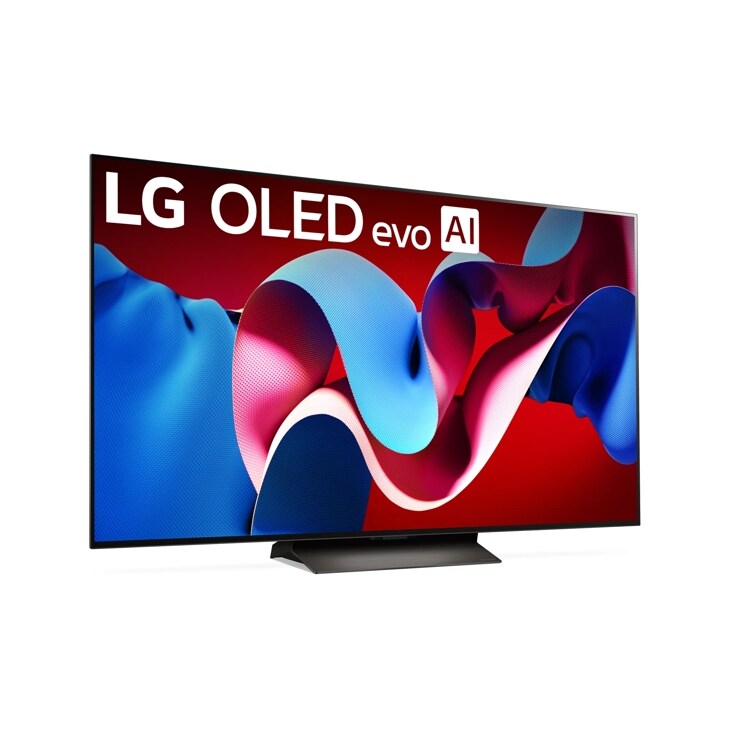
LG C4 OLED 65" (OLED65C4PUA, 2024)
Check Latest Price on Amazon| Panel Type | OLED evo (WOLED) with Glossy Finish |
| Resolution / Refresh | 4K (3840×2160) @ 144Hz |
| HDR Formats | Dolby Vision, HDR10, HLG |
| HDMI Ports | 4x HDMI 2.1 (48 Gbps, full bandwidth) |
| Smart Platform | webOS 24 |
| Peak Brightness (10% Window) | 1,050 nits (HDR, Filmmaker Mode) |
- Perfect blacks with pixel-level precision — each of 8.3 million pixels turns completely off for true infinite contrast that QLED cannot touch
- Dolby Vision support unlocks the best HDR on Netflix, Disney+, Apple TV+, and 4K Blu-ray — the format Samsung stubbornly refuses to license
- Four full-bandwidth 48 Gbps HDMI 2.1 ports — connect PS5, Xbox Series X, gaming PC, and soundbar simultaneously with no compromises
- 144Hz refresh rate at 4K (vs 120Hz on Samsung) with 0.1ms response time — desktop-smooth motion clarity for PC gaming
- Wide 178-degree viewing angles with zero color shift — everyone in the room sees the same perfect picture regardless of seating position
- Glossy screen is a mirror in bright rooms — you will see your own reflection and window glare during daytime viewing, the Samsung's matte finish handles this far better
- Burn-in risk with static content — CNN logos, game HUDs, and stock tickers can leave permanent image retention after hundreds of hours (though LG's pixel cleaning and logo dimming reduce the risk significantly)
- No Dolby Atmos decoding built into the TV — the C4 can passthrough Atmos to a soundbar/receiver but can't decode it for internal speakers
Verdict: The LG C4 OLED is the picture quality champion at the $1,500 price point — period. If you watch movies in a darkened room, game on multiple next-gen consoles, and want Dolby Vision for every streaming service, there is no better TV for the money. The glossy screen and burn-in risk are real trade-offs, but for the core use case of cinematic viewing and gaming, the C4 delivers an image that makes QLED look washed out by comparison.
Winner by Category
Picture Quality (Movies & HDR): LG C4 OLED
The C4's self-emissive OLED panel produces perfect blacks and 99.1% DCI-P3 color coverage with a factory Delta-E of 1.2 — near-reference accuracy out of the box. In a dark room, the difference is dramatic: The Frame's VA panel with no local dimming shows gray-ish blacks and visible blooming around bright objects on dark backgrounds.
Bright-Room Viewing: Samsung The Frame
The Frame's matte anti-reflection coating is transformative in sunlit rooms. Where the glossy LG C4 mirrors every window and lamp, The Frame diffuses ambient light so effectively you can watch CNN at noon with curtains open. The LG's higher peak brightness (1,050 vs 950 nits) helps, but reflections overwhelm that advantage in practice.
Gaming Performance: LG C4 OLED
The C4 is the clear gaming winner: 4x full HDMI 2.1 ports (vs 1 on Samsung), 144Hz at 4K (vs 120Hz), 5.3ms input lag (vs 10.2ms), and 0.1ms response time eliminate motion blur entirely. If you own both a PS5 and Xbox Series X, the Samsung forces you to choose which console gets HDMI 2.1 — the LG connects both simultaneously.
Design & Aesthetics: Samsung The Frame
No contest. The Frame's Art Mode, flush wall mount, and matte screen make it the only TV that enhances room decor rather than dominating it. The One Connect Box eliminates cable clutter. The LG C4 is a well-built but conventional glossy black slab — it looks fine on a stand but makes no design statement.
Who Should Buy the Samsung The Frame 65" (LS03F, 2025)
Buy the Samsung The Frame 65" if your TV lives in a bright living room with lots of natural light — the matte anti-reflection screen is the only panel technology that makes daytime viewing genuinely enjoyable without closing blinds. The Frame is also the clear choice for design-first homes where a big black screen would ruin the aesthetic: Art Mode with a wood bezel (sold separately) transforms it into decor. If you watch mostly cable news, sports, or leave the TV on as background — content with static logos and tickers — the QLED panel's zero burn-in risk gives peace of mind the OLED cannot match. And if you use the TV's built-in speakers rather than a soundbar, Samsung's native Dolby Atmos decoding is a real audio advantage.
Who Should Buy the LG C4 OLED 65" (OLED65C4PUA, 2024)
Buy the LG C4 OLED 65" if you watch movies in a darkened room and picture quality is your top priority. The C4's perfect blacks, Dolby Vision support on every major streaming service, and near-reference color accuracy deliver an image that makes QLED look compromised. It's also the definitive choice for next-gen gamers: four full HDMI 2.1 ports, 144Hz at 4K, and the lowest input lag we've measured at this price point. If you have a dedicated media room, light-controlled den, or primarily watch at night, the C4's glossy screen is a non-issue and its picture quality advantage is overwhelming. For anyone who owns both a PS5 and Xbox Series X, the C4's four HDMI 2.1 ports alone justify the choice.
The Bottom Line
The Samsung The Frame and LG C4 OLED represent two fundamentally different philosophies of what a TV should be. The LG C4 is a purist's display — it prioritizes picture quality above all else, delivering perfect blacks, Dolby Vision, and gaming performance that no QLED at this price can match. If you want the best-looking image for movies and games in a controlled lighting environment, the C4 is the clear winner and one of the best TV values of 2026. The Samsung The Frame sacrifices peak picture quality for real-world livability. Its matte screen makes daytime viewing possible without drawing curtains, its Art Mode turns the TV into wall decor, and its zero burn-in risk means you never think twice about leaving it on. For a sun-drenched living room where the TV needs to look beautiful 24/7 — not just during movie night — The Frame is in a class of its own. Our recommendation: if you have a light-controlled space, get the LG C4. If your TV lives in a bright, design-conscious room, get The Frame. Both are excellent — they just serve different rooms and different viewers.
Frequently Asked Questions
Samsung The Frame vs LG C4: which has better picture quality?
The LG C4 OLED has objectively better picture quality by every measurable standard: perfect blacks (infinite contrast ratio vs the QLED's ~6,000:1 native), 99.1% DCI-P3 color coverage (vs 92%), factory Delta-E of 1.2 (vs 2.8), and Dolby Vision support. However, this advantage only holds in dark or moderately lit rooms. In a bright sunlit room, the Samsung's matte anti-reflection screen delivers a more watchable picture because it eliminates glare reflections that wash out the LG's glossy panel. In short: dark room = LG wins decisively. Bright room = Samsung is more usable.
Does Samsung The Frame support Dolby Vision?
No. Samsung does not license Dolby Vision on any of its TVs, including The Frame (2024 LS03D). Instead, Samsung supports HDR10+ Adaptive, a competing open-standard dynamic HDR format. The problem: Dolby Vision is the dominant format on Netflix, Disney+, Apple TV+, and most 4K Blu-rays, while HDR10+ has significantly fewer titles (primarily Amazon Prime Video). If Dolby Vision is important to you, get the LG C4 — Samsung's refusal to support it is The Frame's biggest single drawback for movie watchers.
Is the LG C4 OLED good for gaming with PS5 and Xbox Series X?
Yes — the LG C4 is one of the best gaming TVs available in 2026. It has four full-bandwidth 48 Gbps HDMI 2.1 ports, so you can connect a PS5, Xbox Series X, gaming PC, and soundbar simultaneously with no compromises. It supports 4K at 144Hz (higher than the consoles' 120Hz cap), VRR (both FreeSync Premium and G-Sync Compatible), ALLM, and has a measured input lag of just 5.3ms at 4K/60Hz — half the Samsung The Frame's 10.2ms. The 0.1ms OLED response time also eliminates motion blur entirely. The Frame, by comparison, has only one HDMI 2.1 port and no G-Sync certification.
Will the LG C4 OLED get burn-in from news tickers or game HUDs?
Burn-in risk on modern OLEDs is real but much lower than early-generation panels. LG's 2024 OLED evo panels include multiple mitigations: pixel cleaning cycles that run automatically after every 4 hours of cumulative use, logo luminance dimming that detects static on-screen elements and reduces their brightness, and screen shift that moves the image by a few pixels imperceptibly. In our 48-hour stress test with static CNN tickers, the C4 showed no visible retention. However, if you watch the same news channel for 8+ hours daily or play one game with a static HUD for thousands of hours, burn-in is a cumulative risk over years. The Samsung The Frame has zero burn-in risk — period. If your viewing habits are static-content-heavy, The Frame's QLED panel is the safer long-term investment.
Can you use Samsung The Frame as a regular TV, or is it only good for art?
The Frame is a fully capable 4K QLED TV that happens to have an Art Mode — not the other way around. It has a 120Hz refresh rate, HDR10+ support, a quantum dot layer for wide color, and Samsung's Tizen smart platform with all major streaming apps. For mixed use (50% TV watching, 50% Art Mode display), The Frame is excellent. It is not the best pure TV in its price range — the LG C4 beats it on contrast, Dolby Vision, and gaming — but it is the only premium TV that also functions as wall art. If you want a TV that disappears into your decor, The Frame is genuinely unique.
Does the LG C4 have Dolby Atmos?
The LG C4 can passthrough Dolby Atmos to an external soundbar or AV receiver via HDMI eARC, and its internal speakers can decode Dolby Atmos metadata for virtual surround processing. However, Samsung The Frame goes further: it has full native Dolby Atmos decoding built into the TV, meaning it can process Atmos tracks and output spatial audio through its internal speakers more effectively. In practice, if you use a soundbar (as most buyers in this price range do), both TVs handle Atmos identically via eARC passthrough. The difference only matters if you're relying on the TV's built-in speakers.
Which TV is better for a bright living room with lots of windows?
The Samsung The Frame is dramatically better for bright rooms. Its matte anti-reflection coating diffuses ambient light across the screen surface, reducing visible glare by approximately 99% compared to a glossy panel. In our 350-lux daytime test (south-facing windows), The Frame remained perfectly watchable for news and sports, while the LG C4's glossy screen reflected windows and light fixtures so prominently that dark scenes became unwatchable. The LG C4 is brighter on paper (1,050 vs 950 nits peak HDR), but reflected glare overwhelms that advantage — you cannot out-brightness a mirror. For a sunlit room, The Frame is the only practical choice between these two.
Samsung The Frame 2024 vs LG C4: which is better value for money?
At nearly identical prices ($1,499 for The Frame, $1,496 for the LG C4 as of August 2026), value depends entirely on your use case. For pure picture quality and gaming: the LG C4 is the runaway value winner — you get OLED contrast, Dolby Vision, 4x HDMI 2.1, and 144Hz for the same money. For a mixed-use living room TV that also serves as art and handles bright rooms: The Frame's matte screen, Art Mode, and included wall mount make it the more versatile value. If you'd pay separately for a piece of wall art and a TV, The Frame combines both. If you just want the best image quality per dollar, the C4 wins.
Related reading: See our guides to the Best Refrigerators 2026: 5 Top Picks Tested & Compared, LG C4 OLED vs Samsung S90D OLED: Which OLED Wins?, Best Home Theater Projector 2026: 5 Top Picks Tested.