Fitness Trackers in 2026: Choose by Phone, GPS and Battery
Quick answer
Choose Fitbit Charge 6 for a narrow band with built-in GPS, Samsung Galaxy Fit3 for a compatible Android phone and basic band tracking, or Apple Watch SE 3 when iPhone apps and smartwatch controls matter more than multi-day battery life. Check the exact phone, region and health-feature eligibility before buying.
A slim band and a full smartwatch differ most in screen, apps, GPS and charging cadence. Start with phone compatibility and the activities you want to track.
Compare the configurations
| Model | Role | Choose another when… |
|---|---|---|
| Fitbit Charge 6 | Narrow band with built-in GPS | you need a large wrist screen and apps, or use an Android phone and want a simpler Samsung Health band. |
| Samsung Galaxy Fit3 | Android-oriented simple band | you use an iPhone, need phone-free GPS, or expect medical-grade measurements. |
| Apple Watch SE 3 | iPhone fitness-smartwatch hybrid | you need multi-day battery life or specifically require an eligible ECG-capable watch. |
Fitbit Charge 6: Narrow band with built-in GPS

Google lists built-in GPS/GLONASS, optical heart-rate tracking, electrical sensors for its ECG app, and up to seven days of battery life for Charge 6. The band shape is less bulky than a smartwatch, and Google’s current store page distinguishes standard tracking from optional Google Health Premium coaching. The ECG app and SpO2 features depend on location, account and software eligibility; neither is a general diagnosis. GPS workouts, always-on display and frequent sensor use can shorten battery life from the maker’s default-use estimate.
Pros
- Built-in GPS permits route recording without relying on a paired phone’s location connection.
- The narrow band and up-to-seven-day maker battery claim make it better suited to continuous wearing than a daily-charge smartwatch.
Cons and trade-offs
- The small display is less suited to replying, maps and full smartwatch apps than the Apple Watch SE 3.
- Premium coaching is a separate membership, so check which desired app feature remains available without it.
Best for: A band wearer who wants independent workout GPS and Fitbit/Google health history.
Choose another if: you need a large wrist screen and apps, or use an Android phone and want a simpler Samsung Health band.
Our recommendation
Choose Charge 6 for a narrow tracker with built-in GPS. Check current ECG and Premium feature eligibility in your region instead of treating every marketed health feature as universal.
Search Amazon for Fitbit Charge 6
Samsung Galaxy Fit3: Android-oriented simple band

Samsung’s US support documentation says Fit3 works with Android phones, has a 208mAh battery with up to 13 days claimed use, and includes optical heart-rate, accelerometer, gyro, barometer and light sensors. Samsung’s Canadian model page shows a 1.6-inch AMOLED screen and notes that Fit3 uses GPS from a paired Galaxy phone when needed. It cannot perform an ECG or measure body composition. Some controls and safety features require a compatible Galaxy phone and regional software; confirm your exact phone, market and seller before buying. Its slim band gives a different experience from an Apple smartwatch.
Pros
- A 1.6-inch AMOLED screen and phone notifications offer more glanceable space than a tiny step counter while retaining band form.
- Up-to-13-day manufacturer battery claim and Samsung Health integration suit frequent wear when the compatible phone stays nearby.
Cons and trade-offs
- There is no built-in GPS or ECG, so route tracking depends on a paired phone and it cannot replace an ECG-capable device.
- Android-only support, Galaxy-specific functions and regional availability narrow its appeal for mixed-phone households.
Best for: An Android user, especially a Galaxy owner, who wants basic activity and sleep tracking in a band.
Choose another if: you use an iPhone, need phone-free GPS, or expect medical-grade measurements.
Our recommendation
Choose Fit3 only after confirming the exact regional unit and phone compatibility. Treat the 13-day claim as a best-case Samsung test condition, not a guaranteed interval.
Search Amazon for Samsung Galaxy Fit3
Apple Watch SE 3: iPhone fitness-smartwatch hybrid
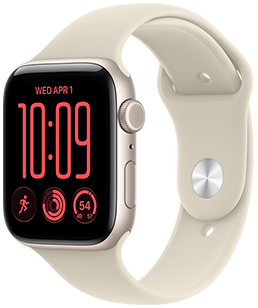
Apple Watch SE 3 is a full iPhone companion rather than a slim fitness band. Apple lists built-in GPS, always-on display, workout views and activity rings, heart-rate alerts, sleep score and up to 18 hours of normal battery life; low-power mode extends the stated ceiling to 32 hours. GPS and cellular are distinct configurations, and cellular use requires a supported plan. SE 3 does not have Apple’s ECG or Blood Oxygen apps, despite those appearing on higher-tier watches. Apple’s current US page requires a compatible iPhone and current iOS; verify the exact software requirement at checkout.
Pros
- Full watch apps, notifications, GPS workouts and Activity rings give an iPhone owner far more wrist interaction than a simple band.
- Always-on display and fast charging make frequent glance-and-recharge use practical when daily charging fits your routine.
Cons and trade-offs
- The stated 18-hour normal-use ceiling is much shorter than the multi-day Fitbit or Samsung band estimates.
- It requires an iPhone and lacks the ECG and Blood Oxygen apps offered on some higher-tier Apple Watch models.
Best for: An iPhone owner who wants fitness tracking and a general-purpose smartwatch together.
Choose another if: you need multi-day battery life or specifically require an eligible ECG-capable watch.
Our recommendation
Choose SE 3 for iPhone integration and watch features, not as a compact band. Check 40mm versus 44mm fit and GPS versus cellular configuration before ordering.
Search Amazon for Apple Watch SE 3
Buying guide
- Start with phone compatibility. Apple Watch SE 3 needs a compatible iPhone. Samsung says Galaxy Fit3 is Android-only, with some features needing a Galaxy phone. Check your phone model, OS, apps and country before comparing step counts.
- Decide whether a phone comes on workouts. Fitbit Charge 6 and Apple Watch SE 3 include GPS. Galaxy Fit3 uses the paired phone for GPS. If you leave the phone behind, that difference matters more than a long list of exercise labels.
- Plan charging around sleep tracking. The SE 3 is an up-to-18-hour normal-use watch; Fitbit says up to seven days and Samsung up to 13 days in specified conditions. GPS, bright or always-on displays, notifications and sensors change real intervals, so reserve charging time before bedtime.
- Audit paid and regional functions. Google Health Premium adds coaching beyond the base tracker; verify current terms. Fitbit ECG and SpO2 eligibility varies. Samsung Fit3 lacks ECG. Apple SE 3 also lacks ECG and Blood Oxygen apps. Do not buy a wellness wearable as a substitute for medical evaluation.
- Fit the band and ecosystem. Measure wrist size, check replacement-band mechanism and assess the companion app where your history will live. If you want a fuller watch comparison, see our smartwatch guide; for exercise audio fit and water resistance, see our wireless-earbud guide.
- For training depth beyond these three, Garmin documents the vívoactive 6 with built-in GPS, Body Battery, AMOLED and up to 11 days in smartwatch mode. Compare its workout tools directly with your training plan; the older Venu Sq 2 in the legacy article should not be assumed to have the current model’s feature set.
FAQ
Does Galaxy Fit3 have its own GPS?
No. Samsung says it uses location from a paired Galaxy phone when GPS is needed.
Can Apple Watch SE 3 record an ECG?
No. Apple excludes SE models from its ECG app. Its heart-rate and irregular-rhythm notifications are different functions.
Will Charge 6 last seven days with GPS workouts?
Google calls seven days an approximate default-use estimate. Continuous GPS, always-on display and other settings may reduce it.
Is a wrist oxygen or sleep reading a diagnosis?
No. These consumer wellness metrics can be affected by fit, motion and other conditions. Use qualified medical care for symptoms or diagnosis.
Sources and method
We reviewed current Google, Samsung and Apple documentation and visually inspected the three exact official photos. This is a compatibility and use-case comparison, not an independent sensor-accuracy, battery or clinical evaluation. Read our research methodology.
- Fitbit Charge 6 manufacturer documentation
- Samsung Galaxy Fit3 manufacturer documentation
- Apple Watch SE 3 manufacturer documentation
As an Amazon Associate, The Gear Audit earns from qualifying purchases. We may earn an affiliate commission when you buy through our links, at no extra cost to you. See our affiliate disclosure.