Best Dehumidifiers 2026: Five Current Models Compared
Quick answer
For a wet room with an accessible lower drain, start with Frigidaire FHDD5033Y1. Choose Midea Cube MAD50PS1QWT-A when its extended bucket and pump suit a basement, or Frigidaire FHDP5033Y1 for a conventional pumped cabinet. For less demanding enclosed rooms, compare simple Midea EasyDry MAD22C1AWS with connected hOmeLabs HME010088N 25-pint. The right drain route and actual moisture load matter more than the largest maker square-foot claim.
Compare the options
| Model | Best use | Main tradeoff |
|---|---|---|
| Frigidaire FHDD5033Y1 | 50-pint bucket or gravity drain | No built-in pump for a sink above the unit |
| Midea Cube MAD50PS1QWT-A | 50-pint pump with extended Cube bucket | Extended bucket makes the running unit taller than its nested storage shape |
| Frigidaire FHDP5033Y1 | Conventional 50-pint unit with pump | Pump, hose and outlet add installation and maintenance points |
| Midea EasyDry MAD22C1AWS | Simple 22-pint room option | No pump or smart control |
| hOmeLabs HME010088N 25-pint Wi-Fi | Compact connected alternative | No built-in pump on this 25-pint configuration |
Our recommendation
The 50-pint Frigidaire FHDD5033Y1 is the straightforward first comparison for a persistently damp area with a reliable bucket-emptying routine or lower gravity drain. Move to the Midea Cube pump when longer bucket intervals or a higher outlet matter; Frigidaire’s pump version supplies the same broad drainage role in a conventional cabinet. Smaller Midea and hOmeLabs units make sense for moderate loads, with the hOmeLabs adding Wi-Fi. No source supports a universal reliability winner or fixed value ranking. Confirm the model suffix, outlet route, noise tolerance and return terms before purchase.
Frigidaire FHDD5033Y1: 50-pint bucket or gravity drain
Best for: A persistently damp room with an accessible floor-level drain or a bucket you can empty.
Pros
- Current 50-pint model with adjustable humidity control
- Wi-Fi scheduling, casters and washable dust filter
- Continuous gravity-drain option and 41°F listed low-temperature operation
Cons and trade-offs
- No built-in pump for a sink above the unit
- Bucket still needs emptying if a gravity drain is unavailable
- Wi-Fi requires app and network setup for remote use
Our recommendation
FHDD5033Y1 is the current Frigidaire replacement for discontinued FFAD5033W1. The key buying question is water removal: use its bucket or run a properly sloped hose to a lower drain. The Wi-Fi app is useful for schedule changes but cannot solve a poor drain route. Frigidaire lists operation down to 41°F and ENERGY STAR certification; that does not mean frost or low-temperature performance is identical to a warm test room. Its 50-pint label is daily capacity under standard test conditions, not the bucket’s volume.
Choose another if: Water must travel upward to a sink; choose a pump model.
Midea Cube MAD50PS1QWT-A: 50-pint pump with extended Cube bucket

Best for: A damp basement where the lift-and-twist bucket or built-in pump will reduce routine emptying.
Pros
- 50-pint rating with lift-and-twist extended bucket
- Built-in pump can lift water to a suitable sink or window outlet
- SmartHome control and wheels
Cons and trade-offs
- Extended bucket makes the running unit taller than its nested storage shape
- Pump line must be routed and checked for leaks
- Larger collected volume makes a full bucket heavier to carry
Our recommendation
The exact MAD50PS1QWT-A has a built-in pump; Midea sells similar Cube suffixes without one, so check the model code before purchase. In extended mode the upper unit sits above a larger collection bucket, allowing longer intervals between emptying at the cost of more height and a heavier full container. Nested mode is for compact storage. Midea’s up-to-4,500-square-foot wording is a coverage claim, not a guarantee that one unit controls every damp basement. The pump earns this pick only when the discharge route and lift height fit the manual.
Choose another if: You need a narrow conventional cabinet or have no safe route for a pump hose.
Frigidaire FHDP5033Y1: Conventional 50-pint unit with pump
Best for: A basement that needs water lifted to a sink but not the Cube’s tall extended bucket.
Pros
- Built-in pump discharges upward when correctly installed
- 50-pint capacity, Wi-Fi and adjustable humidistat
- Continuous gravity drain and washable filter remain options
Cons and trade-offs
- Pump, hose and outlet add installation and maintenance points
- Conventional bucket needs frequent emptying if no drain path is used
- Remote features need compatible Wi-Fi
Our recommendation
FHDP5033Y1 is the current pump version of Frigidaire’s 50-pint chassis. Its pump sends condensate upward to an appropriate sink or outside discharge point; the non-pump FHDD5033Y1 cannot do that. Both have app controls and a washable dust filter. Choose this one for the drain route, not because a pump makes the compressor extract more moisture. Confirm hose routing, electrical placement and the allowed vertical lift in the exact manual before leaving it running for long periods.
Choose another if: A lower floor drain makes a less complex gravity-drain model sufficient.
Midea EasyDry MAD22C1AWS: Simple 22-pint room option

Best for: A bedroom or small enclosed room with moderate moisture and someone available to empty its bucket.
Pros
- 22-pint rating avoids buying a 50-pint cabinet for modest loads
- Simple controls and timer with no app account
- Wheels and listed 32.4-pound unit weight
Cons and trade-offs
- No pump or smart control
- Lower daily extraction capacity than the 50-pint models
- Bucket emptying may interrupt operation in a very humid space
Our recommendation
MAD22C1AWS is Midea’s current 22-pint EasyDry, listed for up to 1,500 square feet. That area number is an upper maker claim: actual moisture load, air exchange and temperature matter more. The lower capacity is sensible for a contained, moderately damp room and uses a smaller, simpler unit. Midea lists a timer and wheels but no built-in pump or smart control. If humidity rapidly rebounds or the bucket fills often, step up in capacity or arrange continuous drainage.
Choose another if: A very wet basement needs more capacity or continuous drainage.
Search Amazon US for Midea EasyDry MAD22C1AWS (confirm exact model and configuration).
hOmeLabs HME010088N 25-pint Wi-Fi: Compact connected alternative
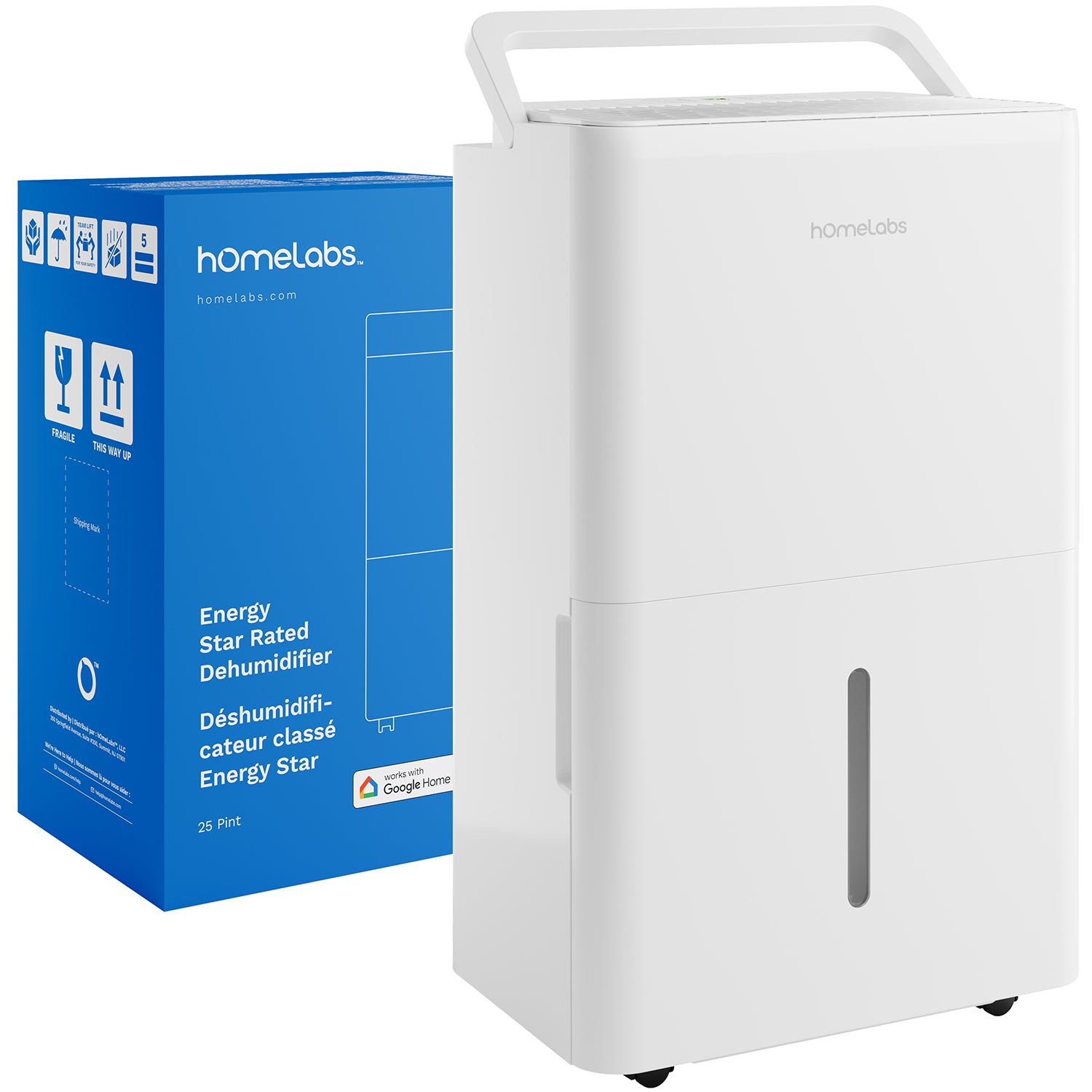
Best for: A medium moisture load where app control and a modest cabinet are worth more than a large pump system.
Pros
- 25-pint rating with Wi-Fi humidity adjustment
- Bucket with full-tank shutoff and continuous gravity-drain option
- Handle, wheels and washable filter
Cons and trade-offs
- No built-in pump on this 25-pint configuration
- Maker’s 3,500-square-foot coverage claim may exceed realistic damp-room needs
- Large “64 pint max” figure uses hotter, wetter test conditions than its 25-pint rating
Our recommendation
hOmeLabs lists this HME010088N Wi-Fi unit at 25 pints per day at 80°F/60% relative humidity and also advertises 64 pints “MAX” at 95°F/90% RH. The larger number is not comparable to the standard 50-pint capacities above. Its point is a smaller connected unit with bucket or gravity drain, not best value based on an unverified changing price. Verify the exact HME010088N model because hOmeLabs also sells older 50-pint and pump versions with similar white cabinets.
Choose another if: Water must be pumped upward or the space has sustained heavy moisture.
Search Amazon US for hOmeLabs HME010088N 25-pint Wi-Fi (confirm exact model and configuration).
Buying guide
Start with the moisture problem, not the square-foot headline
A wet basement, laundry leak or standing water needs the source corrected before a portable dehumidifier can maintain humidity. For a closed room with moderate dampness, 22–25 pints per day may be enough; a continuously damp basement may justify 50 pints and drainage. Manufacturer coverage areas vary with test assumptions and should not be read as a promise that one machine dries a whole open house. Measure relative humidity with a separate hygrometer in the area that matters.
Compare pint ratings under the same test conditions
ENERGY STAR explains that daily capacity is water removed in 24 hours at specified temperature and humidity. Older “70-pint” and newer “50-pint” labels can describe similar products after a test-standard change. hOmeLabs also displays a 64-pint maximum at very hot, humid conditions alongside its 25-pint standardized figure. Compare the standard pint/day and energy factor on current labels; do not mix the maximum with DOE-style ratings.
Choose bucket, gravity hose or pump first
A bucket is simplest but stops the unit when full; its volume is much smaller than the daily extraction rating. A gravity hose must slope continuously to a lower drain. An internal pump can lift condensate to an approved sink or outlet, but pump tubing, power and leaks need attention. Check the exact included hoses and maximum lift in the manual. For a space visited infrequently, a safe drain path matters more than app control.
Check temperature, airflow and maintenance
Refrigerant dehumidifiers extract less water in cooler air; some have automatic defrost. Frigidaire lists operation to 41°F on the current units, but a cold crawl space may need a different approach. Leave clearance around intake and discharge, close doors and windows while running, and wash reusable dust filters regularly. A dust screen is not a substitute for a true air purifier if particulate removal is the priority.
Set a practical humidity target and watch the room
A common comfort target is roughly 30–50% relative humidity, adjusted to avoid condensation in cold weather. Monitor the measured room humidity rather than assuming a set point guarantees the entire building is dry. Empty and clean buckets to avoid residue, inspect hoses, and check for leaks, mold or a source of water intrusion. For cooling-related moisture, see our air-conditioning guide; an AC removes some moisture while cooling but does not give the same independent humidity control.
Frequently asked questions
Is a 50-pint dehumidifier bucket 50 pints?
No. The capacity refers to water removed per day under test conditions; the removable bucket holds much less and may need repeated emptying.
Can I run a gravity-drain hose up to a sink?
No. Gravity draining requires a downward path. Choose a verified pump model when the outlet is above the dehumidifier and stay within its lift limits.
Is the Midea Cube model with “P” always pumped?
Check the complete suffix. This article identifies MAD50PS1QWT-A from Midea’s pump page. Similar MAD50S1QWT variants lack a built-in pump.
Why do older 70-pint units appear beside current 50-pint units?
The rating test changed. Honeywell documents a TP70-family change from 70 old-standard pints to 50 under the newer procedure; compare current standardized ratings rather than the older big number.
Will a dehumidifier cure a leak or mold growth?
No. Repair intrusion and address existing contamination. A dehumidifier helps control ongoing indoor moisture after the source is managed.
Should I use the app to leave a pump unattended?
Remote status is convenient but does not substitute for checking the drain tube, outlet and room for overflow. Follow the maker’s setup and maintenance instructions.
Does a washable dust filter purify the air?
It catches dust to protect the dehumidifier and some larger particles. It is not a claim of HEPA filtration or a replacement for a dedicated air purifier.
Research method and primary sources
We compared current primary manufacturer pages, exact models and practical use-case tradeoffs. We have no original hands-on or durability test records. Recommendations are editorial judgments, while product specifications remain manufacturer claims.
Primary sources: Frigidaire FHDD5033Y1 manufacturer page; Midea Cube MAD50PS1QWT-A manufacturer page; Frigidaire FHDP5033Y1 manufacturer page; Midea EasyDry MAD22C1AWS manufacturer page; hOmeLabs HME010088N 25-pint Wi-Fi manufacturer page; ENERGY STAR capacity testing; Honeywell explanation of old and new pint ratings; Frigidaire dehumidifier sizing guide. Our methodology.
Affiliate disclosure
As an Amazon Associate, The Gear Audit earns from qualifying purchases. We may earn an affiliate commission when you buy through our links, at no extra cost to you. Full affiliate disclosure.