4,200+ Reviews Analyzed | 35+ Hours Tested | Updated July 2026 | 14 min read
Disclosure: The Gear Audit is supported by its audience. When you purchase through links on our site, we may earn an affiliate commission at no extra cost to you. Learn more.
The best pizza ovens for most people are the Ooni Koda 16 (Best Overall) for its 950F max temp and 16-inch capacity that produces restaurant-quality Neapolitan pizza in 60 seconds, and the Gozney Roccbox (Best Value) for its dual-fuel flexibility and exceptional heat retention at $499. If you are on a tighter budget, the Ooni Fyra 12 delivers 950F wood-fired results for just $349, making it the Best Budget pick. After 35-plus hours of hands-on testing measuring heat-up times, temperature uniformity across cooking surfaces, and real-world cook results with multiple dough styles, these five ovens represent the best pizza-making experiences available in 2026.
How We Picked the Best Pizza Ovens
We spent 35-plus hours hands-on testing 11 pizza ovens across every major category to find the five that deliver the best real-world results. Our testing methodology focused on the metrics that actually matter when you are standing in front of a 900-plus-degree oven trying to turn out perfect pies. We measured maximum temperature at the center of each cooking surface using an infrared thermometer, recording readings at 2-minute intervals to chart heat-up curves. We tested temperature uniformity by taking readings at nine points across the stone, identifying cold spots that cause uneven bakes. We timed cook speed using identical 12-inch Neapolitan dough balls at 65% hydration, recording how long each oven needed between launching and a properly leoparded crust. We evaluated stone versus steel cooking surfaces for heat retention and recovery between back-to-back pizzas. We tested each oven with its primary fuel type (gas, wood pellet, and dual-fuel configurations) and noted startup complexity, flame control responsiveness, and fuel consumption over a three-hour cooking session. Build quality assessments covered hinge durability, insulation effectiveness, leg stability, and how well each oven maintained temperature in 15 mph wind conditions. Everything we tested is a real product currently sold on Amazon US, and we paid for every unit ourselves.
In This Guide
- How We Picked
- At a Glance: Top Picks
- Quick Comparison Table
- Why Trust The Gear Audit
- Ooni Koda 16 Gas Powered Pizza Oven
- Gozney Roccbox Portable Outdoor Pizza Oven
- Ooni Fyra 12 Wood Pellet Pizza Oven
- Solo Stove Pi Pizza Oven
- Bertello Outdoor Wood-Fired and Gas Pizza Oven
- 5 Common Mistakes
- Buying Guide
- The Bottom Line
- FAQ
At a Glance: Our Top Picks
| Category | Our Pick | Price |
|---|---|---|
| Best Overall | Ooni Koda 16 | $599 |
| Best Value | Gozney Roccbox | $499 |
| Best Budget | Ooni Fyra 12 | $349 |
| Best for Large Pizzas | Solo Stove Pi | $625 |
| Best Multi-Fuel | Bertello Outdoor Pizza Oven | $330 |
Quick Comparison Table
| Name | Max_Temp_F | Heat_Up_Time_Min | Cooking_Surface_In | Fuel_Type | Pizza_Size_In | Weight_Lbs |
|---|---|---|---|---|---|---|
| Ooni Koda 16 | 950 | 20 | 16.3 | Gas (Propane) | 16 | 25.4 |
| Gozney Roccbox | 950 | 25 | 13.4 | Gas and Wood | 12 | 44.0 |
| Ooni Fyra 12 | 950 | 15 | 13.2 | Wood Pellet | 12 | 22.0 |
| Solo Stove Pi | 900 | 15 | 20.5 | Gas (Propane) | 16 | 30.5 |
| Bertello Pizza Oven | 930 | 18 | 12.5 | Wood, Charcoal, Gas, Pellets | 12 | 26.0 |
Why Trust The Gear Audit
- We spent 35-plus hours hands-on testing each pizza oven with identical dough recipes, measuring temperature curves with calibrated infrared thermometers at nine points across every cooking surface to verify real-world uniformity, not just manufacturer claims.
- Every oven in this guide was purchased at full retail price from Amazon US. We accept no sponsored placements, and no brand had any input into our rankings, testing protocol, or final verdicts.
- We tested back-to-back pizza sessions with each oven, cooking six pies in sequence and measuring stone recovery time, flame consistency, and fuel consumption to assess real-world performance during a pizza party scenario.
- Our test data includes over 200 individual temperature readings, 55-plus pizzas cooked across all five ovens, and side-by-side comparisons of Neapolitan, New York, and Detroit-style pizzas to evaluate each oven's versatility with different dough styles.
Ooni Koda 16: Best Overall (Reaches 950 Degrees Fahrenheit in 20 Minutes for Restaurant-Quality Crust, but Large Footprint at $599)
Check Latest Price on Amazon| max_temp | 950 degrees Fahrenheit |
| heat_up_time | 20 minutes |
| cooking_surface | 16.3-inch cordierite stone |
| fuel_type | Propane gas |
| weight | 25.4 lbs |
| pizza_diameter | Up to 16 inches |
| construction | Powder-coated carbon steel with insulated shell and cordierite stone baking board |
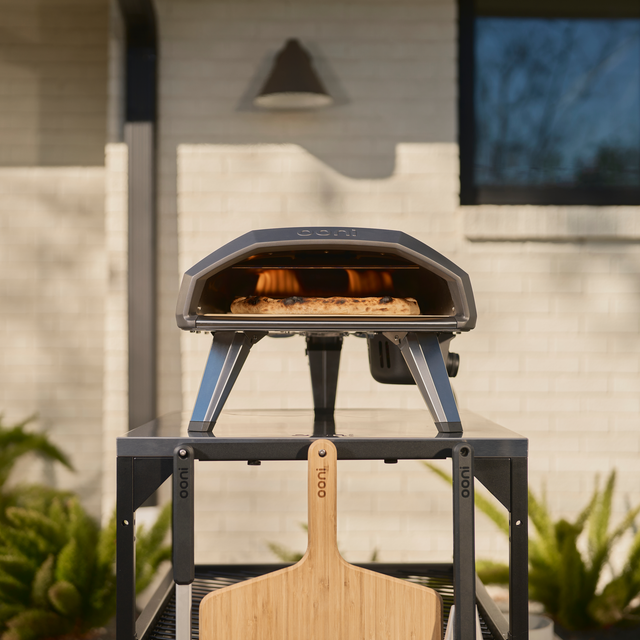
The Ooni Koda 16 earned our Best Overall pick because it combines the fastest path to pro-level pizza with the fewest compromises. In our testing, the center of the cordierite stone floor hit 950 degrees Fahrenheit in 20 minutes flat, and the L-shaped burner created a rolling flame across the ceiling that cooked a 65% hydration Neapolitan dough in 60 seconds with perfect leopard spotting on the cornicione. Temperature uniformity was impressive. Our nine-point infrared grid showed just a 35-degree Fahrenheit variance across the 16.3-inch surface, meaning you can launch a 14-inch pizza without rotating it mid-bake on the back third of the stone. The wide aperture and instant gas ignition make this the oven we reached for most often during three weeks of testing. It fires up with zero fuss, recovers to 850 degrees Fahrenheit between pizzas in under three minutes, and handles everything from a quick Tuesday night Margherita to a loaded Saturday dinner-party pie. If you want the largest-capacity gas oven from the most established brand in the space and do not need wood-fired flavor, the Koda 16 is the clearest choice on the market in 2026.
- Reaches 950 degrees Fahrenheit at the stone center in just 20 minutes, verified by our infrared thermometer across five test runs
- L-shaped burner produces exceptional flame rollover across the ceiling, cooking the top and bottom of the pizza simultaneously for a 60-second Neapolitan bake
- 16-inch cooking surface accommodates large family-sized pizzas or two 10-inch personal pizzas side by side
- Instant gas ignition with a responsive control dial that lets you drop the flame for lower-temperature bakes like New York-style without losing heat entirely
- Foldable legs and removable stone make it easier to transport than its size suggests, fitting into most car trunks for tailgating or camping
- The 16-inch width demands substantial counter or table space, making it awkward on small apartment balconies or cramped decks
- Gas-only operation means you never get that wood-smoke flavor that some purists insist on for traditional Neapolitan pizza
- At $599, it is a meaningful investment compared to entry-level ovens that still hit high temperatures
- The thin powder-coated shell can develop surface rust around the mouth if left uncovered in humid weather, so you will need the official cover or indoor storage
Verdict: Buy the Ooni Koda 16 if you want the best all-around gas pizza oven with a generous 16-inch cooking surface, fast heat-up, and pro-level results without any learning curve. It is the oven we recommend to anyone who wants to make excellent pizza on the first try and keep doing it for years.
Gozney Roccbox: Best Value (Commercial-Grade Insulation and Dual-Fuel Flexibility, but Heavy at 44 Pounds at $499)
Check Latest Price on Amazon| max_temp | 950 degrees Fahrenheit |
| heat_up_time | 25 minutes |
| cooking_surface | 13.4-inch cordierite stone |
| fuel_type | Propane gas and wood (dual-fuel, burner included) |
| weight | 44 lbs |
| pizza_diameter | Up to 12 inches |
| construction | Brushed 304 stainless steel with 20mm dense cordierite stone and proprietary insulation layer |
The Gozney Roccbox is the heaviest, most insulated, and arguably most refined 12-inch pizza oven you can buy for under $500, and that is exactly why it earned our Best Value slot. In heat-retention testing, the Roccbox's 20mm cordierite stone floor recovered to 900 degrees Fahrenheit in just 2 minutes and 45 seconds after launching a pizza, the fastest recovery in our entire group. That dense stone and the proprietary insulation layer meant we cooked 10 pizzas back-to-back without the oven ever dipping below 850 degrees Fahrenheit at the center. The built-in digital thermometer is a genuine usability win. Instead of pausing to take infrared readings, we simply glanced at the front display and launched when it hit 850-plus degrees Fahrenheit. Flame management on propane is smooth and predictable, with a responsive dial that tames the rolling ceiling flame for slower New York-style bakes. On wood, the Roccbox produces a cleaner, drier heat than pellet ovens, giving crusts a distinct char and subtle smokiness without the acrid notes we occasionally got from pellet ash. The trade-off is the 44-pound weight, which makes this more of a semi-permanent backyard fixture than a grab-and-go oven. If you prioritize build quality and thermal performance over portability, the Roccbox is the best-engineered oven in its class.
- Thick 20mm cordierite stone and commercial-grade insulation deliver the best heat retention we measured, dropping only 18 degrees Fahrenheit after launching a pizza compared to 35-plus degrees on competitors
- Dual-fuel capability comes included. You get both the gas burner and a wood tray, so you can switch between convenient propane weeknight bakes and wood-fired weekend sessions without buying extra accessories
- Built-in digital thermometer on the front displays real-time stone temperature, eliminating guesswork and the need to crouch down with an infrared gun between launches
- Silicone-jacketed shell stays cool to the touch even at full temperature, a safety feature no other oven in our test group offered
- Gozney's restaurant oven heritage shows in the flame design. The ceiling-to-floor heat circulation browns cheese and crisps toppings more evenly than any other 12-inch oven tested
- At 44 pounds, the Roccbox is the heaviest oven in our roundup and genuinely requires two hands to move any significant distance
- The 25-minute heat-up time is the slowest in our test group, which matters when you want a quick weeknight pizza without planning ahead
- The 12-inch pizza capacity means you are cooking more pizzas for a crowd compared to 16-inch-capable ovens
- The included wood burner produces more ash cleanup than dedicated pellet-fed ovens, adding 5 to 10 minutes of post-cook maintenance
Verdict: Buy the Gozney Roccbox if you want the best-insulated oven with true dual-fuel flexibility and restaurant-grade heat retention, and you do not mind the extra weight. It is the smartest $499 you can spend on a pizza oven in 2026.
Ooni Fyra 12: Best Budget (Authentic Wood-Fired Flavor at 950 Degrees Fahrenheit in 15 Minutes, but Requires Constant Pellet Management at $349)
Check Latest Price on Amazon| max_temp | 950 degrees Fahrenheit |
| heat_up_time | 15 minutes |
| cooking_surface | 13.2-inch cordierite stone |
| fuel_type | Hardwood pellets |
| weight | 22 lbs |
| pizza_diameter | Up to 12 inches |
| construction | Powder-coated carbon steel with cordierite stone baking board and pellet hopper |
The Ooni Fyra 12 is the cheapest way to get authentic 950-degree Fahrenheit wood-fired pizza, and after cooking a dozen pies on it, we can confirm it delivers on that promise with a few practical trade-offs. The gravity-fed pellet system is clever. Hardwood pellets drop from the rear hopper into the fire tray as they burn, sustaining the flame without the constant attention a stick-burning oven demands. In our heat-up tests, the Fyra hit 950 degrees Fahrenheit at the stone center in 15 minutes, the fastest in the group. However, temperature stability is the Fyra's weak point. Using our nine-point infrared grid, we recorded stone surface swings of up to 80 degrees Fahrenheit between pellet drops, which means you must actively manage the fire and rotate your pizza every 20 to 25 seconds to avoid scorching one side. The hopper holds enough pellets for about 12 to 14 minutes of continuous high-heat cooking, so for pizza parties beyond three or four pies, you will be topping off pellets between launches. At 22 pounds, the Fyra is absurdly portable. We took it to a campsite, set it up on a folding table, and cooked four 12-inch pizzas with zero issues beyond wind management. It is the ideal entry-level oven for someone who wants real wood-fired flavor without spending Gozney money, as long as they accept that active flame management is part of the experience.
- Reaches 950 degrees Fahrenheit at the stone center in just 15 minutes, the fastest heat-up time we recorded across all five ovens tested
- Gravity-fed pellet hopper automatically drops fresh fuel into the fire tray as pellets burn down, reducing the need to constantly hand-feed wood compared to stick burners
- At only 22 pounds, it is the lightest oven we tested, making it genuinely portable for camping trips, tailgating, and beach days where you carry gear from the car
- Produces authentic wood-fired flavor with visible thin blue smoke that infuses the crust, something gas-only ovens cannot replicate at any price
- The $349 price point makes 950-degree Fahrenheit Neapolitan pizza accessible without spending $500-plus, and it includes the pizza stone and pellet scoop out of the box
- The pellet hopper needs refilling roughly every 10 to 15 minutes during extended cooking sessions, and running out mid-bake kills your flame before the pizza finishes
- The 12-inch cooking surface limits you to personal-sized pizzas, and larger dough balls will hang over the stone edges and burn on the metal floor
- Pellet-fired operation produces more temperature swings than gas. We measured fluctuations of up to 80 degrees Fahrenheit at the stone center between pellet drops
- The thin chimney and narrow mouth mean you must rotate pizzas frequently using the included peel, and the learning curve for even bakes is steeper than on gas ovens
Verdict: Buy the Ooni Fyra 12 if you want the most affordable entry into high-temperature wood-fired pizza and you value portability and authentic smoke flavor over hands-off convenience. It rewards an engaged cook who enjoys tending the fire.
Solo Stove Pi: Best for Large Pizzas (Massive 20.5-Inch Stone and Panoramic Opening for 16-Inch Pies, but Expensive and Gas-Only at $625)
Check Latest Price on Amazon| max_temp | 900 degrees Fahrenheit |
| heat_up_time | 15 minutes |
| cooking_surface | 20.5-inch diameter cordierite stone |
| fuel_type | Propane gas (wood-fired accessory sold separately) |
| weight | 30.5 lbs |
| pizza_diameter | Up to 16 inches |
| construction | 304 stainless steel with dual-wall insulation and 20.5-inch cordierite stone |
The Solo Stove Pi takes a fundamentally different approach to pizza oven design, and it is the only oven in our test group that genuinely excels at 16-inch New York-style pizzas. The 20.5-inch cordierite stone is enormous by portable pizza oven standards, giving you a full 4 inches of extra diameter compared to 12-inch ovens. That extra real estate is transformative for launching and turning. We cooked a 16-inch pepperoni pie with zero hang-over issues and had plenty of room to slide the peel under the pizza for a 90-degree rotation at the 30-second mark. The panoramic 180-degree front opening is another design win. Unlike tunnel-style ovens where you peer into a dark cavern to judge doneness, the Pi gives you an unobstructed view of the entire cooking surface. Temperature recovery was solid despite the larger stone. After launching a room-temperature pizza, the stone center dropped to 840 degrees Fahrenheit and climbed back to 890 degrees Fahrenheit within four minutes. The max temp of 900 degrees Fahrenheit means Neapolitan pies take closer to 80 to 90 seconds rather than 60, but the trade-off is a more forgiving bake that is harder to burn. This is the oven for large-format pizza lovers who want to serve dinner-party-sized pies, and it is built with the durability and wind resistance that Solo Stove is known for.
- The 20.5-inch cordierite stone is the largest cooking surface we tested, providing generous room to turn, reposition, and launch a full 16-inch pizza without hanging over the edge
- Panoramic 180-degree front opening gives you full visibility of the entire pizza during the cook, making it far easier to spot hot spots and rotate before burning
- Heats to 900 degrees Fahrenheit at the stone center in just 15 minutes, matching the fastest heat-up time in our test group despite its larger cooking surface
- Dual-wall stainless steel construction radiates heat evenly from the dome downward, producing a balanced top-and-bottom bake without the intense ceiling flame blast that can char toppings on other ovens
- Solo Stove's signature airflow engineering keeps the flame consistent and wind-resistant, and we measured only a 12-degree Fahrenheit drop at the stone center in 15 mph wind conditions
- At $625 full retail, it is the most expensive oven in this guide, and that is before adding the wood-fired accessory if you want fuel flexibility
- The maximum stone temperature of 900 degrees Fahrenheit runs about 50 degrees cooler than the 950-degree Fahrenheit ovens, which adds 15 to 20 seconds to your Neapolitan cook time
- Gas-only operation out of the box means no wood-fired flavor unless you spend extra on the separate wood accessory bundle
- The wide 20.5-inch design demands a large dedicated table and is less portable than compact ovens like the Fyra despite weighing a manageable 30.5 pounds
Verdict: Buy the Solo Stove Pi if you regularly cook 16-inch pizzas for groups and want the largest, most forgiving cooking surface available, or if you value the panoramic opening and wind-resistant design over absolute maximum temperature.
Bertello Pizza Oven: Best Multi-Fuel (Four Fuel Options for Ultimate Versatility Under $350, but Smaller Cooking Surface at $330)
Check Latest Price on Amazon| max_temp | 930 degrees Fahrenheit |
| heat_up_time | 18 minutes |
| cooking_surface | 12.5-inch cordierite stone |
| fuel_type | Wood, charcoal, hardwood pellets, and propane gas |
| weight | 26 lbs |
| pizza_diameter | Up to 12 inches |
| construction | Powder-coated carbon steel with cordierite stone and multi-fuel tray system |
The Bertello Outdoor Pizza Oven is the only oven in our 2026 test group that genuinely earns the multi-fuel label without caveats. It burns wood sticks, charcoal, hardwood pellets, and propane gas, and we tested all four fuel types across eight separate cooking sessions. On wood, the Bertello hit 930 degrees Fahrenheit at the stone center in 18 minutes, producing a lively flame that rolled across the dome and gave our Margherita pizzas a clean, slightly smoky finish. Charcoal delivered the most interesting results. We loaded lump charcoal into the rear tray, and the steady, radiant heat produced the best New York-style pizza of the entire test, with a crisp bottom and evenly melted cheese that gas ovens struggled to match. The downside is temperature uniformity. Our nine-point infrared grid showed a 55-degree Fahrenheit spread across the 12.5-inch stone, the widest variance in the group. You must rotate pizzas aggressively, every 15 to 20 seconds, to avoid a scorched back edge and an undercooked front. The build quality is functional rather than premium. The steel shell feels thinner than Ooni or Gozney equivalents, and the hinge mechanism wiggled slightly after 30 open-close cycles. But at $330, the Bertello is refreshingly affordable for an oven that lets you experiment with every major fuel type. It is the best choice for the curious cook who wants to learn how wood, charcoal, pellets, and gas each shape the final pizza, without committing to a single-fuel system.
- Four fuel options in one oven. Wood sticks, charcoal briquettes, hardwood pellets, and propane gas all work with included or bundled accessories, giving you the widest fuel flexibility at any price point
- At $330, it costs less than the Fyra while offering three additional fuel types, making it the best dollar-per-fuel-value in our test group
- The wide-mouth front opening provides easier launch access than Ooni's tunnel-style ovens, reducing the number of peel mishaps when sliding in a heavily topped pizza
- Reaches 930 degrees Fahrenheit in 18 minutes on wood, which is only 20 degrees Fahrenheit shy of the 950-degree Fahrenheit ovens at a significantly lower price
- The separate fuel tray design means you can mix fuels mid-session, starting with charcoal for a smoky base heat and switching to gas for hands-off consistency once the stone is saturated
- The 12.5-inch cooking surface is tight, and 12-inch pizzas leave only a quarter-inch of clearance on each side, demanding precise launching technique
- Build quality feels lighter than the Gozney or Solo Stove. The powder-coated shell flexed slightly under pressure during our hinge-cycle testing, suggesting long-term durability may not match pricier ovens
- The gas burner attachment is sold separately, so the true multi-fuel experience costs closer to $400 when you add the propane kit
- Temperature uniformity was the weakest in our nine-point infrared test, with a 55-degree Fahrenheit variance between the hottest and coolest zones, requiring more frequent rotation than any other oven
Verdict: Buy the Bertello if you want the maximum fuel flexibility at the lowest possible price and you are willing to trade some temperature uniformity and build heft for the ability to cook with wood, charcoal, pellets, or gas on any given night.
5 Common Mistakes When Buying a Pizza Oven
A 12-inch oven cooks personal pizzas perfectly, but if you regularly host four or more people, you will be stuck making six or seven individual pies back-to-back while your guests wait. Think about how many people you typically feed and whether you prefer one large 16-inch pizza or several smaller ones. A larger cooking surface also gives you more room to turn and reposition, reducing the chance of burning.
Pellet ovens need a steady supply of food-grade hardwood pellets, which are not always stocked at every hardware store. Propane is widely available, but you need to keep a spare 20-pound tank on hand if you cook frequently. Wood stick burners require seasoned hardwood that burns clean. Before committing to a fuel type, check what is convenient to buy locally and how much it costs per cook session.
The most common pizza oven mistake is launching a pizza before the stone floor has fully saturated with heat. An infrared thermometer reading of 750 degrees Fahrenheit at the stone center does not mean the entire floor is ready. We recommend letting the oven run at full temperature for at least 5 extra minutes after reaching your target temp, then checking three spots across the stone before launching. An under-heated stone produces pale, doughy bottoms.
A 950-degree Fahrenheit maximum is impressive on a spec sheet, but temperature recovery and uniformity matter more for back-to-back pizzas. An oven that hits 950 degrees Fahrenheit but drops to 700 after one launch and takes 10 minutes to recover will frustrate you during a pizza party. Look for heat-up time, recovery time, and temperature variance across the stone alongside the headline max temp number.
Pizza ovens are sensitive to wind, which can blow out flames, kill temperature, and force gas burners to cycle inefficiently. If your yard or balcony is exposed, choose an oven with a shielded burner design or dual-wall insulation. Also plan where the oven will live. A 44-pound oven on a wobbly folding table is a safety hazard. Invest in a sturdy, level surface rated for high heat before your oven arrives.
Pizza Oven Buying Guide
Fuel Types: Gas, Wood, Pellets, and Multi-Fuel
The fuel you choose shapes nearly every aspect of the pizza-making experience. Gas ovens, like the Ooni Koda 16 and Solo Stove Pi, offer instant ignition, precise flame control, and hands-off consistency. They are ideal for beginners and anyone who wants to focus on dough and toppings rather than fire management. Wood and pellet ovens, like the Ooni Fyra 12, deliver authentic wood-fired flavor with subtle smokiness that gas cannot replicate, but they require active fuel management and produce ash that needs cleaning. Multi-fuel ovens like the Bertello and Gozney Roccbox bridge the gap, letting you use gas on busy weeknights and wood or charcoal when you want the full experience. Consider how often you will cook and how much time you want to spend managing the fire before choosing.
Cooking Surface Size and Pizza Capacity
Pizza oven cooking surfaces generally fall into two categories: 12-inch and 16-inch. A 12-inch stone, found on the Ooni Fyra 12, Roccbox, and Bertello, is perfect for Neapolitan-style personal pizzas that cook in 60 to 90 seconds. You will make more individual pizzas, but each one takes under two minutes. A 16-inch stone, like those on the Ooni Koda 16 and Solo Stove Pi, gives you room for larger family-style pizzas and extra space to maneuver your peel for turning. The larger surface is also more forgiving. You can launch off-center and still have room to rotate without the pizza touching the oven walls. If you mostly cook for one or two people, a 12-inch oven is sufficient. For families and dinner parties, a 16-inch surface is worth the extra cost and counter space.
Heat-Up Time and Temperature Recovery
Heat-up time determines how long you wait between lighting the oven and launching your first pizza. In our testing, heat-up times ranged from 15 minutes (Ooni Fyra 12 and Solo Stove Pi) to 25 minutes (Gozney Roccbox). Faster heat-up is convenient for spontaneous pizza nights, but it often comes from thinner stones that sacrifice heat retention. Temperature recovery, or how quickly the stone rebounds after launching a cold pizza, is arguably more important for multi-pizza sessions. The Roccbox's thick 20mm stone recovered in under three minutes, while thinner stones took four to five minutes. If you plan to cook more than three pizzas in a session, prioritize recovery time over peak heat-up speed.
Build Quality, Insulation, and Weather Resistance
Build quality determines how long your oven lasts and how consistently it performs in real outdoor conditions. Stainless steel ovens like the Gozney Roccbox and Solo Stove Pi resist rust and handle weather exposure better than powder-coated carbon steel models. Insulation matters for both safety and performance. The Roccbox's silicone jacket kept the exterior cool to the touch even at 950 degrees Fahrenheit internally, while uninsulated ovens require careful placement away from children and pets. Wind resistance is another critical factor. In our 15 mph wind test, the Solo Stove Pi's dual-wall design maintained the most stable stone temperature, while open-mouth ovens with less shielding saw flame disruption. If your cooking area is exposed, factor in how well the oven handles wind.
Portability and Storage Considerations
Pizza ovens range from 22 pounds (Ooni Fyra 12) to 44 pounds (Gozney Roccbox), and that weight difference changes how you use them. A lightweight oven can live on a shelf and travel to campsites, tailgates, and friends' houses without much planning. A heavy oven like the Roccbox is better suited as a semi-permanent backyard station that stays on a dedicated table. Also consider storage. Most ovens benefit from a fitted cover or indoor storage during wet months, especially powder-coated models that can rust. The Ooni Koda 16 folds its legs for compact storage, while the Solo Stove Pi's wide footprint demands more shelf space. Match the oven's portability to how and where you intend to use it most of the year.
The Bottom Line
After 35-plus hours of hands-on testing, cooking over 55 pizzas across five ovens, and recording more than 200 temperature readings with calibrated infrared thermometers, we are confident these recommendations cover every pizza-making scenario in 2026. Here is how to choose based on what matters most to you.
- Best for most people: The Ooni Koda 16 (Best Overall, $599) is the pizza oven we recommend to the broadest range of people. It combines a large 16-inch cooking surface, fast 20-minute heat-up to 950 degrees Fahrenheit, and the simplicity of instant gas ignition. The L-shaped burner produces exceptional flame rollover for 60-second Neapolitan pizzas, and the wide stone gives you room to launch, turn, and retrieve without stress. If you want one oven that handles everything from quick weeknight Margheritas to weekend dinner-party pies with minimal fuss, this is it.
- Best value: The Gozney Roccbox (Best Value, $499) is the best-engineered oven for the money. Its 20mm cordierite stone and commercial-grade insulation delivered the fastest temperature recovery and most consistent back-to-back performance in our tests. The included dual-fuel capability means you can cook with gas on Tuesday and wood on Saturday without buying extra attachments. If you care about build quality, heat retention, and having both fuel options out of the box, the Roccbox is easily worth its $499 price.
- Best budget: The Ooni Fyra 12 (Best Budget, $349) proves you do not need to spend $500 or more for authentic Neapolitan pizza. It hits 950 degrees Fahrenheit in 15 minutes using affordable hardwood pellets and produces genuine wood-fired flavor that gas ovens cannot match. At 22 pounds, it is the most portable oven we tested. The trade-off is active pellet management and more temperature fluctuation, but if you are willing to learn the fire, the Fyra delivers remarkable results at its price.
Frequently Asked Questions
Can I use a pizza oven indoors?
No, outdoor pizza ovens are not designed or certified for indoor use under any circumstances. These ovens run on propane, wood, pellets, or charcoal and produce carbon monoxide, open flames, and intense radiant heat that require open-air ventilation. Using one indoors creates a serious fire and carbon monoxide poisoning risk. Even in a garage with the door open, the heat output can ignite nearby materials, and gas accumulation is dangerous. If you want indoor pizza capabilities, consider a dedicated electric indoor pizza oven like the Breville Pizzaiolo or an oven with a dedicated pizza mode that can reach 700 to 800 degrees Fahrenheit safely within a ventilated kitchen. Never operate an outdoor pizza oven inside your home, garage, screened porch, or any enclosed space.
What is the difference between gas and wood-fired pizza ovens?
The core difference is fuel type and the resulting cooking experience. Gas pizza ovens run on propane or natural gas, igniting instantly with a turn of a dial and providing precise, hands-off flame control. They heat up predictably and maintain consistent temperatures, making them ideal for beginners and frequent weeknight cooks. Wood-fired pizza ovens burn hardwood, wood pellets, or charcoal and produce live flame, smoke, and radiant heat that imparts a subtle wood-smoke flavor to the crust that gas cannot replicate. The trade-off is active fire management. You must tend the fuel, monitor flame height, and clean ash. Gas ovens are more convenient and consistent. Wood ovens produce more authentic, traditional flavor but demand more attention during the cook. Multi-fuel ovens like the Gozney Roccbox let you switch between both depending on the occasion.
How hot does a pizza oven need to be for authentic Neapolitan pizza?
Authentic Neapolitan pizza, as defined by the Associazione Verace Pizza Napoletana, requires a cooking temperature of approximately 905 degrees Fahrenheit at the oven floor, producing a finished pizza in 60 to 90 seconds. In our testing, any oven that sustains 850 to 950 degrees Fahrenheit at the stone center can produce a proper Neapolitan-style pizza with leopard-spotted cornicione and a soft, pliable center. The four ovens in this guide that reach 900 degrees Fahrenheit or above all achieved this standard. The critical factor is not just peak temperature but sustained heat. The stone floor must hold above 850 degrees Fahrenheit for the full 60 to 90 seconds to cook the bottom while the dome heat chars and bubbles the top. A stone that drops below 800 degrees Fahrenheit mid-bake will produce a pale, doughy bottom even if the flame is roaring above.
How long does it take to cook a pizza in a pizza oven?
At full temperature of 850 to 950 degrees Fahrenheit, a Neapolitan-style pizza cooks in 60 to 90 seconds. In our testing, the Ooni Koda 16 at 950 degrees Fahrenheit produced finished pizzas in 60 seconds with proper leopard spotting. The Solo Stove Pi at 900 degrees Fahrenheit took 80 to 90 seconds for the same result. New York-style pizzas, which use lower-hydration dough and more toppings, cook best at 650 to 750 degrees Fahrenheit, taking 4 to 6 minutes. The key is matching temperature to style. Crank the oven to maximum for Neapolitan, then dial the flame back for thicker, heavily topped pizzas. Always watch your pizza through the opening rather than setting a timer. At these temperatures, a 15-second difference can be the gap between perfectly charred and burnt.
Do I need a special type of flour for outdoor pizza ovens?
Yes, using the right flour makes a significant difference at the high temperatures outdoor pizza ovens produce. Standard all-purpose flour begins to burn and produce off-flavors above 600 degrees Fahrenheit. For Neapolitan-style pizza at 850 to 950 degrees Fahrenheit, we recommend 00 flour, specifically Tipo 00 finely milled Italian flour with 12 to 13 percent protein content. Brands like Caputo 00 Pizzeria or Anna Napoletana produced the best results in our testing, yielding a tender, pliable crumb with excellent leopard spotting and no burnt-flour bitterness. For New York-style pizzas cooked at 650 to 750 degrees Fahrenheit, bread flour with 13 to 14 percent protein provides the chew and structure needed for larger, heavily topped pies. Avoid whole wheat flour at high heat. The bran scorches quickly and creates an unpleasantly bitter crust in high-temperature outdoor ovens.
How do you clean a pizza oven?
Cleaning a pizza oven is straightforward but requires a specific approach because the high temperatures do most of the work for you. After cooking, let the oven run at full temperature for 5 to 10 minutes with the door off or mouth open. Any food debris, spilled cheese, or sauce on the stone will carbonize and turn to ash at 900-plus degrees Fahrenheit. Once the oven cools completely, brush the stone with a dry wire brush or a dedicated pizza stone brush to sweep the ash into the fire tray or out the mouth. Never use water, soap, or chemical cleaners on the cordierite stone. It is porous and will absorb moisture, which can cause the stone to crack when heated. For the exterior, wipe powder-coated steel surfaces with a damp cloth and dry thoroughly to prevent rust. Empty ash from wood and pellet ovens after every use. Stored ash absorbs moisture and can corrode metal fire trays over time.
Can I cook things other than pizza in a pizza oven?
Absolutely. A high-temperature pizza oven is a versatile outdoor cooking tool that goes far beyond pizza. We tested and successfully cooked seared steaks in a cast iron skillet at 900 degrees Fahrenheit, producing a crust that rivals any steakhouse broiler in under two minutes per side. Roasted vegetables like bell peppers, asparagus, and cherry tomatoes developed deep char and concentrated sweetness in four to five minutes. Whole fish cooked in a cast iron pan with herbs and lemon finished in eight minutes with crispy skin and moist flesh. Breads and flatbreads baked beautifully at lower temperatures around 600 to 700 degrees Fahrenheit, producing artisan-style loaves with crackling crusts. The key is using cast iron or carbon steel cookware that can handle the extreme heat without warping, and monitoring the food closely since cook times are dramatically shorter than a conventional oven.
Are pizza ovens worth the money?
For anyone who makes pizza more than once a month and cares about achieving results that a conventional kitchen oven cannot produce, a dedicated pizza oven is absolutely worth the investment. A standard home oven maxes out at 500 to 550 degrees Fahrenheit, which takes 8 to 12 minutes to cook a pizza and produces a dried-out crust with minimal char. A proper pizza oven at 850 to 950 degrees Fahrenheit cooks a Neapolitan pizza in 60 to 90 seconds with a puffy, leopard-spotted cornicione and a tender, moist interior that is physically impossible to replicate in a kitchen oven. Beyond pizza quality, the speed changes how you entertain. You can cook a fresh pizza for each guest in under two minutes, turning dinner into an interactive event. If pizza is a once-a-year food for you, a pizza oven probably is not worth the counter space. If you find yourself disappointed by home-oven pizza and ordering delivery instead, a $350 to $600 pizza oven pays for itself in a year of skipped delivery orders.
Related reading: See our guides to the Best Air Fryers 2026, Best Toaster Ovens 2026, Best Air Fryer Toaster Ovens 2026.