Will an espresso machine fit under your cabinets? A measuring worksheet
A coffee machine can fit on the counter and still be awkward to refill, empty or clean. Before ordering, measure the route your hands and removable parts will take, alongside the space occupied by the body.
Quick answer
Check three spaces: the closed machine, the room needed to operate it, and the route for removing its tank and drip tray. A cabinet height greater than the listed machine height only answers the first question. Tape out the proposed station, then compare every opening and removal movement with the exact model’s manual.
This worksheet is for a machine you are already considering. For help choosing the grinder and milk arrangement first, use our espresso workflow buying guide.
1. Measure the counter as it is actually used
Use one unit throughout your notes. Record the distance from the countertop to the lowest obstruction above it, including cabinet trim, lighting and sockets. Measure usable depth from the backsplash or plug to the proposed front of the station. Record width with neighboring appliances left in their normal positions.
Mark the machine’s proposed outline with removable tape. Set your normal cup, milk jug and cleaning container nearby. Leave space for the grinder you intend to use and somewhere to rest a portafilter. The tape is a planning aid; it does not establish manufacturer operating clearances.
- Look above: which lid opens, and does a tank or bean container lift out? Check the removal path as well as the lid’s final open position.
- Look in front: where will the cup sit, and where will the drip tray go when you pull it out? A tray needs a destination you can reach without carrying it across other equipment.
- Look to the sides: check the portafilter insertion movement, wand movement, jug position and any service door shown in the manual.
- Trace the cleaning route: decide where wet parts go and where you can put the container used for the machine’s cleaning cycle.
If a seller lists only three numbers, confirm which is width, depth and height. Ask whether the measurements include protruding handles and what clearance the manufacturer requires. A diagram or written model-specific answer is more useful than inferring the axes from a photograph.
2. Copy this fit worksheet before you buy
Fill the last column from your measurements and the current manual. Keep an unanswered row open until you can verify it.
| Check | What to compare | Your note |
|---|---|---|
| Closed body | Exact model’s width, depth and height against the usable counter space. | Model and market: ___ W / D / H: ___ |
| Above the machine | Cabinet underside against lid opening, refill access and removable parts. | Lowest obstruction: ___ Removal path checked: ___ |
| Front and sides | Handle movement, jug position, tray removal and access panels. | Obstructions: ___ Parts can be removed: ___ |
| Whole station | Machine, grinder, preparation area and a place for wet parts. | Working arrangement: ___ |
| Cleaning cycle | Required container and the space to place and remove it. | Container size and position: ___ |
| Maker’s installation instructions | Required clearances, surface and placement instructions. | Manual page and any open question: ___ |
3. Worked example: Breville Bambino BES450
The Bambino illustrates why a compact body needs a separate access check. This is the BES450 with a manual steam wand, rather than the Bambino Plus. Breville’s US product page links the stainless steel BES450BSS1BUS1 image below.
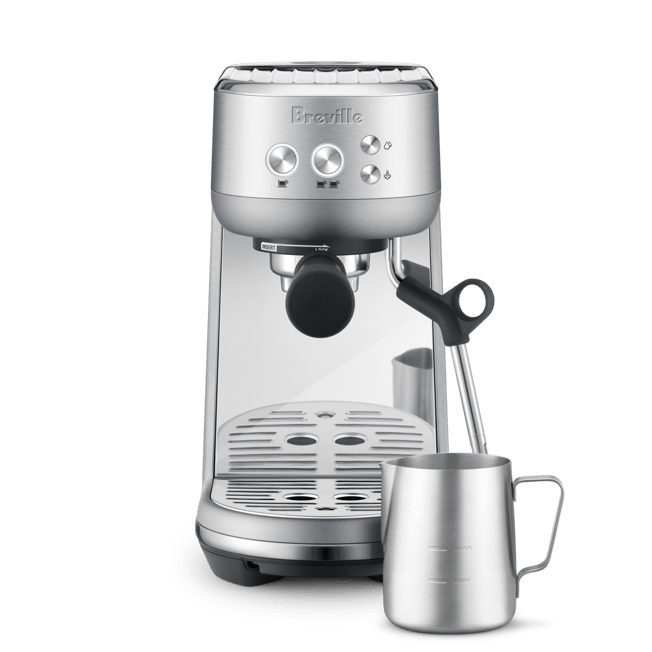
Its current US instruction book says to lift out the water tank, which sits against the back of the machine. It also shows a rotating portafilter insertion movement, a jug held at the steam wand and a 2 L container for descaling. Check each of those movements in your proposed position.
Why this arrangement may suit
- You can assign separate places to the brewer, grinder and preparation tools.
- An open counter lets you plan tank access without an overhead cabinet directly above it.
- A clear front and wand side give you room to arrange the cup and jug you already use.
Where to reconsider
- A rear tank is inconvenient if your chosen position blocks its removal path.
- A neighboring appliance can obstruct working room even when both bodies fit.
- A narrow shelf may leave no practical location for a cleaning container and wet parts.
Our recommendation: consider the BES450 for a station where you can verify the tank, handle and wand movements in advance. If the only available location is a tightly enclosed recess, resolve its access requirements before shortlisting it. These are planning judgments, rather than measurements of a machine we own.
Dimension check: Breville’s current US page labels its three dimensions in an order that needs clarification before using them as a precise cutout specification. Confirm the width and depth for the actual unit with Breville or the seller; this worksheet does not substitute assumed axes.
Search Amazon for the Bambino BES450
This is a model search, so check the listing’s model, region and included parts before buying.
4. Make the decision from your completed sheet
Fits and remains accessible: every listed action has room, and you can follow the maker’s placement instructions. Keep the measurements with the model number so another household member can check the plan.
Body fits, access remains unresolved: identify the exact blocked task. A tank that cannot be removed and a jug with nowhere to sit need different solutions. Compare another position or another machine’s access layout, rather than relying on a smaller advertised width.
Important information is missing: ask the manufacturer or seller for the relevant drawing or demonstration before ordering. Do not treat a return policy as evidence of fit. If your plan depends on moving the machine, check its handling instructions first. Breville’s BES450 manual requires switching off and unplugging before moving it, and allowing it to cool.
Once the physical layout is resolved, compare the daily preparation options in our espresso workflow guide or browse our espresso machine comparison.
Fit questions before checkout
Is there one cabinet clearance that works for every espresso machine?
No universal number is established here. Use the exact model’s instructions and verify the space needed to open, refill and remove parts. A nominal body height cannot establish those clearances.
Should I count my grinder in the machine footprint?
Count it in the station layout, with space to use and refill it. A machine’s published dimensions describe that machine; they do not reserve counter space for your other tools.
Can I check fit using a product photograph?
A photo can help identify parts to investigate. It cannot establish the scale, the full movement of a part or the operating clearance. Use it alongside a labelled drawing and the manual.
Research method and sources
We checked the Breville US Bambino product page and BES450 US instruction book on November 6, 2026. The manual supports the model-specific movements above; the worksheet and fit recommendations are our editorial planning advice. We have not measured a physical machine, established operating clearances, tested coffee or verified retail availability. Confirm the current manual for the exact regional model before purchase.