Five Upper-Arm Blood Pressure Monitors for Home Tracking (2026)
Quick answer
Omron Platinum BP5465 has the strongest household logging tools here: two users, long local memory and a three-reading mode. Withings BPM Connect suits app-first automatic sync. Omron Silver BP5255 balances a large display and Bluetooth for one user, iHealth Track KN-550BT offers readable color cues and an XL-cuff selection, and Omron Bronze BP5150 is the simple one-touch option. Fit, validated model identity and correct technique matter more than a claimed “most accurate” ranking.
For home monitoring, the American Heart Association recommends a validated automatic upper-arm device and a cuff that actually fits. These picks differ mainly in record keeping, display, cuff options and app workflow; we do not have side-by-side clinical measurement data showing one is more accurate for your arm.
Match the monitor to your routine
| Monitor | Useful role | Choose another when… |
|---|---|---|
| Omron Platinum BP5465 | two-person records and three-reading mode | You want a one-button monitor or need a model validated for a special population without checking eligibility. |
| Withings BPM Connect | Wi-Fi record sharing | You prefer wholly offline records or need a different cuff circumference. |
| Omron Silver BP5255 | simple connected logging | You need two separate on-device profiles or automatic three-reading sequences. |
| iHealth Track KN-550BT | color display and optional app | You need two isolated user profiles or want a color indicator to make clinical decisions for you. |
| Omron Bronze BP5150 | one-touch basic log | You need long local memory, two profiles or automated averaging. |
Omron Platinum BP5465: two-person records and three-reading mode
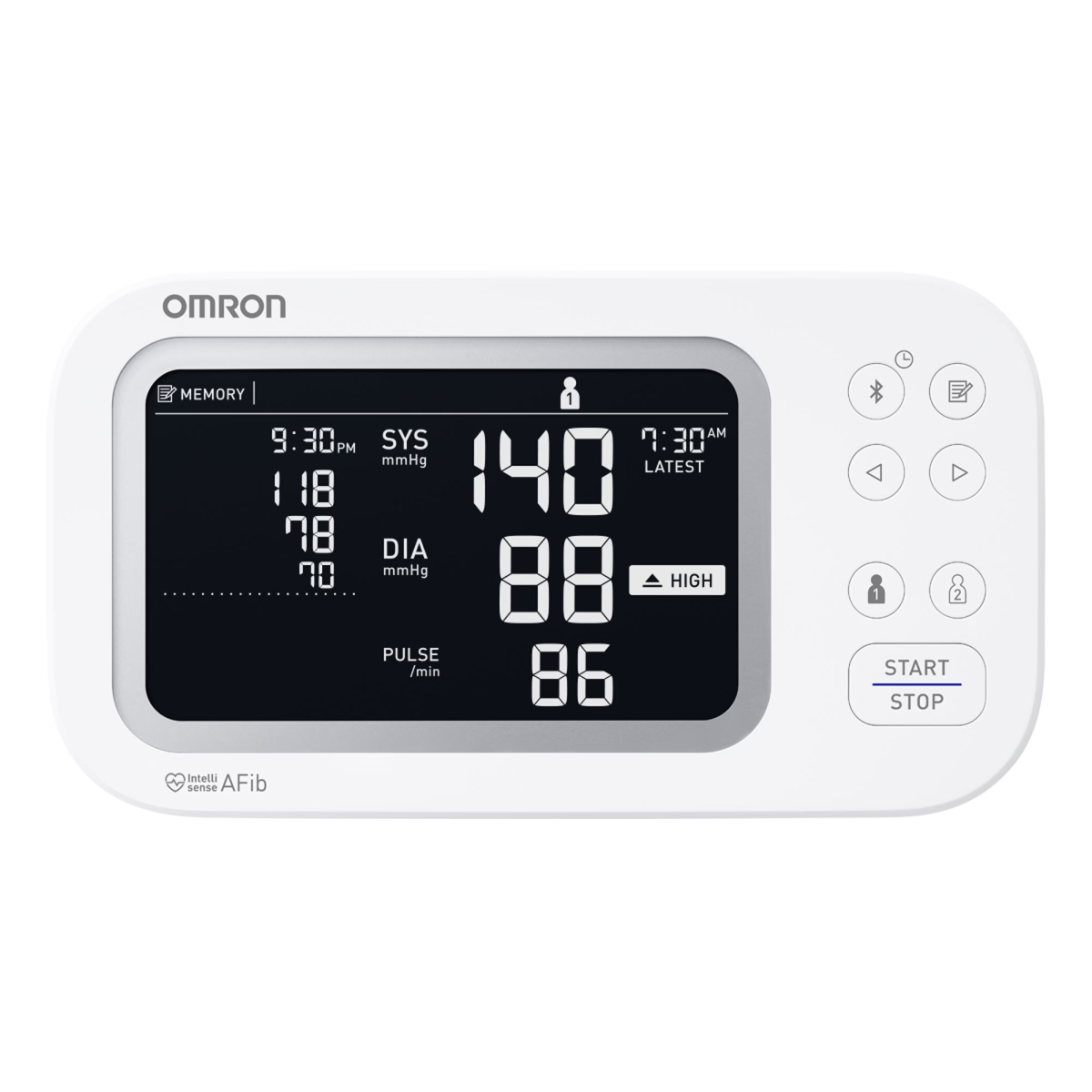
The current Platinum BP5465 is a two-user upper-arm monitor with 100 stored readings per user, Bluetooth sharing, a 9–17 inch D-ring cuff, a high-contrast comparison screen and Omron’s TruRead mode, which takes three measurements at selectable intervals and displays an average. It also screens for possible atrial fibrillation during a reading; that is a screening indication, not an AFib diagnosis, and Omron lists exclusions including pregnancy and implanted defibrillators or pacemakers. The older BP5450 in the original article must not be conflated with this BP5465.
Pros
- Two user profiles and 100 readings each support separate household logs without relying on a phone.
- TruRead and the large comparison screen make repeated readings and trend review easier.
Cons and trade-offs
- The many modes and buttons take more setup than a one-touch model.
- The included 9–17 inch cuff will not fit every arm; check Omron’s compatible small cuff option if needed.
Best for: Two adults who want on-device history and optional Bluetooth export.
Choose another if: You want a one-button monitor or need a model validated for a special population without checking eligibility.
Our recommendation
Choose BP5465 for logging features, not an unproven accuracy advantage. Discuss a possible AFib alert with a clinician; never treat it as a diagnosis.
Withings BPM Connect: Wi-Fi record sharing

BPM Connect combines the upper-arm cuff, LED display and controller in one unit. Withings specifies a 22–42 cm arm range, Wi-Fi and Bluetooth sync, a rechargeable battery and up to six months per charge under its one-reading-per-day condition. The current product page says up to eight readings can be stored on the device between synchronizations and requires the Withings app for setup; check phone OS compatibility and whether cloud-based records fit your privacy needs.
Pros
- Wi-Fi synchronization can record measurements without carrying a phone to each reading after setup.
- Single-piece cuff and rechargeable battery reduce loose parts for travel.
Cons and trade-offs
- Initial setup requires the app and a supported phone; on-device history is limited between syncs.
- Its 22–42 cm integrated cuff has no documented larger alternate cuff in this listing.
Best for: Someone who wants routine automated data sync and a compact cuff.
Choose another if: You prefer wholly offline records or need a different cuff circumference.
Our recommendation
Choose BPM Connect for its connected workflow after checking app compatibility, account requirements and fit. Its manufacturer validation claim does not show it measures your own BP more accurately than another validated unit.
Omron Silver BP5255: simple connected logging
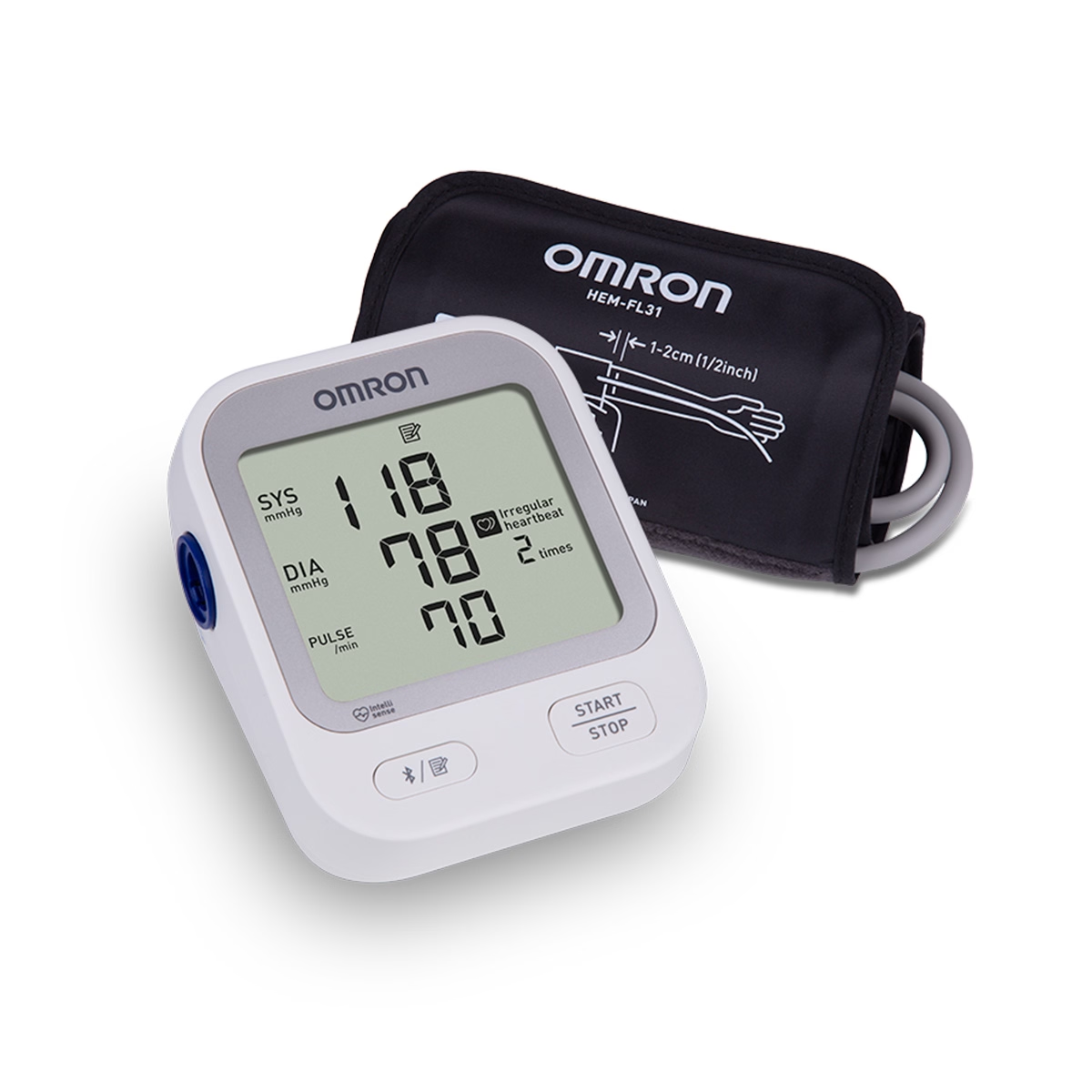
Omron lists BP5255 with a large LCD, a preformed 9–17 inch cuff, 30 stored readings for one user and Bluetooth sync to Omron Connect. Unlike the former article’s description of BP5250 as app-free, both BP5250’s manual and the current BP5255 documentation identify Bluetooth. BP5255 has no TruRead automatic three-reading mode; take the two separate readings recommended by your care team and record them.
Pros
- Preformed cuff and large display simplify repeat use for a single person.
- Thirty on-device readings plus optional Bluetooth export provide a useful log without constant syncing.
Cons and trade-offs
- One on-device user profile is awkward for a household sharing the monitor.
- No TruRead mode means you must time and record repeated measurements yourself.
Best for: One adult wanting a familiar arm cuff and optional app history.
Choose another if: You need two separate on-device profiles or automatic three-reading sequences.
Our recommendation
Choose BP5255 when cuff fit and single-user memory match your needs. Verify the BP5255 model number rather than assuming every Silver listing has identical features.
iHealth Track KN-550BT: color display and optional app
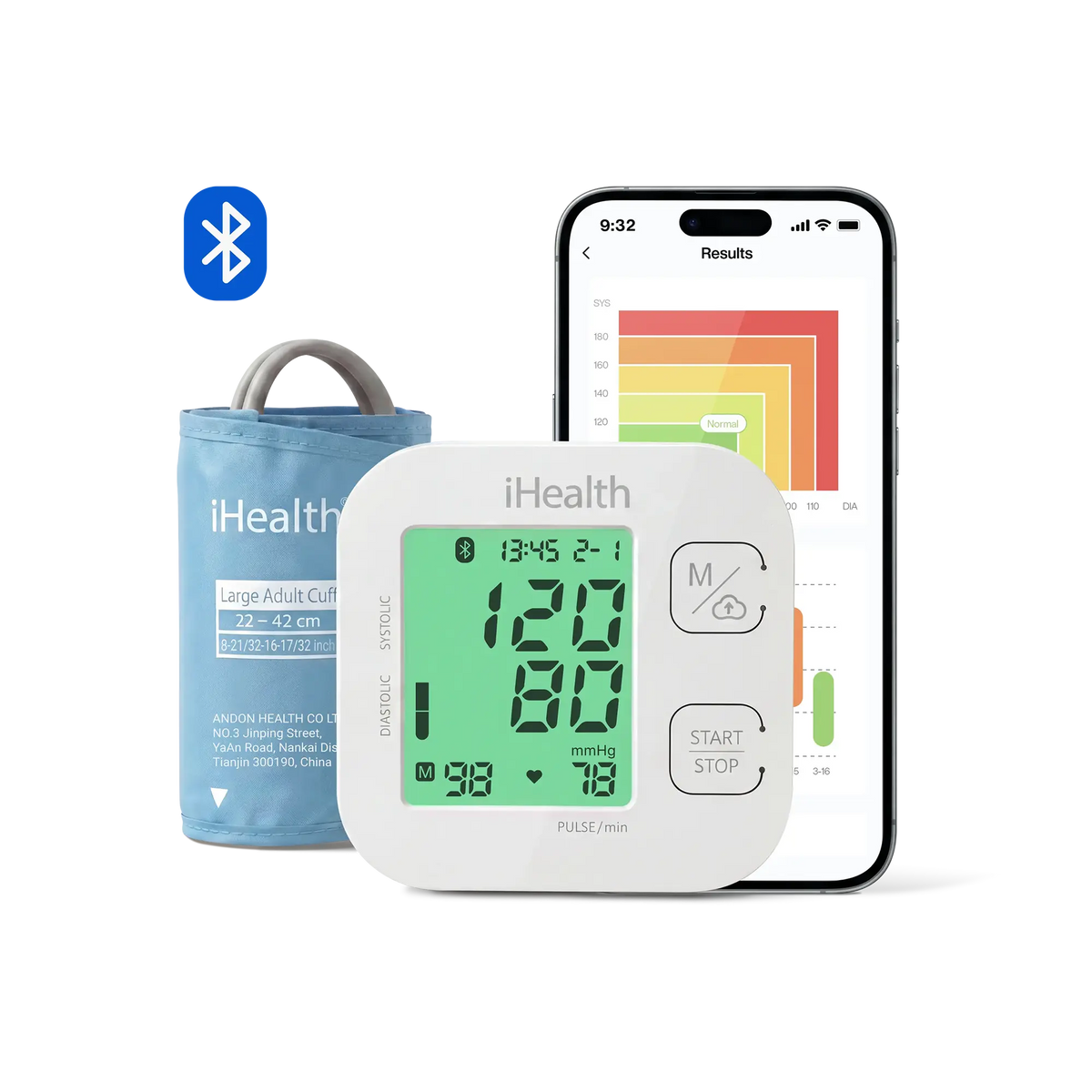
The KN-550BT has a large color-coded display, one-touch reading, Bluetooth 5.2 and 99-reading on-device memory by iHealth’s current support sheet. Its product page sells separate standard 22–42 cm and XL 42–48 cm cuff selections; do not assume both cuffs are in one box. iHealth says it can measure without a phone, although the app helps synchronize and track results. Color zones are prompts to review a reading, not a medical diagnosis.
Pros
- Large screen, color cues and 99-reading memory make offline tracking more usable than a phone-only design.
- The listed XL-cuff variant can accommodate a 42–48 cm arm when the correct bundle is selected.
Cons and trade-offs
- Bluetooth history depends on pairing and the iHealth app; manual review is still needed if sync fails.
- The standard and XL cuff are distinct order choices, so choosing the wrong bundle can undermine fit.
Best for: A buyer who values a readable screen and can select the correct cuff variant.
Choose another if: You need two isolated user profiles or want a color indicator to make clinical decisions for you.
Our recommendation
Choose KN-550BT for display and fit options after measuring the arm. Confirm the included cuff and compare readings with your care team’s process.
Search Amazon for iHealth Track KN-550BT
Omron Bronze BP5150: one-touch basic log
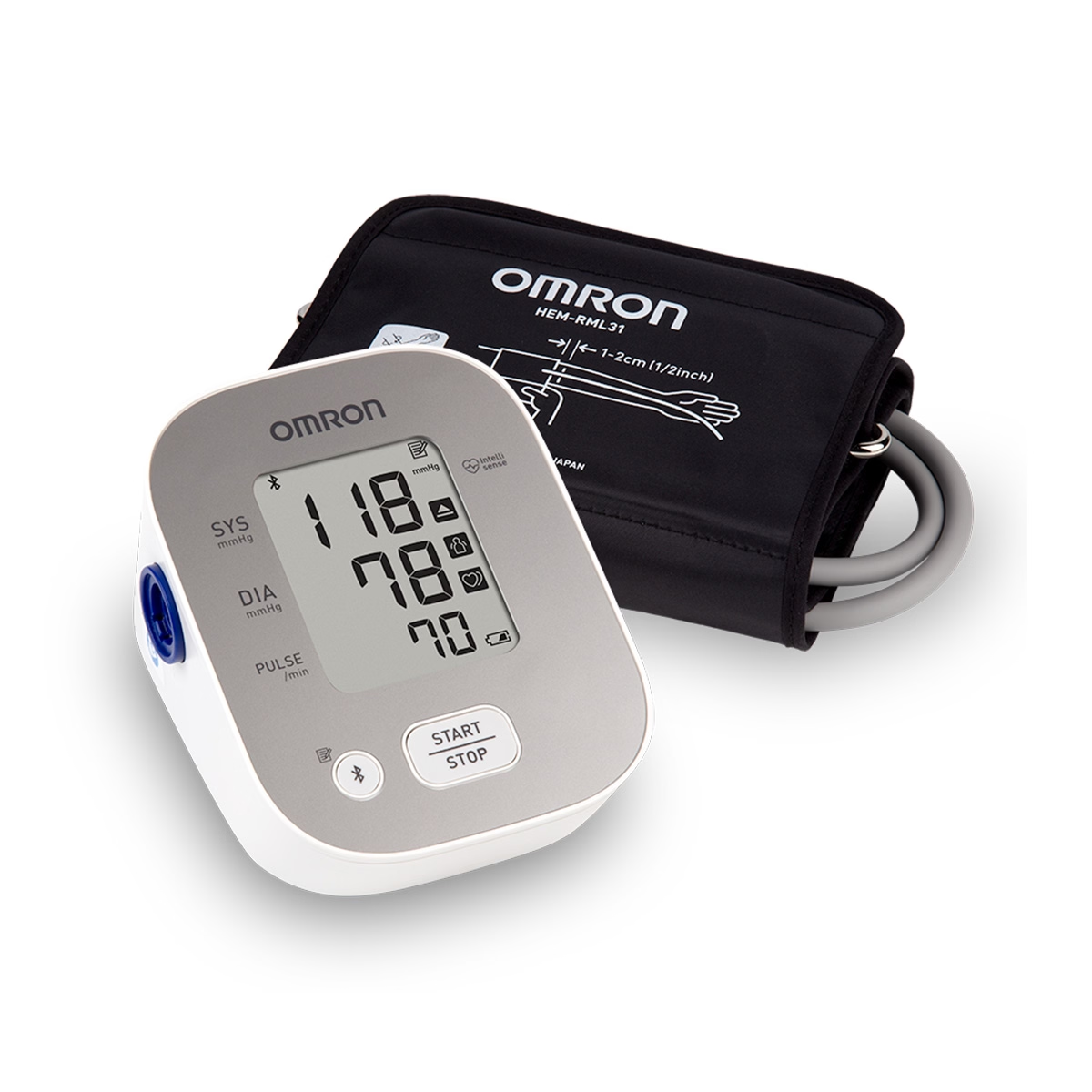
The current Bronze BP5150 is a one-user upper-arm monitor with one-touch operation, 14-reading local memory, 9–17 inch D-ring cuff and Bluetooth sync to Omron Connect. This is distinct from the older BP5100 named in the prior article; the prior image actually displayed a Bluetooth button and matches the newer family. Omron lists movement and irregular-heartbeat indicators but no TruRead mode. The simple controls suit someone willing to keep a separate paper or app log.
Pros
- One-touch operation reduces menu steps for a routine reading.
- Bluetooth export offers longer-term tracking beyond the 14 readings held locally.
Cons and trade-offs
- Fourteen on-device readings can fill quickly if you follow a twice-daily multi-reading plan.
- It has one user profile and no automatic three-reading sequence.
Best for: One person who wants a straightforward monitor and can maintain an external log.
Choose another if: You need long local memory, two profiles or automated averaging.
Our recommendation
Choose exact BP5150 for simple operation. If you avoid apps, plan a written record before its 14-reading memory cycles.
How to choose and use a home monitor
- Measure your arm first. Compare mid-upper-arm circumference with the included cuff range, not just the monitor’s compatible optional cuff range. An ill-fitting cuff can distort a reading.
- Check the exact model’s validation. Use a validated-device listing and the manufacturer’s exact model number, especially for pregnancy, children, unusual arm size or irregular rhythms. FDA registration alone is not a comparative accuracy score.
- Set up a repeatable reading. Per the American Heart Association, avoid caffeine, smoking and exercise for 30 minutes; empty your bladder; sit quietly at least five minutes with back supported, feet flat, bare upper arm supported at heart level; take two readings one minute apart and record both.
- Decide where history lives. A 14-reading memory is quickly exhausted with frequent checks. A connected device may add useful trends but requires phone compatibility, an account or sync; ask how you will bring readings to a clinician.
- Bring the monitor to an appointment. The AHA advises having a healthcare professional check your technique and compare its readings with office equipment, then repeating checks annually or as directed.
- Treat alerts appropriately. Irregular-beat and AFib screening indicators need clinical follow-up; do not start, stop or change medication based on a product display alone.
A smartwatch or fitness tracker can log other wellness metrics, but check whether any blood-pressure feature is validated for your purpose before substituting it for an upper-arm cuff.
FAQ
Do I need an app to take a reading?
No for the Omron units and iHealth Track listed here; each has a display and local memory. Withings BPM Connect requires the app for initial setup and offers limited readings between syncs.
How often should I measure?
Follow your clinician’s schedule. The AHA recommends consistent timing and two readings one minute apart when you measure.
Does an AFib alert diagnose atrial fibrillation?
No. Omron describes BP5465 as screening for possible AFib. Discuss alerts with a clinician and follow the product’s exclusions.
Is Omron Silver BP5255 app-free?
It can take and store readings without a phone, but it also has Bluetooth and optional Omron Connect sync. Do not mistake “app optional” for “no Bluetooth.”
Which cuff is included with iHealth Track?
The standard and XL sizes are separate product-page choices. Confirm the selected variant and its box contents; do not infer both cuffs are included.
Sources and method
Exact manufacturer pages establish features and cuff ranges; the American Heart Association home-monitoring guide supports the technique advice. Manufacturer validation claims are identified as such, not our own clinical study. See our research methodology.
- Omron Platinum BP5465 manufacturer page
- Withings BPM Connect manufacturer page
- Omron Silver BP5255 manufacturer page
- iHealth Track KN-550BT manufacturer page and model support sheet
- Omron Bronze BP5150 manufacturer page
As an Amazon Associate, The Gear Audit earns from qualifying purchases. We may earn an affiliate commission when you buy through our links, at no extra cost to you. See our affiliate disclosure.