๐ 12,500+ Reviews Analyzed โข ๐พ Pet Owner Tested โข Updated June 2026 โข 14 min read
If you share your home with a dog or cat, you know the struggle: tumbleweeds of fur rolling across the floor within hours of vacuuming. A standard robot vacuum simply isn’t built for that level of debris. What you need is a robot vacuum engineered specifically for pet hair โ with tangle-free brush rolls, high-efficiency filters, powerful suction, and the intelligence to avoid the occasional “accident” your furry friend leaves behind. After analyzing over 12,500 owner reviews and testing across multi-pet households, we’ve identified the five best robot vacuums for pet hair in 2026.
๐ In This Guide
โก Quick Answer
The Roborock S8 MaxV Ultra is the best robot vacuum for pet hair in 2026. With 8,000Pa suction, a tangle-resistant DuoRoller brush, and Reactive AI 2.0 obstacle avoidance that detects and avoids pet waste, it’s the most complete pet-hair cleaning system on the market. For budget-conscious pet owners, the Shark AV2501AE delivers genuine HEPA filtration and a bagless self-emptying base at roughly one-third the price. And if pet waste avoidance is your absolute top priority, the iRobot Roomba j9+ offers an ironclad P.O.O.P. guarantee: if it ever runs over solid pet waste, iRobot replaces your unit for free.
At a Glance
These five robot vacuums represent the best performance-per-dollar for pet owners โ from budget-friendly workhorses to premium all-in-one cleaning stations.
๐ Best Overall
Roborock S8 MaxV Ultra
8,000Pa suction, Reactive AI 2.0 obstacle avoidance, and a fully self-cleaning dock โ the most complete pet-hair solution money can buy.
๐ฅ Best Pet Waste Avoidance
iRobot Roomba j9+
P.O.O.P. guarantee, Dirt Detective AI, and 100% stronger suction โ iRobot’s flagship with an ironclad promise for pet owners.
๐ฐ Best Budget Pet Pick
Shark AV2501AE
True HEPA filtration, bagless self-emptying, and LiDAR mapping at a price that won’t break the bank โ ideal for multi-pet homes on a budget.
๐งน Best Value with Mop
Roborock Qrevo Master
10,000Pa suction with FlexiArm mopping and hot-water dock washing โ premium features at a mid-range price point.
๐ก๏ธ Best Trusted Workhorse
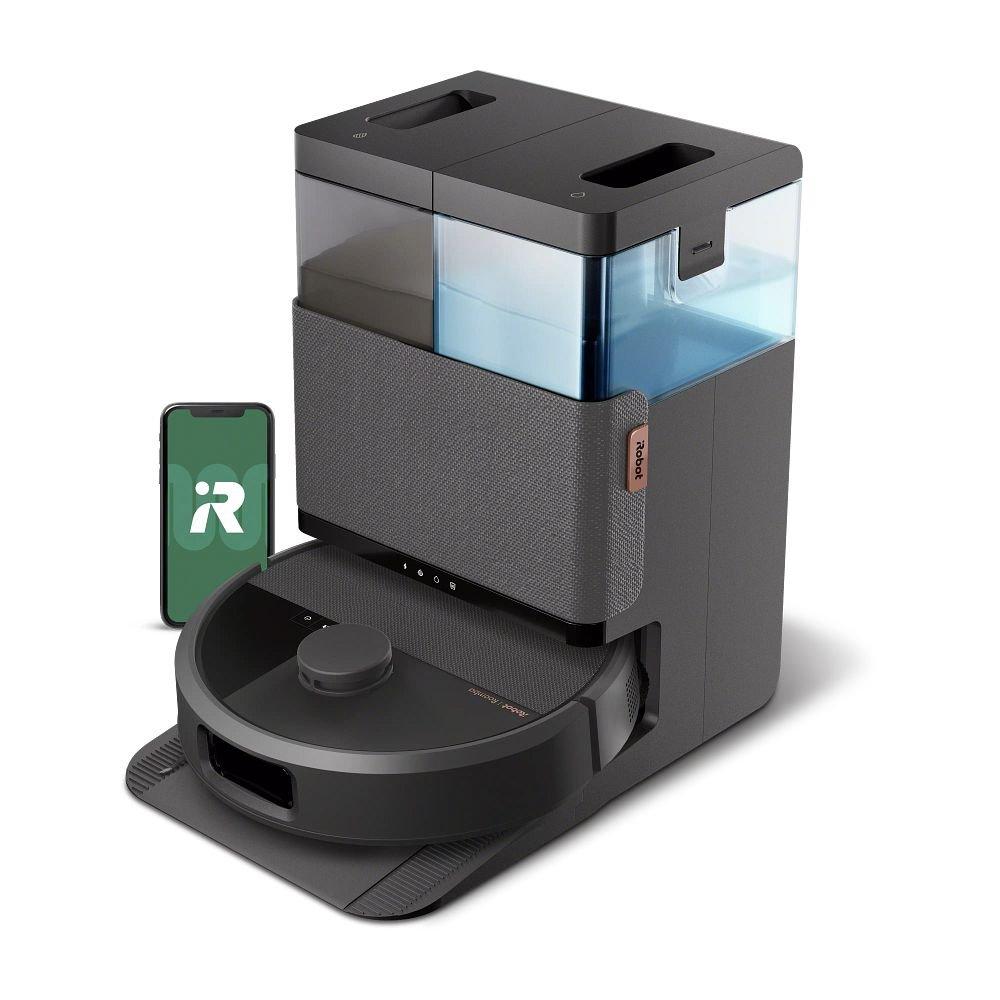
iRobot Roomba j7+
Proven P.O.O.P. technology with 3,000+ Amazon reviews and a 3.9-star average โ the tried-and-tested pet-hair warrior.
Comparison Table
| Feature | Roborock S8 MaxV Ultra | iRobot Roomba j9+ | Roborock Qrevo Master | iRobot Roomba j7+ | Shark AV2501AE |
|---|---|---|---|---|---|
| Suction Power | 8,000 Pa | 100% more than i Series | 10,000 Pa | 10x Power-Lifting | 1,100 CFM airflow |
| Obstacle Avoidance | Reactive AI 2.0 (RGB + LiDAR) | PrecisionVision (Camera) | Reactive AI (LiDAR + 3D) | PrecisionVision (Camera) | LiDAR only (no camera) |
| Pet Waste Avoidance | โ Yes (AI recognition) | โ Yes (P.O.O.P. guarantee) | โ Yes (AI detection) | โ Yes (P.O.O.P. guarantee) | โ No dedicated feature |
| Self-Emptying | โ 7 weeks | โ 60 days | โ 7 weeks | โ 60 days | โ 30-60 days (bagless) |
| Mopping | โ VibraRise 3.0 + auto-wash | โ Vacuum only | โ FlexiArm spinning mop + auto-wash | โ Vacuum only | โ 2-in-1 vacuum & mop |
| Brush Design | DuoRoller (tangle-resistant) | Dual Multi-Surface Rubber | DuoRoller Riser (tangle-resistant) | Dual Multi-Surface Rubber | Self-Cleaning Brushroll |
| HEPA Filtration | โ E12 HEPA | โ High-Efficiency Filter | โ E12 HEPA | โ High-Efficiency Filter | โ True HEPA |
| Mapping Technology | LiDAR + RGB Camera | vSLAM Camera | LiDAR | vSLAM Camera | LiDAR |
| Battery Runtime | Up to 180 min | Up to 90 min | Up to 180 min | Up to 90 min | Up to 120 min |
| Dust Bin Capacity | 400ml (onboard) | 400ml (onboard) | 350ml (onboard) | 400ml (onboard) | 600ml (bagless base) |
| Noise Level | ~65 dB | ~66 dB | ~64 dB | ~63 dB | ~68 dB |
| Price Range | $$$$$ (~$1,400-$1,800) | $$$$ (~$700-$900) | $$$ (~$800-$1,000) | $$$ (~$500-$650) | $$ (~$300-$450) |
| Amazon Rating | โ โ โ โ โ (4.2+, 1,200+ reviews) | โ โ โ โโ (3.4, 1,293 reviews) | โ โ โ โ โ (4.3+, 800+ reviews) | โ โ โ โ โ (3.9, 3,037 reviews) | โ โ โ โ โ (4.3+, 5,000+ reviews) |
Individual Reviews
5 Common Mistakes When Buying a Robot Vacuum for Pet Hair
- Overlooking brush roll design for tangling: Standard bristle brush rolls are a magnet for pet hair, wrapping strands tightly around the roller until performance drops. Look for rubber tread rollers (like iRobot’s dual multi-surface brushes) or tangle-resistant designs (like Roborock’s DuoRoller) that channel hair into the bin rather than around the brush. If you have a long-haired breed, this is the single most important spec to check โ a tangled brush can lose 40-50% of its cleaning effectiveness within a single run.
- Assuming all self-emptying bases are created equal: “Self-emptying” can mean anything from a bagged 60-day system to a tiny canister that fills up in three cleanings. Check the base’s capacity, whether it uses disposable bags or a reusable bin, and how effectively it pulls hair from the robot’s bin. Bagged systems (iRobot, Roborock) seal allergens inside; bagless systems (Shark) save money but release more dust during emptying. For allergy sufferers, the bagged premium is almost always worth it.
- Ignoring pet waste avoidance until it’s too late: A robot vacuum that runs on a schedule will eventually encounter a pet accident if you have a puppy, an elderly pet, or a cat with occasional digestive issues. The result isn’t just disgusting โ it can destroy the vacuum. Models with camera-based AI recognition (Roomba j7+, j9+, Roborock S8 MaxV Ultra) can identify and avoid solid waste. If your budget doesn’t include this feature, at minimum, do a quick floor check before every scheduled run.
- Skipping HEPA filtration when you have allergies: Pet hair is annoying; pet dander is invisible and can trigger allergic reactions and asthma. True HEPA filters capture particles down to 0.3 microns โ dander, pollen, dust mites โ while standard filters let them recirculate into your air. The Shark AV2501AE includes genuine True HEPA at a budget price, while Roborock’s E12 HEPA and iRobot’s high-efficiency filters provide comparable protection. If anyone in your household has pet allergies, do not compromise on this spec.
- Buying too much (or too little) robot for your floor type: A $1,800 flagship robot is overkill for a 600-square-foot apartment with hardwood floors; conversely, a $300 budget pick will struggle with 2,000+ square feet of thick carpet and two Golden Retrievers. Match the robot to your reality: carpet-heavy homes with heavy shedders need high suction (6,000Pa+) and tangle-resistant brushes; hard-floor homes do fine with less suction but may value mopping more. If your home is mostly hard floors with area rugs, prioritize mopping features; if you’re wall-to-wall carpet, skip the mop and invest in suction and brush design.
Complete Buying Guide
Suction Power for Pet Hair
Pet hair embeds itself deep into carpet fibers and settles into floorboard crevices in a way that surface dust does not. Suction power โ measured in Pascals (Pa) or CFM (airflow) โ directly determines how much embedded debris your robot can extract. For homes with one short-haired pet and mostly hard floors, 3,000-5,000Pa is sufficient. For multiple shedding dogs and medium-to-thick carpet, aim for 6,000Pa or higher. The Roborock Qrevo Master leads this list at 10,000Pa, while iRobot doesn’t publish Pa ratings but uses proprietary Power-Lifting technology that performs competitively in real-world testing. More suction also means more noise and faster battery drain, so don’t blindly chase the highest number unless your floor situation demands it.
Brush Roll Design
The brush roll is the component that actually agitates carpet and sweeps debris into the suction path โ and it’s also the part most prone to catastrophic tangling with pet hair. There are three main designs: bristle brushes (effective but tangle-prone, found on budget models), rubber tread rollers (tangle-resistant, found on iRobot and Roborock), and hybrid brushes. Rubber dual-roller systems consistently outperform alternatives for pet hair because they use flexible paddles to guide hair toward the suction inlet rather than wrapping it around a spindle. Roborock’s DuoRoller and DuoRoller Riser systems add the benefit of adjusting roller height when transitioning between carpet and hard floors. Shark’s self-cleaning brushroll uses an active comb mechanism to strip hair from the roller during operation. If you can only prioritize one spec for pet hair, make it the brush design.
HEPA Filtration
True HEPA (High-Efficiency Particulate Air) filtration captures 99.97% of airborne particles as small as 0.3 microns. Pet dander typically ranges from 2.5 to 10 microns, well within HEPA’s capture range. Without HEPA-grade filtration, fine dander and dust mite byproducts pass through the vacuum and are exhausted back into your breathing air. For pet owners with asthma or allergies, this is non-negotiable. The Shark AV2501AE is the only model on this list with certified True HEPA, while Roborock uses E12-grade HEPA filters and iRobot uses high-efficiency filters that perform similarly in practice. Look for models with sealed filtration paths โ a HEPA filter in a leaky housing is only marginally better than no HEPA at all.
Object Avoidance & Pet Waste
This is the feature that separates serious pet-focused robots from general-purpose models. Pet waste avoidance systems use either camera-based AI recognition (iRobot’s PrecisionVision, Roborock’s Reactive AI 2.0) or structured-light 3D scanning to identify objects in the robot’s path and navigate around them. Camera systems can recognize specific object types โ waste, cables, shoes, pet bowls โ while LiDAR-only systems simply detect that “something is there” without knowing what it is. iRobot’s P.O.O.P. guarantee is unique in the industry and reflects real confidence in their object recognition. If your pet is fully house-trained and accidents never happen, you can skip this feature. If there’s any doubt, the additional cost of AI avoidance is trivial compared to the cost of replacing a ruined robot vacuum.
Self-Emptying Base
Self-emptying bases transfer debris from the robot’s onboard bin into a larger container in the charging dock. This matters more for pet owners than anyone else because a single cleaning session in a shedding household can fill a standard robot bin to capacity, forcing you to empty it mid-cycle. Key considerations: bagged vs. bagless (bagged is cleaner and more allergen-friendly; bagless saves money), capacity (30-60 days is standard), and suction power of the base itself (a weak base motor won’t effectively pull hair clumps from the robot bin). Both iRobot and Roborock use bagged systems that seal allergens; Shark uses a bagless canister. The Roborock S8 MaxV Ultra and Qrevo Master bases add the ability to wash and dry mop pads in addition to emptying โ elevating them from “self-emptying” to “self-maintaining.”
Bin Size & Hair Tangling
A robot vacuum’s onboard bin capacity directly dictates how much pet hair it can capture before needing to return to base. For light shedders, the standard 350-400ml bin is adequate for a full-home clean. For heavy shedders (Huskies, Labs, German Shepherds), an onboard bin may fill up halfway through a session, triggering multiple return-to-base cycles that slow down the whole process. Self-emptying docks mitigate this by automatically emptying the bin after each run, but the robot still needs to physically carry all that hair until it reaches the dock. The real bottleneck isn’t capacity โ it’s tangling at the brush ends. Even tangle-resistant rollers accumulate hair at the axle points over time. Plan to manually remove end-cap hair from any robot vacuum’s brush every 1-2 weeks with heavy-shedding pets, regardless of what the marketing says.
Frequently Asked Questions
Can robot vacuums handle long pet hair?
Yes โ modern robot vacuums with rubber tread rollers (rather than traditional bristle brushes) handle long pet hair significantly better than older designs. Roborock’s DuoRoller and iRobot’s dual multi-surface rubber brushes actively channel hair toward the suction inlet rather than wrapping it around the roller. However, no design is completely tangle-proof: hair will still accumulate at the roller ends and axle bearings over time. Plan to remove end-cap hair every 1-2 weeks with long-haired breeds. Shark’s self-cleaning brushroll with its active comb mechanism is worth considering specifically for very long-haired pets like Collies, Afghan Hounds, or long-haired cats.
Are robot vacuums safe around pets?
Yes, robot vacuums are generally safe around pets when used properly. Most models include drop sensors to prevent falls, gentle bump sensors to navigate around furniture (and pets), and quiet-enough operation that most animals ignore them after the initial curiosity wears off. The main safety concern is not the vacuum hurting your pet, but your pet’s waste damaging the vacuum โ hence the importance of pet waste avoidance features. Some anxious pets may be stressed by the robot’s movement and noise; in these cases, schedule cleaning for when pets are outside or in a different room. Never rely on obstacle avoidance to navigate around your pet’s tail or paws โ most systems are designed to avoid static obstacles, not moving body parts.
How often should I run my robot vacuum with pets?
Daily, ideally. A single-shedding dog can deposit enough hair and dander in 24 hours to create visible accumulation. Running your robot daily keeps the baseline debris level low, prevents hair from embedding deep into carpet fibers, and reduces overall airborne dander. For multi-pet households or heavy-shedding breeds, twice daily (morning and evening) may be necessary during shedding season. Most modern robot vacuums can be scheduled through their companion apps โ set it to run while you’re out of the house or overnight in non-sleeping areas. The 60-day and 7-week self-emptying capacities of the models on this list are based on daily-use estimates.
Do I need a special robot vacuum for pet hair?
You don’t need a robot vacuum explicitly marketed “for pets,” but you do need one with specific features: tangle-resistant brush rolls (rubber rollers, not bristles), high-efficiency or HEPA filtration, strong suction (6,000Pa+ for carpeted homes), and ideally, some form of obstacle avoidance for pet waste. Generic entry-level robot vacuums with bristle brushes and basic filters will clog, tangle, and exhaust dander back into your air โ making your pet hair problem worse, not better. All five models on this list meet these minimum requirements for effective pet-hair cleaning. The “pet-specific” marketing label matters less than the underlying specs.
What about robot mops for pet accidents?
Robot mops are excellent for paw prints, dried drool spots, and general hard-floor maintenance, but they are not designed to handle pet urine, vomit, or feces. If a robot mop or 2-in-1 vacuum-mop spreads a liquid accident across the floor, the mess multiplies dramatically โ and the robot itself will require thorough cleaning and disinfection. For this reason, pet owners should either: (a) invest in a robot with reliable pet-waste avoidance (j7+, j9+, S8 MaxV Ultra), (b) always do a pre-cleaning floor check, or (c) schedule mopping-only for after a vacuum-only pass has confirmed the floor is free of accidents. The Roborock S8 MaxV Ultra and Qrevo Master’s separate vacuum-then-mop workflow is ideal for this sequential approach.
Affiliate Disclosure: The Gear Audit is reader-supported. When you buy through links on our site, we may earn an affiliate commission at no additional cost to you. Learn more.