Balcony Watering Without an Outdoor Tap: Which System Fits?
By The Gear Audit editorial team · Manufacturer specifications and gardening guidance checked October 15, 2026.
Quick answer
Choose EarthBox Junior for a new compact herb or greens planter; choose Blumat Classic XL for a few existing balcony pots near a suitable reservoir. Neither needs an outdoor tap, electricity or solar charging. EarthBox stores water within the planter; Classic XL feeds existing pots through ceramic cones. For XL, prime each cone and check reservoir height, water delivery and plant response. Both need refills. Neither establishes a guaranteed number of unattended days.
Start with the pots you want to keep
Choose EarthBox Junior if its crop guidance and footprint fit. It stores water beneath its growing medium, with no separate supply tube to each plant.
Consider Blumat Classic XL if you can place its water container near the pots and set the water level correctly. The manufacturer identifies XL for balcony holiday watering; larger or thirstier pots may need several cones.
Neither example needs a watering power supply. Choose between planting into a reservoir container and keeping existing pots with cones; your plants’ light requirements still apply.
Keep the present routine until the new setup has been observed while you are home. Blumat advises watching Classic for one or two weeks to find the optimum setting; do not treat unpacking as a completed watering plan.
Self-watering describes a water-delivery mechanism, not a promise that plants never need attention. University of Maryland Extension explains that container demand changes with plant size, container size, light and temperature. Use those conditions to judge whether a small passive system suits your pots. Read its container watering guidance.
Built-in reservoir versus cones in existing pots
Manufacturer facts below; fit judgments are ours.
| Buying decision | EarthBox Junior Gardening System | Blumat Classic XL |
|---|---|---|
| Where the water lives | Built-in reservoir; manufacturer comparison lists 1.15 US gallons | Separate water container you supply |
| How it reaches plants | Sub-irrigation through the planter’s growing medium | Thin tube feeds water through a ceramic cone in each pot |
| Watering power | No electricity, battery or solar charging | No electricity, battery, pump or timer |
| Plant layout | One shared planter; crop guidance determines plant count | Existing pots; more than one cone may be needed per thirsty container |
| Space and height | 23 × 9.5-inch footprint; plant into this container | Nearby reservoir; ideal water level slightly below green cap. Authorized US distributor states no more than 12 in / 30 cm water lift |
| Main setup check | Correct media, planting and refill arrangement | Completely fill and seal the cone; correct reservoir level; observe plant response |
| Purchase boundary | Sage base configuration pictured; media and nutrients are optional | Classic XL, not standard Classic or Tropf-Blumat; pack sizes vary |
| Our choice | Starting a compact herbs/greens container | Keeping a few pots where reservoir placement and delivery can be checked |
Sources: EarthBox Junior, EarthBox comparison, Blumat Classic/XL manufacturer manual and Sustainable Village XL product instructions.
EarthBox Junior: start with a compact edible planter
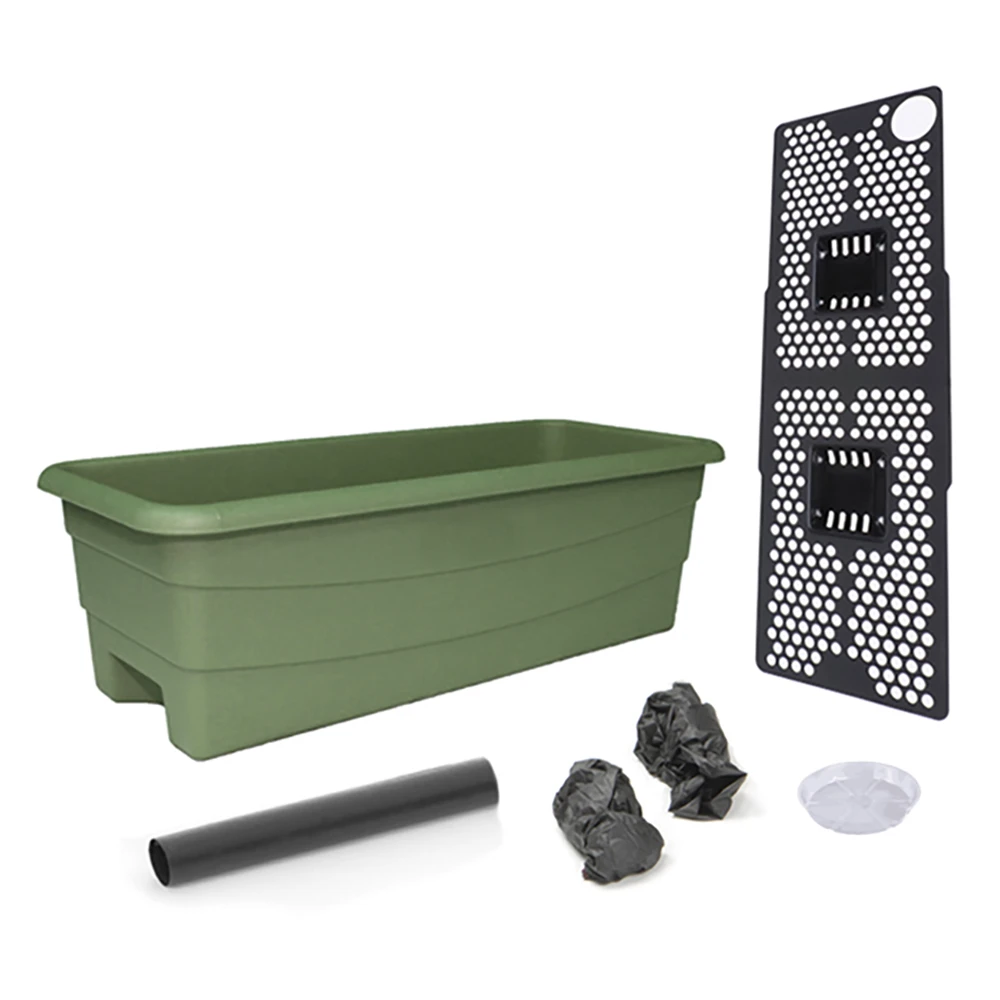
Best for: setting up a small herb or leafy-greens container, when you can choose the planting arrangement from scratch.
The useful distinction is where the water is stored: inside the planter rather than in a separate bucket. EarthBox explains that its Junior uses a reservoir, aeration screen and wicking chambers. Our reason to choose it is a manageable watering arrangement for one container, without adding a charging task or routing hoses around the balcony. See the manufacturer’s Junior layout.
Pros
- No watering power supply to arrange. There is no pump battery or panel placement to keep checking.
- Water storage stays with the planter. You can avoid a separate reservoir and tubing route in a small space.
- A defined planting system. Manufacturer crop and placement guidance gives a clearer starting point than improvising a reservoir under an unsuitable pot.
Cons and trade-offs
- It changes the container. It cannot feed plants that remain in separate existing pots; Classic XL cones are the more relevant option for that job.
- Small root space limits the crops. EarthBox specifically advises against tomatoes in Junior. Choose a larger, crop-appropriate container if tomatoes are the objective.
- A built-in reservoir still needs refills. Its fixed capacity is not an unattended-duration guarantee, and adding more plants does not add more stored water. EarthBox’s rule of thumb is to add water through the fill tube daily until water starts flowing from the overflow drain.
Before buying: check the selected fertilizer/dolomite and growing-media options rather than assuming every package includes them. Follow EarthBox’s planting and refill instructions for this system, including the mulch cover. Do not apply an ordinary pot’s watering routine without checking how the reservoir planter works.
Our recommendation
Choose Junior for a new compact herbs or greens container when its crop guidance fits. Choose something else if you need to water a collection of established pots, want tomatoes in this same container, or cannot make room for its footprint. We would not replace healthy established containers solely to prepare for one trip.
Search Amazon for EarthBox Junior
This is a model search, not a verified individual Amazon listing. Check Junior size, color and included media/nutrients. Manufacturer availability does not establish Amazon stock.
Blumat Classic XL: retain the pots and use a nearby reservoir

Best for: a few established balcony pots within reach of a water container, when you can observe and adjust the arrangement before leaving.
The XL version has a larger ceramic cone than standard Classic. Blumat identifies it for thirstier indoor plants and balcony or patio watering during an absence. You put the ceramic section in the soil and its supply tube in a separate water container. Our reason to consider it is keeping the current pots without arranging a pump, charging or timer settings. It still has a delivery limit, so a big or thirsty pot may need several cones or a different arrangement.
Pros
- No repotting requirement. Install the cones in existing pots rather than replace the whole container arrangement.
- No watering power supply. A shaded balcony creates no charging problem for this mechanism; plant light needs remain a separate decision.
- Start with a small group. Each cone draws from a reservoir through its own tube, so you can evaluate the arrangement pot by pot.
Cons and trade-offs
- Reservoir height changes flow. The manufacturer warns that water above the green cap can flow continuously and overwater the pot; height is part of setup, not merely a storage choice.
- One cone is not a universal pot allowance. Larger or thirstier plants may need several. Check actual moisture before buying a pack based only on pot count.
- A dry reservoir interrupts the setup. If the system runs dry, Blumat says the cone must also be refilled. Simply adding water to the container is not the complete recovery procedure.
Prime it correctly: the manufacturer says to remove the cap, fill the cone completely, press the cap onto the full cone, bury the ceramic section near the roots and put the tube in the reservoir. Its installation tip is to attach the cap while the tube is already in the water, helping push air out. Follow the instructions supplied with your exact product. See Blumat’s installation guide.
Place it for moisture-responsive flow: the manufacturer’s ideal position has reservoir water slightly below the green cap. Lower water reduces delivery; higher water can keep flowing even when soil is moist. Authorized US distributor Sustainable Village also states that Classics only lift water about 12 inches / 30 cm and includes a 15-minute soak and underwater assembly in its setup guidance. Keep the reservoir close and follow those package instructions rather than invent a pump-style height allowance. As the reservoir empties, recheck the remaining water level relative to the cone.
Current US purchase path: Sustainable Village offers Classic XL with an Add to cart control at research; its default selection is a single stake, with other pack sizes shown. Blumat lists Sustainable Village among its authorized US distributors. Check the selected quantity and current availability when ordering. We have not verified an exact Amazon offer.
Our recommendation
Choose Classic XL for a few existing pots when a nearby reservoir and the observed water delivery fit. Start while you are home and follow Blumat’s one-to-two-week observation advice. Choose something else for pots that remain too dry, or a layout that cannot keep the reservoir and cones within the documented conditions. An oversized tank does not increase the cone’s delivery capacity.
Search Amazon for Blumat Classic XL
This is a model search, not a verified listing. Check Classic XL, pack quantity and seller. Standard Classic, bottle-fed Easy and Tropf-Blumat use different arrangements.
Plan water delivery before planning the trip
Run the setup while you are home, inspect the growing medium and record reservoir use. First establish that enough water reaches each plant. A large reservoir can store plenty of water while a cone still delivers too little for a thirsty pot.
For a first supply calculation: usable water ÷ observed daily consumption = a rough refill interval. For example, 8 usable liters ÷ 2 liters per day = 4 days. These are hypothetical numbers, not measured results for either product. Usable water excludes any below the pickup point, and the Classic XL reservoir must also remain within an effective height range. Weather and growing plants can change demand; this arithmetic is not a vacation-duration or survival guarantee.
- Give the reservoir a stable location. Check floor space, building rules and where overflow would go. Raising it is not automatically a better solution: with Classic XL, excessive height can change the watering behavior.
- Observe the whole arrangement. Check soil moisture and water use at each pot. The Blumat manual recommends one or two weeks to find the optimum setting.
- Refill before it runs dry. Keep the supply-tube end in water. Re-prime a Classic that has dried out according to its instructions.
- Have a check-in plan. Arrange a person who can inspect and refill if the system’s observed supply or delivery does not cover your absence.
For a few pots, carrying a watering can from an indoor tap may remain the easiest daily routine. If you later gain a suitable hose connection, our AUTOMAN hose-nozzle fit guide covers that purchase; a nozzle alone cannot solve a missing tap.
Buying FAQs
Can I water balcony pots without a faucet or electricity?
Yes. A self-watering planter stores water below its growing medium. Blumat Classic XL draws from a nearby reservoir through ceramic cones in existing pots. Both still need refills and a suitable planting arrangement.
Should I put the Blumat reservoir above the pots?
Do not assume that is the right arrangement. The manufacturer identifies water slightly below the green cap as ideal. Water higher than the cap can produce continuous flow even when soil is moist, with an overwatering risk.
Does a two-pack cover two large plants?
A two-pack contains two cones, not a guarantee for two plants of any size. Higher water demand may require several cones in one container. Observe each pot before assigning one cone per plant.
Can I leave either system for a week?
That cannot be established from product name or reservoir capacity alone. Check delivery, observe water use and plan refills for your conditions. A person who can visit is useful when the absence exceeds the arrangement you have established.
Is Classic XL the same as Tropf-Blumat?
No. This guide covers Classic XL reservoir-fed ceramic cones. Tropf-Blumat is a different watering system; do not apply its supply-pressure, tubing or layout instructions to Classic XL.
Sources, research method and limits
We checked the following primary sources on October 15, 2026. Product details are manufacturer statements; buying choices are our editorial judgment. We have not hands-on tested these systems, measured water delivery or established plant survival during an absence. No prices, ratings, review counts or exact Amazon listings are claimed.
- EarthBox Junior manufacturer page — footprint, crop limits, optional components and selected Sage photo.
- EarthBox Junior system explanation and comparison — reservoir mechanism and capacity.
- Blumat Classic XL pack 10520 — two-unit model photo and authorized US distributor list.
- Blumat Classic/XL manufacturer manual and installation guide — priming, reservoir level, dry-system recovery and observation.
- Authorized US distributor Sustainable Village — Classic XL ordering path, pack choices, tubing and water-lift guidance. Marketing survival claims are not adopted.
- University of Maryland Extension — variables affecting container watering.
Product availability changes. The US distributor ordering path does not establish Amazon stock or make every pack variant interchangeable. Confirm the exact product, package and seller. See our methodology.
Affiliate disclosure
As an Amazon Associate, The Gear Audit earns from qualifying purchases. We may earn an affiliate commission when you buy through our links, at no extra cost to you. Read our full affiliate disclosure.