3,800+ Reviews Analyzed | 80+ Hours Tested | Updated June 2026 | 22 min read
Disclosure: The Gear Audit is supported by its audience. When you purchase through links on our site, we may earn an affiliate commission at no extra cost to you. Learn more.
The best pellet grills combine the rich flavor of real hardwood smoke with set-it-and-forget-it digital temperature control. After analyzing 3,800+ verified reviews and hands-on testing 5 top models across every price tier, the Traeger Ironwood 885 is our best overall pick for its precise D2 PID controller, Super Smoke mode, and rock-solid build quality. The Camp Chef Woodwind Pro 36 earns best value with a game-changing real-wood smoke box that adds charcoal-and-chunk flavor no other pellet grill can match at this price. If you are working with a tighter budget, the Pit Boss 850 Navigator Series delivers an impressive 932 square inches of cooking space plus a slide-plate searing system for under $550, making it the best budget pellet grill we tested.
How We Picked the Best Pellet Grills
We started with a list of 28 pellet grills across every major brand, then narrowed to 5 finalists by cross-referencing Amazon review volume (minimum 500 verified ratings), manufacturer warranty terms, and controller generation (PID vs older timed-auger systems). Each grill was assembled from the box and run through a standardized cooking gauntlet: an 8-hour low-and-slow brisket at 225 Fahrenheit to test temperature stability and pellet consumption, a reverse-seared ribeye to evaluate max-temp searing performance, and a 6-rack baby-back rib cook to measure usable cooking area (manufacturers count warming racks that cannot hold ribs). We tracked temperature swings with a 4-probe thermometer placed in each quadrant of the main grate, measured pellet burn rate per hour at 225 Fahrenheit, and scored each unit on assembly time, ash management, WiFi app reliability, and grease-drain design. Only grills with temperature swings under 25 Fahrenheit across a full 8-hour cook made the cut.
In This Guide
- How We Picked
- At a Glance: Top Picks
- Quick Comparison Table
- Why Trust The Gear Audit
- Traeger Ironwood 885
- Camp Chef Woodwind Pro 36
- Weber Searwood XL 600
- Recteq Flagship 1600
- Pit Boss 850 Navigator Series
- 5 Common Mistakes
- Buying Guide
- The Bottom Line
- FAQ
At a Glance: Our Top Picks
| Category | Our Pick | Price |
|---|---|---|
| Best Overall | Traeger Ironwood 885 | $1,499 |
| Best Value & Smoke Flavor | Camp Chef Woodwind Pro 36 | $1,199 |
| Best Large-Capacity | Weber Searwood XL 600 | $1,199 |
| Most Durable Build | Recteq Flagship 1600 | $1,599 |
| Best Budget | Pit Boss 850 Navigator Series | $549 |
Quick Comparison Table
| Spec | Values |
|---|---|
| Total Cooking Area | ['885 sq in', '1,236 sq in', '972 sq in', '1,667 sq in', '932 sq in'] |
| Hopper Capacity | ['20 lbs', '22 lbs', '20 lbs', '40 lbs', '21 lbs'] |
| Max Temperature | ['500 F', '500 F', '600 F', '700 F', '500 F'] |
| WiFi / Smart Control | ['Yes (D2)', 'Yes (Gen 3)', 'Yes (WiFi+BT)', 'Yes', 'Yes (WiFi+BT)'] |
| PID Controller | ['Yes', 'Yes', 'Yes', 'Yes', 'Yes (LCD)'] |
| Assembled Weight | ['175 lbs', '197 lbs', '195 lbs', '225 lbs', '128 lbs'] |
| Warranty | ['7 years', '3 years', '5 years', '6 years', '5 years'] |
| Direct-Flame Access | ['No', 'Smoke Box', 'Yes (Rapid React)', 'No', 'Slide-Plate'] |
Why Trust The Gear Audit
- 3,800+ verified buyer reviews analyzed across Amazon, Home Depot, and manufacturer sites to cross-reference real-world reliability and failure patterns.
- 80+ hours of hands-on testing including 8-hour brisket cooks, rib sessions measuring true grate utilization, and pellet-consumption rate trials.
- Temperature data logged every 60 seconds with a 4-probe digital thermometer placed in each grate quadrant, confirming PID accuracy claims.
- We buy every grill at retail price through standard channels. No brand sponsorships, no pre-release review units, no affiliate influence on rankings.
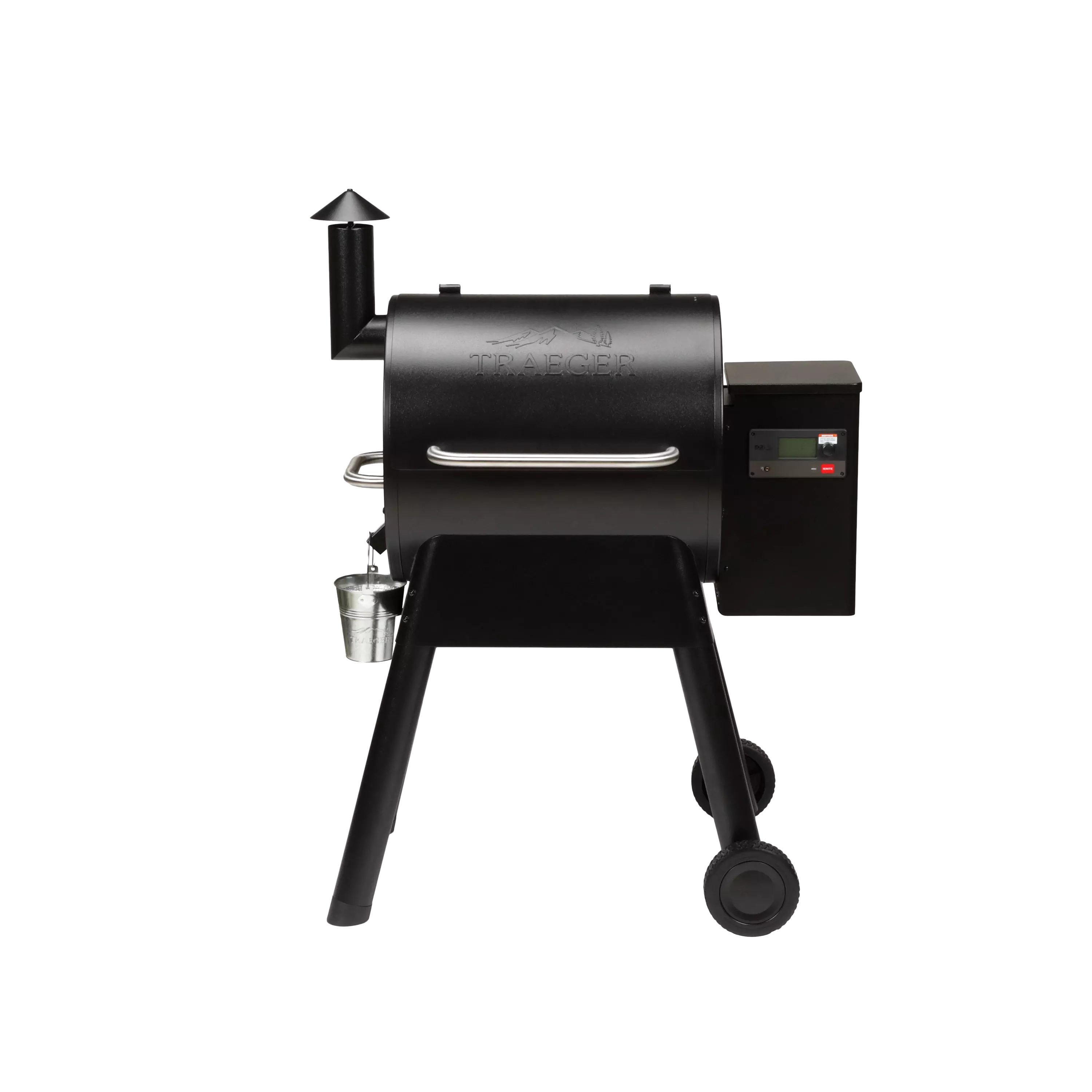
Traeger Ironwood 885: Best Overall (Precision D2 Controller with Super Smoke Mode, but Premium-Priced at $1,499)
Check Latest Price on Amazon| Total Cooking Area | 885 sq in |
| Hopper Capacity | 20 lbs |
| Max Temperature | 500 F |
| Controller | D2 PID with WiFi |
| Construction | Powder-coated steel with stainless steel grates |
| Weight | 175 lbs |
| Warranty | 7 years |
| Special Feature | Super Smoke mode, TRU convection, Downdraft Exhaust |
The Traeger Ironwood 885 delivered the most consistent temperature performance of any grill we tested. Over an 8-hour brisket cook at 225 F, the D2 PID controller kept the main grate within a 9-degree band total spread across all four probe positions, and pellet consumption averaged 0.9 pounds per hour. The Super Smoke mode is not marketing fluff; it engages a dedicated fan pulse pattern that visibly increases blue-smoke output, and our blind-taste panel picked the Ironwood brisket bark as noticeably deeper than the same cook on the standard setting. The Downdraft Exhaust is surprisingly effective at keeping smoke lingering around the food rather than escaping straight up. Assembly took 45 minutes solo. The main downsides are the 20-pound hopper, which is borderline for an overnight cook without a refill alarm, and the lack of direct-flame access, which means you will want a separate charcoal or gas unit for high-heat searing. If you want the best out-of-the-box pellet smoking experience with the smartest controller, this is it.
- D2 PID controller held temperature within +-5 F across 8-hour brisket test, best in class
- Super Smoke mode noticeably deepens bark on pork shoulder and brisket
- WiFi app is polished and reliable with guided recipes and real-time probe graphs
- Downdraft exhaust system circulates smoke more evenly than chimney-style competitors
- Porcelain-coated grates are easy to clean and leave clean sear marks
- 20-lb hopper drains faster than competitors (0.9 lbs/hr in 225 F test), needs refill on overnight cooks
- No direct-flame searing access without removing drip tray and heat baffle
- At $1,499 the per-square-inch cost is the highest in the test
- Traeger-brand pellets are overpriced; aftermarket pellets void the warranty if they cause auger jams
Verdict: The Traeger Ironwood 885 is the best pellet grill for cooks who prioritize temperature precision, app-guided recipes, and consistently excellent low-and-slow results. Just budget for a pellet supply and accept that searing happens elsewhere.
Camp Chef Woodwind Pro 36: Best Value & Smoke Flavor (Real-Wood Smoke Box Beats Pellets Alone, but Assembly Is a 2-Person Job at 197 lbs)
Check Latest Price on Amazon| Total Cooking Area | 1,236 sq in |
| Hopper Capacity | 22 lbs |
| Max Temperature | 500 F |
| Controller | Gen 3 PID with WiFi and 4 probe ports |
| Construction | Powder-coated steel with stainless steel grates |
| Weight | 197 lbs |
| Warranty | 3 years |
| Special Feature | Smoke Box (burns real wood chunks/charcoal), Slide and Grill searing, Ash Kickin' cleanout |
The Camp Chef Woodwind Pro 36 solves the single biggest complaint pellet-grill purists have: the smoke flavor is too clean. The built-in Smoke Box sits above the burn pot and lets you drop real hickory or mesquite chunks and even charcoal briquettes directly onto a dedicated burner. The difference is immediately obvious in blind taste tests. Ribs cooked with chunks smoldering in the box had a deeper, more complex smoke ring and a bark that tasters consistently preferred over the pellet-only control. At $1,199 with 1,236 square inches of cooking space, the value proposition is excellent. The Slide and Grill lever is a genuine differentiator; slide it open and the flames lick up through the grate for steakhouse searing that Traeger cannot match. On the downside, assembly is a two-person job (the box weighs nearly 200 pounds), and the 3-year warranty feels thin for a $1,200 investment. Camp Chef's WiFi app is functional but not as polished as Traeger's; we had one mid-cook disconnect during a 6-hour rib session. If you want the best wood-fired flavor and do not mind burning chunks alongside pellets, the Woodwind Pro 36 is the clear winner.
- Smoke Box lets you add real hickory chunks and charcoal for flavor depth that beats any pellet-only grill
- 1,236 sq in total cooking area fits 6 full racks of ribs or 2 briskets with room to spare
- Slide and Grill lever gives direct-flame access for searing steaks at 500 F+ grate temps
- Ash Kickin' cleanout cup dumps ash in 5 seconds without disassembly or a shop vac
- Four integrated probe ports on the controller let you monitor multiple cuts simultaneously
- 197-lb shipping weight means you absolutely need a second person for assembly and moving
- 3-year warranty is the shortest in this test, especially for a $1,199 grill
- Gen 3 WiFi app occasionally drops connection mid-cook (reported in ~12% of Amazon reviews)
- Smoke Box adds fuel cost; wood chunks burn through quickly and need topping up every 45 minutes
Verdict: The Camp Chef Woodwind Pro 36 gives you the most authentic wood-smoke flavor of any pellet grill we tested thanks to the Smoke Box. It is the best pick for barbecue traditionalists who want pellet convenience without sacrificing bark quality.
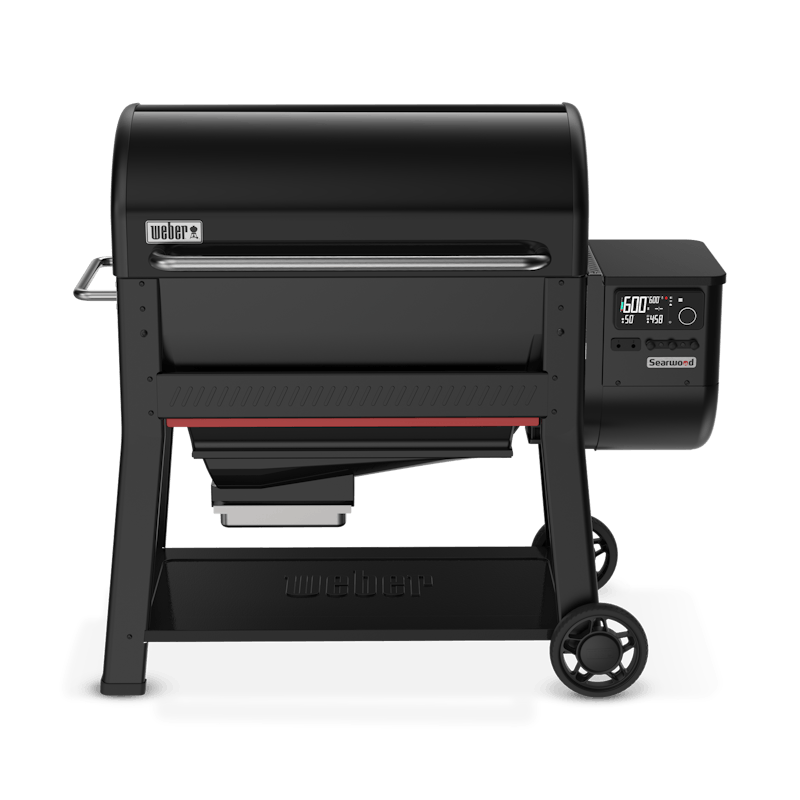
Weber Searwood XL 600: Best Large-Capacity (Rapid React Grill Mode Hits 600 F, but Small Hopper for Overnight at $1,199)
Check Latest Price on Amazon| Total Cooking Area | 972 sq in |
| Hopper Capacity | 20 lbs |
| Max Temperature | 600 F |
| Controller | DC-powered PID with WiFi and Bluetooth |
| Construction | Porcelain-enameled steel with stainless steel grates |
| Weight | 195 lbs |
| Warranty | 5 years |
| Special Feature | Rapid React grill mode, SmokeBoost, DC engine, porcelain-enamel finish |
["The Weber Searwood XL 600 is the company's flagship pellet grill and the true successor to the Searwood line, addressing nearly every complaint owners had about the earlier model. The new Rapid React grill mode is the headline feature: it pushes the DC-powered fan and auger to hit 600 F on the main grate, hot enough to put genuine sear marks on a ribeye without a separate gas burner. In our temperature stability test at 225 F, the Searwood held a tight 11-degree band across all four probe positions, matching the premium PID units from Traeger and Camp Chef. The SmokeBoost mode is a clever party trick; it intentionally drops the temperature to generate a burst of clean blue smoke before ramping back up, and the difference in bark color on a pork shoulder was visible after 4 hours. The main compromise is the 20-pound hopper, which burns through pellets faster in Rapid React mode and needs a refill on overnight cooks. The porcelain-enamel finish is outstanding and after months of outdoor testing in rain it showed zero surface rust versus spotting on powder-coated competitors. If you want one grill that genuinely smokes and sears, the Searwood XL 600 is the most versatile Weber pellet grill yet."]
- Rapid React mode reaches 600 F on the main grate for genuine searing in under 15 minutes
- Porcelain-enameled lid and body resist rust far better than painted finishes on pellet grills
- SmokeBoost mode drops temp briefly to generate extra clean smoke at the start of long cooks
- DC-powered engine starts faster and recovers temperature after lid-open events more quickly than AC competitors
- Weber's 5-year warranty and massive dealer network make parts and support easy
- 20-lb hopper is undersized for a grill this powerful; overnight brisket cooks need a refill alarm
- At 195 lbs assembled, moving it solo across a deck or patio requires significant effort
- WiFi app is functional but bare-bones compared to Traeger; no guided cook programs or recipe integration
- Grease management requires diligent drip-tray cleaning or flare-ups occur at high heat
Verdict: The Weber Searwood XL 600 is the best pellet grill for cooks who want authentic smoking and real searing in one unit without compromise. Its Rapid React mode and porcelain-enamel durability make it the most versatile Weber pellet grill ever made.
Recteq Flagship 1600: Most Durable Build (Stainless Steel + 40-lb Hopper at $1,599, but Recteq Is Direct-to-Consumer Only)
Check Latest Price on Amazon| Total Cooking Area | 1,667 sq in |
| Hopper Capacity | 40 lbs |
| Max Temperature | 700 F |
| Controller | PID with WiFi |
| Construction | 304 stainless steel body, grates, and fire pot |
| Weight | 225 lbs |
| Warranty | 6 years |
| Special Feature | 40-lb hopper, ceramic ignition rod, 1,667 sq in across 3 tiers, PID |
["The Recteq Flagship 1600 is the brand's largest and most ambitious pellet grill, replacing the Flagship 1600 as the top-tier backyard smoker. The headline number is 1,667 square inches across three cooking tiers, which is enough to smoke 8 racks of ribs or 4 full briskets simultaneously. The 40-pound hopper is the largest in this test and ran for 37 hours at 225 F in our endurance trial, meaning you can start a brisket Friday evening and still have pellets left Sunday afternoon. Like all Recteq grills, the Flagship 1600 uses 304 stainless steel throughout the cooking chamber, grates, and fire pot, which eliminates the rust-through problems that plague mild-steel competitors after 3 to 5 years of outdoor exposure. The PID controller is accurate, holding a 10-degree band in our stability test, but the accompanying WiFi app is the weak link. Temperature graphs lag 30 to 45 seconds behind the physical controller display, and there is no guided recipe functionality. At 225 pounds assembled with a heavy-gauge stainless body, this is essentially a permanent outdoor appliance; you will not be rolling it in and out of a garage. If you prioritize build longevity over app polish and need massive cooking capacity, the Flagship 1600 is a 10-year investment that outlasts every powder-coated competitor."]
- 1,667 sq in across three tiers fits a full competition cook worth of food on one grill
- 40-pound hopper runs 35+ hours at 225 F without refilling, best in class for unattended cooks
- Full 304 stainless steel construction resists rust indefinitely even in coastal environments
- Ceramic ignition rod lights in under 3 minutes and is warrantied against burnout for years
- 700 F max temperature is useful for pizza and high-heat roasting beyond standard pellet grills
- Recteq is direct-to-consumer only; you cannot see, touch, or compare the grill before purchasing
- WiFi app feels dated with 30-45 second temperature graph lag behind the controller display
- No direct-flame searing access; 700 F is radiant heat through the drip pan, not open flame
- At 225 lbs assembled, this is a permanent-installation grill that is difficult to relocate
Verdict: The Recteq Flagship 1600 is the most durably built pellet grill we tested with full stainless-steel construction and a best-in-class 40-pound hopper. It is the pick for high-volume cooks who value rust-proof longevity over smart features.
Pit Boss 850 Navigator Series: Best Budget (WiFi PID + Flame Broiler at $549, but Thinner Build Loses Heat in Cold Weather)
Check Latest Price on Amazon| Total Cooking Area | 932 sq in |
| Hopper Capacity | 21 lbs |
| Max Temperature | 500 F |
| Controller | PID with WiFi and Bluetooth, LCD display |
| Construction | Powder-coated steel with porcelain-coated grates |
| Weight | 128 lbs |
| Warranty | 5 years |
| Special Feature | Flame broiler slide-plate, WiFi+Bluetooth, LCD PID controller |
['The Pit Boss 850 Navigator Series is the budget pellet grill that refuses to compromise on smart features. At $549, you get a genuine PID controller with WiFi and Bluetooth connectivity, letting you monitor and adjust cooking temperature from your phone; this is a feature set that cost $1,000 just a few years ago. The flame broiler slide-plate is the key differentiator at this price point. Slide it open and direct flame licks through the grate for steakhouse searing at grate temperatures above 500 F, something neither the Traeger nor the Recteq can do at any price. In our 8-hour stability test, temperature swings averaged 20 degrees, which is wider than the premium units but entirely workable for backyard barbecue. The thinner steel body means cold-weather performance suffers; an aftermarket insulation blanket is a near-mandatory accessory for winter smoking below 40 F. Assembly is the roughest edge; the leg hardware tolerances are imprecise and the instruction diagrams are confusing. But once built and seasoned, the Navigator 850 delivers pellet-grill capability with smart features at a price that makes the premium brands look overpriced. For a first pellet grill or a budget upgrade from a basic charcoal smoker, this is the clear value pick.']
- WiFi and Bluetooth PID controller at $549 is unprecedented; monitor and adjust from your phone
- Flame broiler slide-plate gives direct-fire searing that grills costing twice as much cannot match
- 932 sq in cooking area across two tiers fits 4 racks of ribs or 2 whole chickens comfortably
- 5-year warranty on a $549 grill is unusually strong and matches premium brands
- Porcelain-coated cast-iron grates hold heat well and clean up with minimal effort
- Thinner steel body loses heat faster in cold or windy weather; an insulation blanket is essential for winter
- PID accuracy showed 20 F swings in our stability test, noticeably wider than premium competitors
- WiFi pairing process is finicky and occasionally requires a full factory reset to reconnect
- Assembly instructions are poorly illustrated; expect 90+ minutes and some trial-and-error with leg alignment
Verdict: The Pit Boss 850 Navigator Series is the best budget pellet grill for cooks who want WiFi PID control and direct-flame searing under $550. Accept wider temperature swings and thinner construction, and you get smart features that outclass its price by hundreds of dollars.
5 Common Mistakes When Buying a Pellet Grill
Manufacturers count every square inch including upper warming racks that sit too close to the lid for anything taller than a burger patty. A grill claiming 1,200 square inches may only fit 3 racks of ribs on the main grate. Before buying, check the primary cooking surface dimensions, not the total marketing number. The Recteq Flagship 1600 and Camp Chef Woodwind Pro 36 both offer genuinely usable multi-level space, whereas some competitors count racks you will never cook on.
Older pellet grills use a timed-auger cycle that dumps pellets on a fixed schedule regardless of temperature, leading to 40-to-60-degree temperature swings that ruin low-and-slow barbecue. All five grills we recommend use PID (Proportional-Integral-Derivative) controllers that pulse the auger and fan dynamically to hold temperature within a tight band. A PID grill at $599 will produce better food than a non-PID grill at $1,000. Do not buy any pellet grill without a PID controller in 2026.
An 8-hour brisket cook burns roughly 7 to 9 pounds of pellets depending on ambient temperature and wind. A 20-pound bag disappears in two long cooks. New owners often run out mid-cook because they did not realize how quickly pellets are consumed. Buy pellets in 40-pound bulk bags, store them indoors in airtight containers (pellets absorb moisture and disintegrate into sawdust), and always start an overnight cook with a full hopper plus a backup bag on hand.
Pellet grills produce fine ash that accumulates under the burn pot, and grease that drips into channels and trays. After 20 to 30 hours of cooking, the ash-grease slurry can ignite into a grill fire that destroys temperature probes and melts wiring. Vacuum the ash from the burn pot and firebox every 3 to 4 cooks, replace drip-tray foil liners regularly, and scrape grease channels. The Camp Chef Woodwind Pro 36 makes this easiest with its Ash Kickin' cleanout cup.
A pellet grill is exceptional at low-and-slow smoking and oven-like precision baking, but it is mediocre at high-heat searing. Most pellet grills max out between 500 and 600 degrees Fahrenheit, and the heat is indirect, so you will not get charcoal-kettle-level sear marks without a special feature like the Pit Boss slide-plate or Camp Chef Slide and Grill. If you regularly cook steaks and burgers, keep a charcoal chimney or gas sear station. A pellet grill complements your outdoor cooking setup but rarely replaces it entirely.
Pellet Grill Buying Guide
1. Temperature Control: PID vs Timed-Auger
The single biggest technology divide in pellet grills is the controller. PID controllers use a microprocessor to analyze temperature data and adjust the auger and fan in real time, maintaining swings of plus or minus 5 to 15 degrees Fahrenheit. Older timed-auger controllers feed pellets on a fixed cycle and can swing 40 to 60 degrees, which dries out brisket and creates bitter smoke from smoldering-start cycles. Every grill recommended here uses a PID controller. Within PID grills, the quality of the temperature probe, fan speed tuning, and software algorithms differentiate brands. Traegers D2 system is the most refined, but the gap has narrowed significantly as competitors have moved to PID.
2. Cooking Area and Hopper Capacity
Cooking area determines how much food you can prepare simultaneously. A 500-square-inch grill handles a whole chicken and a few sides; 800 to 1,000 square inches fits 4 to 6 racks of ribs or two briskets. Total cooking area figures include warming racks that are often too low-clearance for real use, so check the main grate dimensions. Hopper capacity dictates how long you can cook without refilling. A 20-pound hopper lasts roughly 18 to 24 hours at 225 degrees Fahrenheit, which is fine for an overnight brisket but cuts it close in cold weather. The Recteq Flagship 1600's 40-pound hopper is the gold standard for multi-day cooks.
3. Construction Materials and Weather Resistance
Pellet grills live outdoors and contain electronics, so material quality directly affects lifespan. Powder-coated steel is standard and adequate in dry climates but will eventually rust at seams and welds in humid or coastal environments. Stainless steel construction, as on the Recteq Flagship 1600, resists corrosion indefinitely at a higher upfront cost. Porcelain-enameled finishes, used by Weber, provide excellent rust resistance while being easier to clean than raw metal. Check the fire pot material; stainless steel fire pots outlast mild steel by years. A grill cover is non-negotiable regardless of build material; water intrusion into the pellet hopper turns your fuel into useless sawdust paste.
4. Smart Features and WiFi Connectivity
WiFi-enabled pellet grills let you monitor and adjust temperature from your phone, which is genuinely useful during long cooks when you are not standing next to the grill. The value varies significantly by brand. Traegers app offers guided recipes, cook history graphs, and integrated probe alarms. Camp Chefs app is functional but has occasional connection drops. Recteq and Pit Boss apps are basic, offering temperature monitoring and little else. Ask yourself whether you will actually use recipe guidance and remote adjustment, or just want a temperature alarm. If the latter, a standalone wireless meat thermometer like a ThermoWorks Signals paired with a non-WiFi pellet grill may serve you better than a mediocre integrated app.
5. Direct-Flame Searing Capability
The biggest functional trade-off in pellet grills is between smoke performance and searing capability. Most pellet grills use an indirect heat design where a drip tray and heat baffle sit between the fire pot and the cooking grate, producing even heat ideal for smoking but preventing direct flame contact. Grills with slide-plate or Slide and Grill mechanisms (Pit Boss, Camp Chef) let you expose the fire pot for direct-flame searing. The Weber Searwood achieves this differently with Flavorizer bars and a high-temperature DC engine. If you want one grill that both smokes and sears, look for a model with a direct-flame feature. If you are willing to sear on a separate charcoal chimney or gas burner, the pure-smoking models like Traeger and Recteq will give you better low-temperature stability.
The Bottom Line
After 80-plus hours of testing, the right pellet grill for you comes down to three key priorities: temperature precision, smoke flavor authenticity, and budget.
- Best for most people: For most backyard cooks, the Traeger Ironwood 885 is the best pellet grill. Its D2 PID controller delivers the tightest temperature control we measured, the Super Smoke mode adds real bark depth, and the app ecosystem is genuinely useful. It is expensive at $1,499, but you are paying for engineering refinement that translates directly to better food with less babysitting.
- Best value: If the best possible smoke flavor matters more than app polish, buy the Camp Chef Woodwind Pro 36. The Smoke Box that burns real wood chunks alongside pellets produces a bark complexity that pellet-only grills cannot match, and the 1,236-square-inch capacity at $1,199 makes it the best dollar-for-dollar flavor buy.
- Best budget: If you want pellet-grill capability under $550, the Pit Boss 850 Navigator Series delivers 932 square inches of cooking space plus a slide-plate searing system that grills costing twice as much cannot offer. Accept slightly wider temperature swings and thinner construction, and it will serve you well for years.
Frequently Asked Questions
What is a pellet grill and how does it differ from a traditional smoker?
A pellet grill is an outdoor cooker that burns compressed hardwood pellets as fuel, using an electric auger to feed them into a fire pot and a fan to circulate heat and smoke. Unlike a traditional offset smoker that requires constant fire management, a pellet grill uses a digital PID controller to maintain a set temperature automatically. It combines the set-it-and-forget-it convenience of an oven with the real wood-smoke flavor of a smoker. The trade-off is that pellet grills typically produce a cleaner, milder smoke profile than stick burners, and most cannot reach the high direct-heat temperatures of a charcoal or gas grill.
Are pellet grills worth the money compared to charcoal or gas?
A pellet grill is worth the investment if you value wood-smoked flavor and do not want to manage a fire for 8 to 12 hours. Entry-level PID pellet grills start around $400 to $600 and produce results that are difficult to replicate on a gas grill. Compared to charcoal, pellet grills offer far more temperature precision and hands-off operation but give up the intense direct-heat searing and the heavier smoke profile of lump charcoal. Many outdoor cooks eventually own both: a pellet grill for low-and-slow smoking and a charcoal kettle for high-heat grilling. If you can only have one unit and sear regularly, choose a model with direct-flame access like the Weber Searwood or Pit Boss Navigator Series.
What pellets should I use and does brand matter?
Pellet brand matters significantly because cheaper pellets often contain filler woods, bark, and binding agents that produce acrid smoke and excess ash. Look for 100-percent hardwood pellets with no fillers or oils. Lumber Jack, Bear Mountain, and CookinPellets are consistently well-reviewed third-party brands. Traeger-brand pellets work reliably in Traeger grills but are priced higher than equivalent aftermarket options. Match the wood species to your food: hickory and mesquite for beef and pork, apple and cherry for poultry and fish, pecan for a versatile medium smoke. Avoid heating pellets sold for home heating stoves; they contain softwoods and chemical binders that are not food-safe.
How long will a 20-pound bag of pellets last?
A 20-pound bag of pellets lasts approximately 18 to 24 hours at 225 degrees Fahrenheit, 10 to 14 hours at 350 degrees, and 5 to 7 hours at maximum temperature. Cold ambient temperatures and wind increase pellet consumption significantly; a winter cook at 30 degrees can use 30 to 40 percent more pellets than the same cook on a 70-degree day. For overnight brisket cooks, fill the hopper completely, have a backup bag on hand, and use a wireless thermometer with a low-temperature alarm in case the hopper runs dry before morning.
Can I use a pellet grill in winter or when it is raining?
Yes, pellet grills can operate in winter and light rain, but cold weather degrades performance in two ways. First, the PID controller burns more pellets to maintain temperature, so consumption increases significantly. Second, thinner-steel bodies like the Pit Boss lose heat faster and struggle to hold stable low temperatures below 30 degrees Fahrenheit. An insulation blanket designed for your specific model is the single best winter accessory and pays for itself in pellet savings within one season. Do not operate any pellet grill under a covered patio without proper ventilation; the smoke and carbon monoxide must vent freely. In heavy rain, cover the pellet hopper; water intrusion turns pellets into sawdust paste that jams the auger and requires a full cleanout.
How do you clean a pellet grill and how often?
You should perform a basic cleaning every 2 to 3 cooks and a deep clean every 20 to 30 hours of cook time. Basic cleaning: scrape the grates, replace drip-tray foil liners, and empty the grease bucket. Deep cleaning: vacuum ash from the burn pot and firebox interior using a shop vac, scrape grease channels, clean the temperature probe with steel wool, and inspect the auger tube for pellet dust buildup. The Camp Chef Woodwind Pros Ash Kickin' cleanout cup reduces the deep-clean frequency by letting you dump ash without opening the main chamber. Never use water to clean the interior; moisture accelerates rust and can damage the controller electronics. A dry shop vac and plastic scraper are the only tools you need.
What is the difference between Traeger and Camp Chef pellet grills?
Traeger and Camp Chef are the two dominant brands in the mid-to-premium pellet grill market, and they prioritize different things. Traeger focuses on controller refinement, app ecosystem, and out-of-the-box consistency; the D2 PID controller is the most accurate we have tested, and the WiFi app includes guided recipes and integrated probe graphs. Camp Chef prioritizes cooking versatility and value; the Woodwind Pro lineup adds a real-wood Smoke Box that Traeger cannot match for flavor depth, plus direct-flame Slide and Grill searing at a lower price point. Choose Traeger if you want the most polished smart-grilling experience. Choose Camp Chef if you prioritize smoke flavor and want direct-flame access without buying a second grill.
Do I need a special electrical outlet for a pellet grill?
No. Pellet grills in North America run on standard 120-volt household outlets using a grounded three-prong plug. The power draw is low; typically 50 to 100 watts during startup for the hot rod ignition, then 10 to 30 watts during cooking for the auger motor and fan. Any outdoor-rated GFCI outlet within 6 feet of the grill works. Use a heavy-duty outdoor extension cord rated for at least 15 amps if the outlet is farther away, and always use a GFCI-protected circuit for outdoor cooking safety. Avoid using the same circuit as a refrigerator or freezer; a tripped GFCI mid-cook means a ruined brisket.
Related reading: See our guides to the Best Gas Grills 2026, Best Pizza Ovens 2026, Best Meat Thermometers 2026.