Portable Power Stations in 2026: Capacity and Output Compared
Quick answer
Choose the EcoFlow DELTA 3 for a carryable 1kWh-class station, the Jackery Explorer 2000 v2 for a lighter 2kWh-class reserve, or the Anker SOLIX C2000 Gen 2 for 2,400W rated AC output and a documented expansion route. These are use-case judgments from maker specifications, not field-tested runtime rankings.
A portable power station is a battery, charger, and inverter in one case. The two figures that matter first are watt-hours (stored energy) and continuous watts (what the inverter can run at once). A 2,000Wh station does not guarantee a 2,000W appliance for an hour: AC conversion losses, startup surges, ambient temperature and battery reserve all reduce practical runtime. We compare exact US base-station configurations and distinguish optional kits from what the photo shows.
Compare the configurations
| Model | Role | Choose another when… |
|---|---|---|
| EcoFlow DELTA 3 | Portable 1kWh-class backup | you need around 2kWh before adding an extra battery or a 2,200–2,400W continuous AC rating. |
| Jackery Explorer 2000 v2 | Lighter 2kWh-class station | you need the Anker’s TT-30 outlet or expansion path, or the smaller EcoFlow’s lower carry weight. |
| Anker SOLIX C2000 Gen 2 | Expandable higher-output backup | low carry weight matters most, or a 1kWh reserve covers your actual loads. |
EcoFlow DELTA 3: Portable 1kWh-class backup

The base DELTA 3 stores 1,024Wh in an LFP battery and has 1,800W combined rated AC output across six AC outlets; EcoFlow separately advertises 3,600W surge and X-Boost for some loads. At about 27.6lb it is markedly easier to move than the 2kWh-class units below. The maker lists 1,500W AC charging and up to 500W solar input within an 11–60V DC input range. Its under-10ms UPS claim is conditional on the connected equipment and does not make it a medical or zero-interruption power source. The pictured selection is the standalone station, without a solar panel or extra battery.
Pros
- About 27.6lb and a compact 1,024Wh base make it practical to carry for short outages or a small mobile setup.
- Six AC outlets, two 100W USB-C ports and 500W maximum solar input provide flexible everyday charging paths.
Cons and trade-offs
- A 1,024Wh battery supplies roughly half the nameplate energy of the Jackery and Anker options, before inverter losses.
- The 1,800W rated AC ceiling may be too low for a simultaneous group of high-draw appliances despite the larger surge headline.
Best for: Short outages, small electronics, and a station you expect to move often.
Choose another if: you need around 2kWh before adding an extra battery or a 2,200–2,400W continuous AC rating.
Our recommendation
Choose the base DELTA 3 when portability matters more than long runtime. Budget real load and conversion losses, and select an expansion battery only after checking the exact compatible model.
Jackery Explorer 2000 v2: Lighter 2kWh-class station
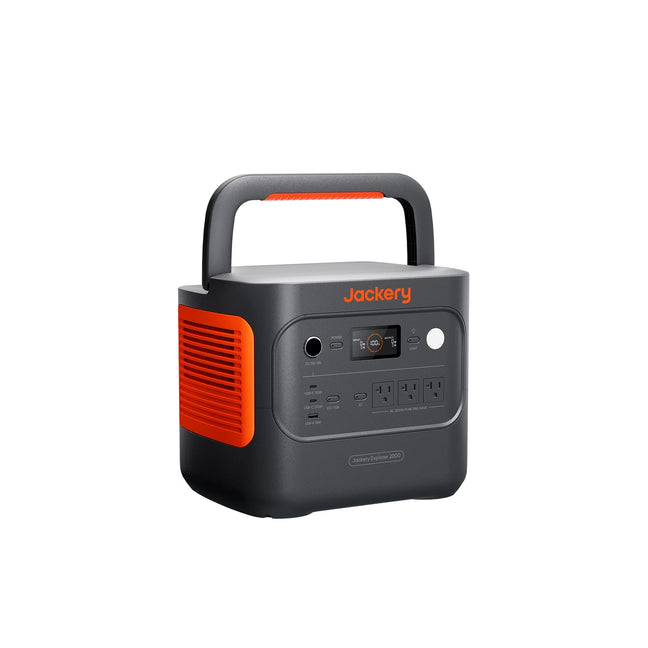
The Explorer 2000 v2 is a different model from the older Explorer 2000 Pro. Jackery specifies 2,042Wh capacity, LFP chemistry, 2,200W rated AC output and a 4,400W peak, with a listed weight around 39.5lb. It has three AC receptacles plus 100W and 30W USB-C outputs. Jackery lists a roughly 1.7-hour full AC recharge under its conditions. No solar panel is included with the bare station pictured here; the available solar bundles and connector requirements need separate checking.
Pros
- 2,042Wh gives substantially longer energy reserve than an unexpanded 1,024Wh DELTA 3 for moderate loads.
- At about 39.5lb, this is a comparatively portable 2kWh-class choice with high-power USB-C charging.
Cons and trade-offs
- Three AC outlets are fewer than on the DELTA 3 and the Anker C2000 Gen 2, so a multi-device setup may need a properly rated power strip.
- Its 2,200W continuous AC limit sits below the Anker’s 2,400W rating; an appliance near that threshold needs closer startup and simultaneous-load review.
Best for: A roughly 2kWh reserve that still needs to be lifted and moved regularly.
Choose another if: you need the Anker’s TT-30 outlet or expansion path, or the smaller EcoFlow’s lower carry weight.
Our recommendation
Choose Explorer 2000 v2 for an LFP 2kWh-class station with a manageable listed weight. Check the exact v2 name: the older 2000 Pro has different battery chemistry and specifications.
Anker SOLIX C2000 Gen 2: Expandable higher-output backup

Anker lists 2,048Wh LFP capacity, 2,400W continuous AC output and 4,000W peak output for the C2000 Gen 2. It weighs about 41.7lb and provides five standard AC sockets plus an RV-style TT-30 outlet. Anker lists an 800W maximum solar input and a compatible BP2000 Gen 2 battery to take the system to about 4kWh. The TT-30 is an outlet format, not proof that every RV or appliance will run from this station; check total watts, startup surge and the plug’s electrical requirements. The image depicts the base station only.
Pros
- The 2,400W rated inverter and TT-30 outlet cover a wider set of documented AC connection needs than the other base stations here.
- BP2000 Gen 2 expansion and up to 800W listed solar input give a concrete route to longer off-grid runtime.
Cons and trade-offs
- At roughly 41.7lb, it is less comfortable to lift and carry than the EcoFlow DELTA 3.
- Expansion batteries and solar panels are separate purchases, and compatibility is specific to the Gen 2 accessory family.
Best for: A stationary outage or RV setup needing higher continuous AC output and a documented expansion path.
Choose another if: low carry weight matters most, or a 1kWh reserve covers your actual loads.
Our recommendation
Choose C2000 Gen 2 when 2,400W rated output, TT-30 and optional expansion are useful. Buy the exact Gen 2 configuration; an old SOLIX F2000 page now points to this newer product.
Buying guide
- Calculate your energy target. Multiply each appliance’s measured running watts by hours needed, then add the loads. Allow for AC inverter losses and reserve; do not equate the printed Wh figure with AC energy delivered at the outlet. A plug-in watt meter is more useful than guessing a refrigerator’s cycle or a projector’s brightness setting.
- Check continuous output and startup surge separately. Sum simultaneous running loads against the rated AC watts; motors and compressors may demand higher startup power. A surge or vendor boost figure does not raise the continuous rating for all devices.
- Confirm the exact base unit and kit. DELTA 3 standalone is 1,024Wh, not an expanded 5kWh system. The pictured Jackery and Anker units do not include a solar panel or expansion battery. Verify the accessory, cable and generation before paying for a bundle.
- Plan recharge from a real source. Solar wattage is a maximum under ideal panel and weather conditions; verify input voltage, connector polarity and charging limits in the manual. AC fast-charge figures assume the correct outlet and conditions.
- Treat backup switching as equipment-specific. A claimed under-10ms UPS transfer may still interrupt sensitive gear. For critical medical or safety equipment, follow that equipment maker’s backup requirements and use a purpose-built, validated solution.
- Count the devices you actually need. A portable monitor and a portable projector have very different power draw; measure their real setups before choosing battery size.
FAQ
Is a 2kWh station the same as a 2kW inverter?
No. kWh/Wh measure stored energy; kW/W measure power at one moment. You must satisfy both the runtime budget and the simultaneous rated-output limit.
Does the Jackery Explorer 2000 Pro use LFP?
No. Jackery’s Explorer 2000 Pro FAQ specifies lithium-ion NCM. The newer Explorer 2000 v2 selected here is a separate LFP model; check the exact suffix.
Can a sub-10ms UPS claim protect medical equipment?
Do not assume so. Transfer time and suitability depend on the load, wiring and equipment requirements. Follow the medical equipment maker’s validated backup guidance.
Does a 500W or 800W solar input mean that charge rate all day?
No. Those are maximum input limits. Sun, panel orientation, temperature, shading, wiring and voltage determine actual charging.
Sources and method
We checked the current exact manufacturer product pages and visually inspected each selected official product image. Specifications and charging examples are maker claims; we did not run independent capacity, inverter, noise or transfer-time tests. Read our research methodology.
- EcoFlow DELTA 3 manufacturer documentation
- Jackery Explorer 2000 v2 manufacturer documentation
- Anker SOLIX C2000 Gen 2 manufacturer documentation
As an Amazon Associate, The Gear Audit earns from qualifying purchases. We may earn an affiliate commission when you buy through our links, at no extra cost to you. See our affiliate disclosure.