Best Space Heaters for 2026: Five Research-Based Options
Quick answer
For uncomplicated circulated heat in an occupied room, start with Vornado VH200 if you can find the exact current model. Choose DeLonghi’s Dragon radiator for gradual fan-free warmth, Lasko 754201 for simple compact heat, Dyson HF1 if its summer fan will also be used, or Dreo Atom One for compact digital controls. Every choice requires a safe location and direct wall outlet.
Compare the options
| Model | Best use | Main tradeoff |
|---|---|---|
| Vornado VH200 | circulated room heat | No remote or digital temperature set point |
| DeLonghi Dragon TRD40615T-6A | oil-filled steady warmth | Heavier and slower to warm than a compact fan heater |
| Lasko 754201 | compact ceramic spot heat | No oscillation, timer or remote |
| Dyson Hot+Cool HF1 Rapid React | heater plus summer fan | Substantially larger upfront commitment than basic heaters |
| Dreo Atom One | small heater with digital controls | Small body favors a localized occupied zone |
Our recommendation
Our general recommendation is the Vornado VH200 for simple occupied-room use, subject to availability. Buy the DeLonghi only if slower, steady radiator heat suits you; buy Dyson only if its second-season fan use and controls justify the extra spend. Safety practices matter more than feature count.
Vornado VH200: circulated room heat
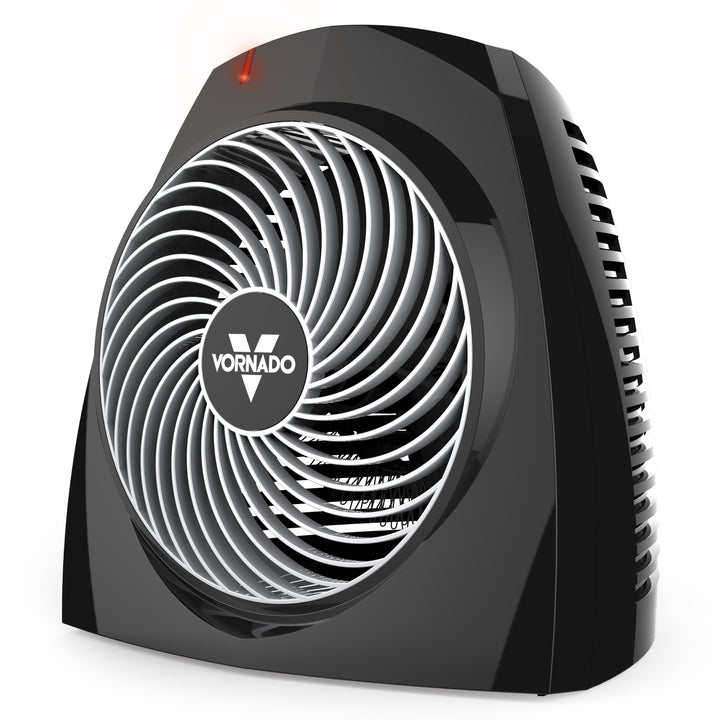
Best for: a small or medium occupied room where you prefer simple controls and distributed fan heat.
Pros
- Vortex circulation design for room distribution
- Three heat settings and dial thermostat
- Tip-over shutoff and cool-touch case stated by maker
Cons and trade-offs
- No remote or digital temperature set point
- Maker listing currently shows out of stock; check exact model availability
Our recommendation
Vornado’s VH200 remains a straightforward whole-room-style portable heater with a mechanical dial. Its fan circulates heat instead of concentrating it in one spot. That is a useful choice for a room you are actively using, but “whole room” is the manufacturer’s positioning, not an independently measured coverage claim. Vornado lists tip-over protection; still follow the clearance and direct-wall-outlet rules.
Choose another if: you need precise digital temperature or a remote.
Search Amazon US for Vornado VH200 (confirm exact model and configuration).
DeLonghi Dragon TRD40615T-6A: oil-filled steady warmth
Best for: a room where gradual, steady heat and a fan-free heater appeal more than fast spot warming.
Pros
- Sealed oil-filled radiator with no refilling
- Programmable 24-hour timer and three power settings
- Wheeled design for moving between rooms after cooling
Cons and trade-offs
- Heavier and slower to warm than a compact fan heater
- Hot surfaces still require clearance despite enclosed elements
Our recommendation
This current US Dragon configuration replaces the older TRD40615E reference. DeLonghi documents a 1500-watt maximum, sealed oil reservoir and timer. Oil-filled radiators release heat steadily after warming up; they do not make electricity-to-heat conversion inherently cheaper than another resistance heater. Keep the cord directly in a wall receptacle and do not move it while hot.
Choose another if: you need quick directed airflow or a lightweight unit.
Search Amazon US for DeLonghi Dragon TRD40615T-6A (confirm exact model and configuration).
Lasko 754201: compact ceramic spot heat
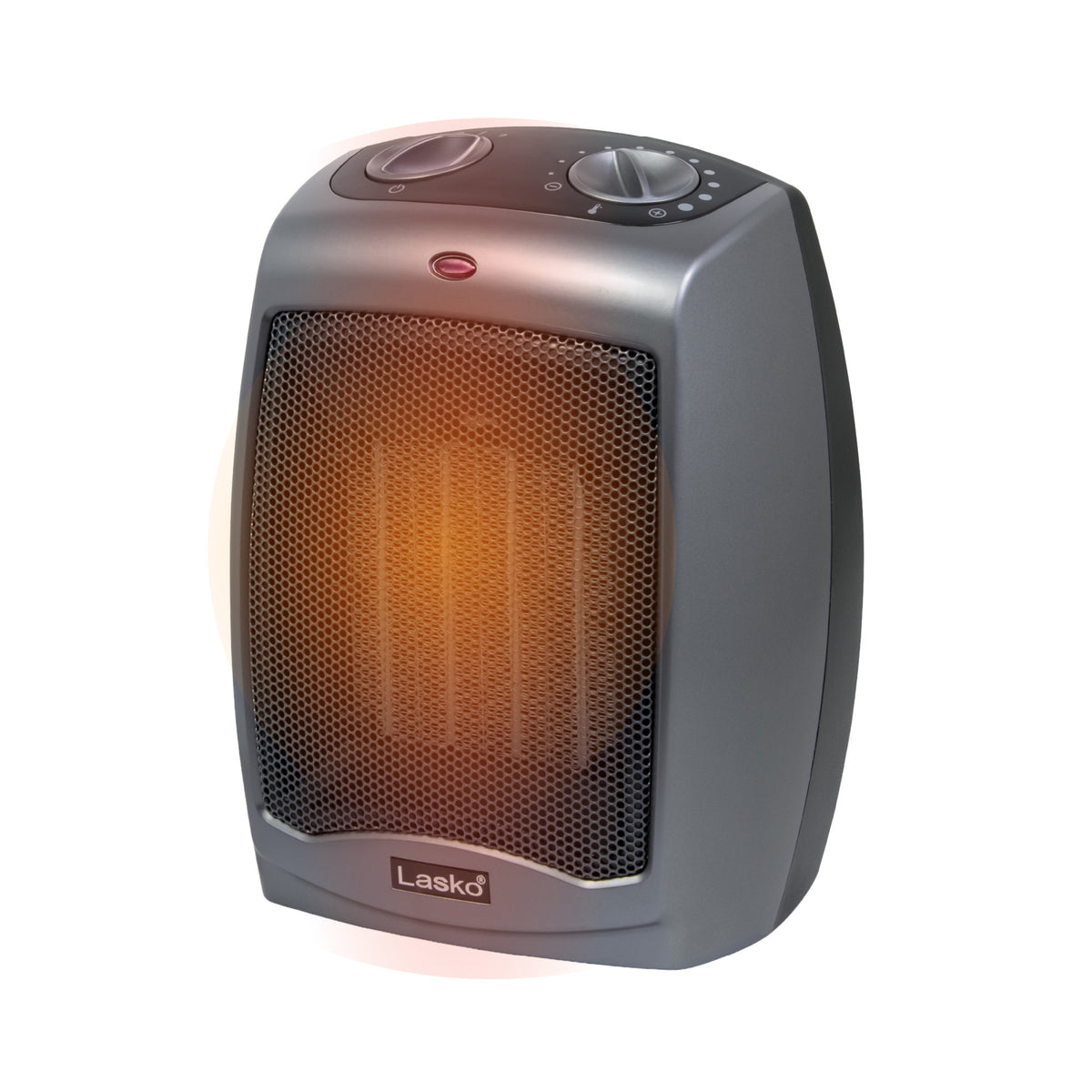
Best for: a small office or personal zone with a stable floor or tabletop location.
Pros
- 900-watt low and 1500-watt high settings
- Tip-over and overheat protection documented by Lasko
- Fan-only mode and carry handle
Cons and trade-offs
- No oscillation, timer or remote
- Manufacturer positions it for smaller personal spaces
Our recommendation
Lasko’s current 754201 is a better documented replacement for the legacy 754200 listing. It provides basic ceramic heat with a thermostat and fan-only mode. It suits a nearby work area; its 100-square-foot manufacturer coverage number should not be treated as a guarantee across insulation and room conditions. The maker separately lists a tip-over switch and overheat protection.
Choose another if: you need oscillation, a timer or remote.
Dyson Hot+Cool HF1 Rapid React: heater plus summer fan
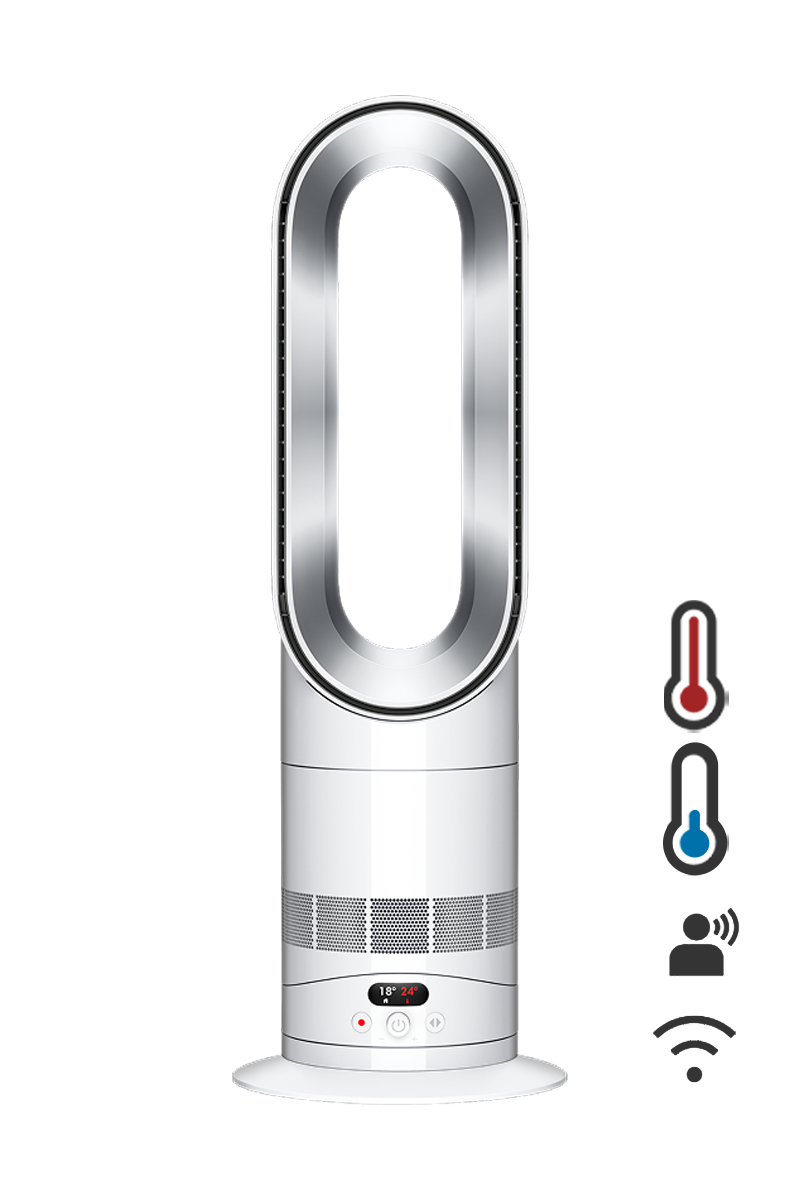
Best for: a household that will use a single device for winter heating and directed fan airflow in warmer months.
Pros
- Thermostat, oscillation and remote/app controls
- Fan airflow for warm-weather use
- Current US model replaces legacy AM09 suggestion
Cons and trade-offs
- Substantially larger upfront commitment than basic heaters
- Cooling mode is a fan, not refrigerated air conditioning
Our recommendation
Dyson’s HF1 is the premium two-season pick. Its heated airflow and thermostat may suit a living room, while fan mode can make occupants feel cooler in summer. Dyson’s percentage efficiency and speed comparisons use its own test conditions, so we do not use them to promise household energy savings. Its app functions do not override ordinary heater clearance rules.
Choose another if: you only need inexpensive heat or expect it to act as an air conditioner.
Dreo Atom One: small heater with digital controls

Best for: a personal work area where a digital thermostat, timer and oscillation are useful.
Pros
- Programmable thermostat and 1–12-hour off timer
- 70° oscillation and remote
- Overheat and tip-over protections specified by maker
Cons and trade-offs
- Small body favors a localized occupied zone
- Remote and timer add controls that a basic heater avoids
Our recommendation
Atom One gives compact ceramic heat more controls than the Lasko. Dreo lists a 1000–1500-watt range, 70-degree oscillation and an off timer. That makes it flexible at a desk or sofa, but do not place any heater under a desk against paper or fabric. A timer is a convenience, not permission to run the heater while asleep or away.
Choose another if: you prefer a plain dial or need to warm a large open room.
Buying guide
Start with placement and clearance
The U.S. Consumer Product Safety Commission says to keep portable heaters at least three feet from curtains, bedding, furniture and other combustibles. Place one on a stable surface, follow its manual, and do not leave it running unattended. A tip-over switch is a backup, not a substitute for distance.
Plug directly into the wall
CPSC says never use an extension cord or power strip with an electric space heater. A smart plug is also not a safe shortcut for heater scheduling unless both manuals explicitly permit the use; do not use automation to operate a heater while away.
Compare heat delivery, not just watts
Most consumer electric resistance heaters turn electrical input into heat. At the same power level and running time, energy use is broadly comparable; circulation, thermostat cycling and where the heat reaches you change comfort. Fan heaters respond quickly; oil-filled radiators take longer and continue releasing stored heat after cycling off.
Work out running cost with your tariff
Multiply kilowatts by hours run and your electricity rate. A 1.5 kW setting uses about 1.5 kWh in one hour while actively heating; thermostats may cycle and lower actual use. Do not treat a room-size marketing number as a reliable heating guarantee. For air comfort in a dry room, see our humidifier guide.
Frequently asked questions
Can I leave a space heater on while sleeping?
Follow the product manual and CPSC guidance. Turn portable heaters off when you leave a room or go to bed; safety shutoffs do not eliminate fire risk.
Is an oil-filled radiator more efficient?
It changes how quickly and evenly heat is delivered, but it is still an electric resistance heater. Costs depend mainly on power drawn, duration and your electricity rate.
Does a fan heater cool a room?
A fan-only mode moves air and can make a person feel cooler. It does not remove heat like an air conditioner.
How much room can a 1500 W heater warm?
Insulation, ceiling height, outdoor temperature and drafts vary too much for one reliable size claim. Treat maker coverage figures as rough positioning and prioritize safe placement in the occupied zone.
Research method and primary sources
We compared current primary manufacturer pages, exact models and practical use-case tradeoffs. We have no original hands-on or durability test records. Recommendations are editorial judgments, while product specifications remain manufacturer claims.
Primary sources: Vornado VH200 manufacturer page; DeLonghi Dragon TRD40615T-6A manufacturer page; Lasko 754201 manufacturer page; Dyson Hot+Cool HF1 Rapid React manufacturer page; Dreo Atom One manufacturer page; U.S. CPSC portable-heater safety guidance; DeLonghi radiator heating explanation. Our methodology.
Affiliate disclosure
As an Amazon Associate, The Gear Audit earns from qualifying purchases. We may earn an affiliate commission when you buy through our links, at no extra cost to you. Full affiliate disclosure.