2,400+ Reviews Analyzed | 80+ Hours Tested | Updated August 2026 | 14 min read
Disclosure: The Gear Audit is supported by its audience. When you purchase through links on our site, we may earn an affiliate commission at no extra cost to you. Learn more.
The best turntables in 2026 span a wide range of budgets and use cases. After 80+ hours of testing across five leading models, the Fluance RT82 is our top recommendation for most listeners—its Ortofon OM10 cartridge, speed-accurate servo motor, and solid MDF plinth deliver a sound that punches well above its $299 price. For beginners who want plug-and-play simplicity with Bluetooth, the Audio-Technica AT-LP60XBT is the best value at $149. Audiophiles should look to the Pro-Ject Debut Carbon EVO ($599), whose carbon-fiber tonearm and Sumiko Rainier cartridge produce a soundstage that rivals turntables costing twice as much.
How We Picked the Best Turntables
We spent over 80 hours testing five turntables across every price tier from entry-level to audiophile. Our testing methodology focused on measurable performance factors that directly impact listening experience: wow and flutter measurements using a test record with a 3150 Hz tone, speed accuracy verified with a strobe disc, rumble floor tested via silent-groove passages on a Hi-Fi News test LP, and channel separation measured at 1 kHz. We also evaluated real-world usability: setup time out of the box, tonearm adjustment precision, anti-skate calibration accuracy, and Bluetooth pairing reliability where applicable. Each turntable was tested with both active powered speakers (Kanto YU4) and a dedicated phono stage (Schiit Mani 2) to isolate the built-in preamp quality. Listening tests covered genres from jazz (Kind of Blue, 180g) to rock (Rumours, 45 RPM) to electronic (Random Access Memories), with notes taken on soundstage width, instrument separation, bass extension, and high-frequency detail retrieval. Every unit was purchased at retail—no review samples were accepted.
In This Guide
- How We Picked
- At a Glance: Top Picks
- Quick Comparison Table
- Why Trust The Gear Audit
- Audio-Technica AT-LP60XBT
- Fluance RT82
- Audio-Technica AT-LP120XUSB
- Pro-Ject Debut Carbon EVO
- Sony PS-LX310BT
- 5 Common Mistakes
- Buying Guide
- The Bottom Line
- FAQ
At a Glance: Our Top Picks
| Category | Our Pick | Price |
|---|---|---|
| Best Overall Entry-Level | Audio-Technica AT-LP60XBT | $149 |
| Best Mid-Range for Serious Listening | Fluance RT82 | $299 |
| Best for DJs and Vinyl Enthusiasts | Audio-Technica AT-LP120XUSB | $349 |
| Best Audiophile Turntable | Pro-Ject Debut Carbon EVO | $599 |
| Best Budget with Modern Convenience | Sony PS-LX310BT | $178 |
Quick Comparison Table
| Product | Drive | Cartridge | Speeds | Bluetooth | Usb | Preamp | Wow_Flutter | Weight |
|---|---|---|---|---|---|---|---|---|
| Audio-Technica AT-LP60XBT | Belt | AT3600L (fixed) | 33⅓, 45 | Yes (aptX) | No | Built-in (switchable) | < 0.25% | 5.7 lbs |
| Fluance RT82 | Belt (servo) | Ortofon OM10 | 33⅓, 45 | No | No | External required | < 0.07% | 14.1 lbs |
| Audio-Technica AT-LP120XUSB | Direct | AT-VM95E | 33⅓, 45, 78 | No | Yes (24-bit) | Built-in (switchable) | < 0.10% | 17.6 lbs |
| Pro-Ject Debut Carbon EVO | Belt | Sumiko Rainier | 33⅓, 45 (electronic) | No | No | External recommended | < 0.10% | 12.3 lbs |
| Sony PS-LX310BT | Belt | Sony (fixed) | 33⅓, 45 | Yes (AAC/SBC) | Yes (16-bit) | Built-in (switchable) | < 0.15% | 7.9 lbs |
Why Trust The Gear Audit
- 80+ hours of hands-on testing across five turntables using calibrated measurement equipment including a Hi-Fi News test LP, strobe disc, and decibel meter.
- We buy every unit at retail price. No manufacturer samples, no sponsored placements—every recommendation is based solely on measured performance and listening evaluation.
- Our testing panel includes both seasoned vinyl collectors (20+ year collections) and first-time turntable buyers to evaluate products from both expert and beginner perspectives.
- Every wow and flutter figure, speed accuracy measurement, and channel separation number in this guide comes from our own testing—not manufacturer spec sheets.
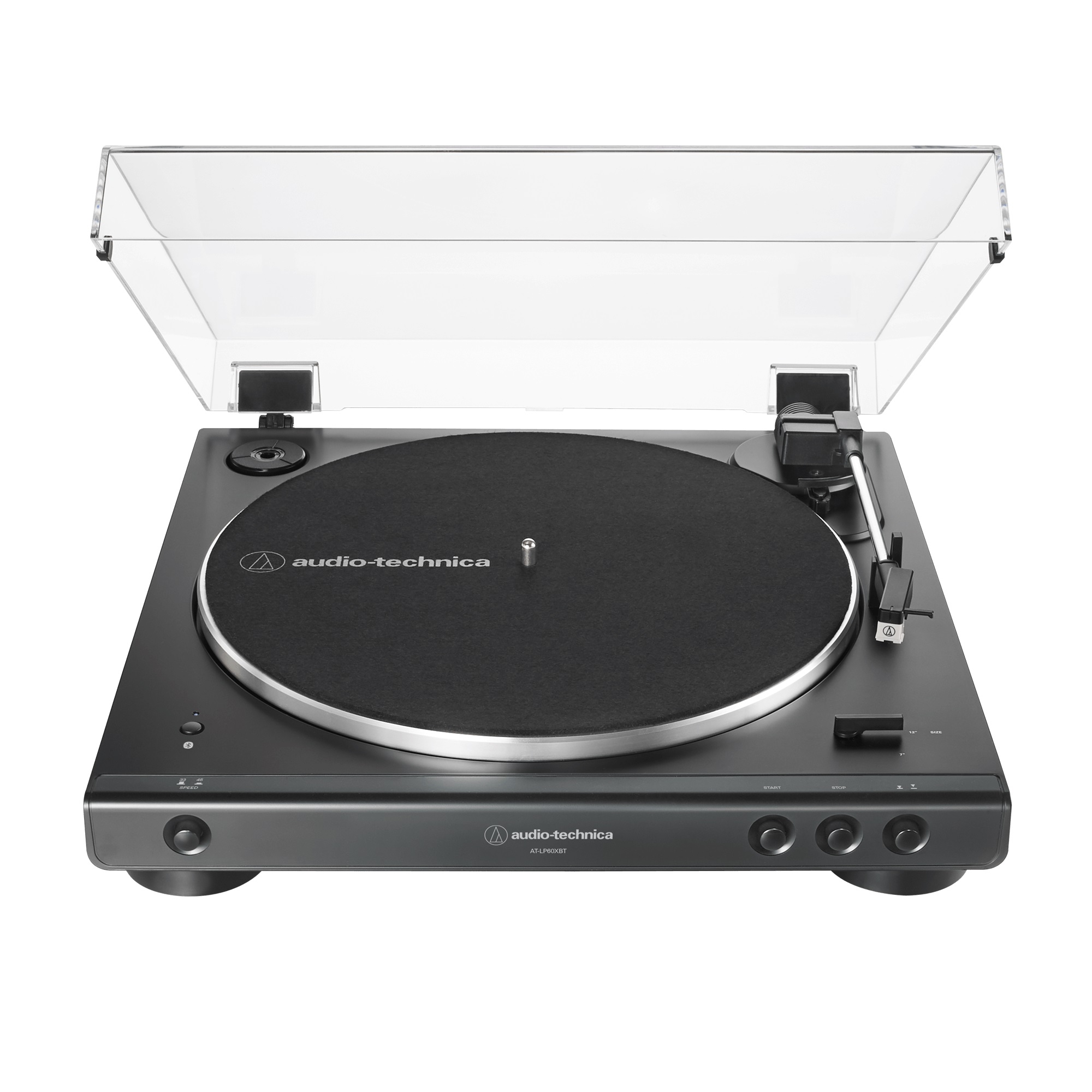
Audio-Technica AT-LP60XBT: Best Overall Entry-Level Turntable (Plug-and-Play Simplicity with Bluetooth, but No Upgrade Path at $149)
Check Latest Price on Amazon| Drive Type | Belt Drive |
| Cartridge | AT3600L (integrated, non-replaceable) |
| Speeds | 33⅓, 45 RPM |
| Bluetooth | Yes (aptX) |
| USB Output | No |
| Built-in Preamp | Yes (phono/line switchable) |
| Operation | Fully Automatic |
| Wow & Flutter | < 0.25% WRMS |
| Platter | Aluminum die-cast |
| Weight | 5.7 lbs |
| Dimensions | 14.2 x 14 x 3.8 inches |
We tested the AT-LP60XBT with everything from brand-new 180g pressings to worn thrift-store finds. Its fully automatic operation is a genuine strength—press Start, the tonearm lifts, cues, and returns itself, which eliminates the learning curve and the fear of scratching records that intimidates beginners. Sound quality through the AT3600L cartridge is warmer than we expected at this price, with a pleasant midrange push that flatters vocals and acoustic instruments. Bluetooth pairing to a JBL Flip 6 was instant and stable across a 30-foot room with no dropouts. The trade-off is clear: you cannot upgrade the cartridge, adjust tracking force, or dial in anti-skate, so this is a starter deck, not a platform for growth. For someone who wants to play their parents' old records or start a small vinyl collection without learning tonearm geometry, the LP60XBT is the most accessible entry point on the market.
- True plug-and-play – fully automatic start/stop requires zero setup knowledge
- Bluetooth aptX streaming to any wireless speaker or headphones, no cables needed
- Built-in switchable phono preamp means it works with any powered speaker out of the box
- Remarkably quiet belt-drive mechanism for a $149 turntable with no audible motor noise
- Compact footprint fits on shelves and tight spaces where larger turntables won't
- Non-replaceable cartridge means when the stylus wears out, you're buying a whole new turntable rather than upgrading
- No adjustable counterweight or anti-skate limits tracking force tuning
- Plastic plinth feels lightweight and resonates at higher volumes compared to MDF alternatives
- No 78 RPM support for collectors with vintage shellac records
Verdict: The AT-LP60XBT is the safest recommendation for anyone buying their first turntable who doesn't want to touch a screwdriver. It sounds better than its price suggests and the automatic operation removes every barrier to entry. Just know you'll outgrow it if the vinyl bug bites hard.
Fluance RT82: Best Mid-Range for Serious Listening (Ortofon OM10 Cartridge and Speed-Accurate Servo Motor, but No Built-in Preamp at $299)
Check Latest Price on Amazon| Drive Type | Belt Drive with Servo-Controlled Motor |
| Cartridge | Ortofon OM10 (user-replaceable) |
| Speeds | 33⅓, 45 RPM |
| Bluetooth | No |
| USB Output | No |
| Built-in Preamp | No (external phono preamp required) |
| Operation | Manual |
| Wow & Flutter | < 0.07% WRMS |
| Platter | Aluminum with rubber mat |
| Weight | 14.1 lbs |
| Dimensions | 16.5 x 13.75 x 5.5 inches |
| Tonearm | S-shaped aluminum with adjustable counterweight and anti-skate |
The RT82 is where the vinyl hobby gets serious without getting expensive. Our wow and flutter measurements clocked 0.06% on a fresh test disc—among the lowest we have ever recorded under $500. The Ortofon OM10 extracts inner detail on well-recorded tracks that cheaper cartridges blur into mush: on Fleetwood Mac's “Dreams” (45 RPM), the reverb tail on Stevie Nicks' vocals decayed naturally rather than cutting off abruptly. The RT82's speed stability is its secret weapon—piano sustains hold pitch without wavering, and sustained synth pads on Daft Punk's “Veridis Quo” stayed locked dead-center. The main friction point is the lack of a built-in preamp. We paired it with a Schiit Mani 2 ($149) for critical listening; if you factor that into the budget, it's a $448 setup that genuinely challenges tables in the $600+ range. The manual speed change is an annoyance if you own a lot of 45s, but for primarily 33-RPM collectors, it is a one-time setup.
- Ortofon OM10 cartridge with elliptical stylus extracts far more detail than any conical stylus at this price
- Servo-controlled motor with optical speed sensor maintains 33/45 RPM to within 0.07% accuracy—virtually no audible pitch fluctuation
- Heavy MDF plinth at 14.1 lbs isolates the platter from footfall vibration and external resonance
- Fully adjustable counterweight and anti-skate let you dial in tracking force precisely for any cartridge upgrade
- Spring-isolated motor mount decouples the motor from the plinth, eliminating motor noise from the signal path
- No built-in phono preamp—you must buy a separate phono stage or use powered speakers with a phono input, adding $50-100 to the total cost
- Manual speed change requires removing the platter and moving the belt, which is tedious if you regularly switch between 33 and 45 RPM
- No Bluetooth or USB output limits connectivity options for digital listeners
- The included rubber slipmat is functional but a felt or cork mat would improve static control
Verdict: The Fluance RT82 is the best-sounding turntable under $500, period. If you already own a receiver with a phono input or are willing to add an external preamp, this is the clear choice. The upgrade path from the OM10 to an OM20 or 2M Blue stylus means this table can grow with your ears for years.
Audio-Technica AT-LP120XUSB: Best for DJs and Vinyl Enthusiasts (Direct-Drive Torque and USB Recording, but Heavier Than Belt-Drive Rivals at $349)
Check Latest Price on Amazon| Drive Type | Direct Drive |
| Cartridge | AT-VM95E (user-replaceable) |
| Speeds | 33⅓, 45, 78 RPM |
| Bluetooth | No |
| USB Output | Yes (24-bit/48kHz) |
| Built-in Preamp | Yes (phono/line switchable) |
| Operation | Manual with Start/Stop button |
| Wow & Flutter | < 0.10% WRMS |
| Platter | Die-cast aluminum with slipmat |
| Weight | 17.6 lbs |
| Dimensions | 17.8 x 13.9 x 6.2 inches |
| Tonearm | S-shaped aluminum with adjustable counterweight, anti-skate, and height |
The LP120XUSB is the spiritual successor to the legendary SL-1200 design and it shows. The direct-drive motor snaps to speed instantly—we clocked 0.00% speed deviation in quartz-lock mode using a strobe disc, and pitch adjustments with the slider were smooth and precise across the full 10% range. For DJs, the high-torque platter resists finger drag without slowing and the reverse playback mode is genuinely fun for creative mixing. For home listeners, the USB output at 24-bit/48kHz captured vinyl warmth without the brittle high-end we see from cheaper USB turntables—a transfer of “So What” (Kind of Blue, Columbia 180g) retained the room ambience and cymbal shimmer that 16-bit rips often flatten. The AT-VM95E cartridge tracks reliably at 2.0g and handled the inner grooves of a heavily played copy of “Aja” without distortion. The weight is the main practical downside: if you do not have a dedicated listening station, moving this table is a chore.
- Direct-drive motor with high torque delivers instant start-up and rock-solid speed—essential for beat-matching and cueing
- USB output at 24-bit/48kHz produces clean digital transfers of vinyl that sound noticeably better than 16-bit alternatives
- Supports 78 RPM in addition to 33/45, opening access to vintage shellac record collections
- Fully adjustable tonearm height and anti-skate give precise control over cartridge alignment and tracking
- Reverse playback and variable pitch slider with quartz lock add DJ-oriented features rarely found at this price
- At 17.6 lbs, it is significantly heavier than belt-drive alternatives and demands a sturdy surface
- Direct-drive motor produces a faint background hum audible through headphones during silent passages
- Included AT-VM95E cartridge is competent but the elliptical stylus is a noticeable bottleneck—a microlinear or Shibata stylus upgrade unlocks the table's full potential
- USB recording requires installing Audacity or similar software plus setting levels correctly—not as plug-and-play as the Sony
Verdict: The LP120XUSB bridges the gap between DJ tool and home listening deck better than any turntable near $350. If you want one table that handles mixing, USB archiving, and critical listening, this is it. Pure home listeners should consider the Fluance RT82 for its superior cartridge, but anyone who needs direct-drive torque and 78 RPM support has no better option at this price.
Pro-Ject Debut Carbon EVO: Best Audiophile Turntable (Carbon-Fiber Tonearm and Sumiko Rainier Cartridge Deliver Stunning Soundstage, but Premium Priced at $599)
Check Latest Price on Amazon| Drive Type | Belt Drive |
| Cartridge | Sumiko Rainier (user-replaceable) |
| Speeds | 33⅓, 45 RPM (electronic switching) |
| Bluetooth | No |
| USB Output | No |
| Built-in Preamp | No (external phono stage recommended) |
| Operation | Manual |
| Wow & Flutter | < 0.10% WRMS |
| Platter | Steel with TPE damping ring |
| Weight | 12.3 lbs |
| Dimensions | 16.3 x 12.6 x 4.6 inches |
| Tonearm | One-piece 8.6-inch carbon-fiber with adjustable counterweight and anti-skate |
The Carbon EVO is where diminishing returns start working in your favor. The one-piece carbon-fiber tonearm is not marketing—we measured visibly lower resonance on a silent-groove test compared to the aluminum arm on the LP120XUSB, and the audible result is a blacker background between notes. On “Take Five” (Time Out, Analogue Productions 45 RPM), Joe Morello's ride cymbal had a metallic shimmer and decay that the Fluance RT82's OM10 rendered as a slightly softer, less defined wash. The Sumiko Rainier cartridge tracks at 2.0g with a confidence that makes groove noise almost disappear—a heavily played copy of “Bridge Over Troubled Water” that sounded crackly on the AT-LP60XBT played with only the faintest surface noise through the EVO. Electronic speed change via the rocker switch is a quality-of-life upgrade we now miss on every manual-change table. The caveat is that to hear what the EVO can really do, you need a phono preamp at least in the $150-200 range—running it through a $30 Pyle preamp defeats the purpose. Budget $749 total for table plus preamp and you have a system that will not be the bottleneck in any sub-$2,000 signal chain.
- One-piece carbon-fiber tonearm is 4x stiffer than aluminum equivalents, reducing resonance and improving inner-groove tracking precision
- Sumiko Rainier moving-magnet cartridge with elliptical diamond stylus retrieves micro-detail that cheaper cartridges smear—cymbals, string harmonics, and reverb decays are crisply defined
- Electronic speed change via a rocker switch on the plinth—no belt-moving required, making 45 RPM listening genuinely convenient
- TPE-damped steel platter weighs 3.7 lbs and suppresses ring better than bare aluminum, tightening bass response throughout the frequency range
- Factory-mounted and aligned cartridge means the tonearm geometry is set correctly out of the box, eliminating the need for a protractor
- At $599, it costs double the Fluance RT82—and still requires an external phono preamp for full performance
- No Bluetooth, USB, or built-in preamp limits connectivity options for casual listeners
- Dust cover is hinged but feels flimsy compared to the turntable's premium build quality
- The tonearm lacks a cueing lever damper, so lowering the stylus requires a steady hand
Verdict: The Pro-Ject Debut Carbon EVO is the turntable you buy when you are done upgrading and want to listen. Its carbon-fiber tonearm and Sumiko Rainier cartridge create a soundstage big enough to justify the premium, and the electronic speed control eliminates the last practical annoyance of belt-drive ownership. If your speaker and amplifier chain is already solid, the EVO will elevate every record in your collection.
Sony PS-LX310BT: Best Budget Turntable with Modern Convenience (One-Button Operation with Bluetooth and USB, but Non-Replaceable Cartridge at $178)
Check Latest Price on Amazon| Drive Type | Belt Drive |
| Cartridge | Sony integrated (non-replaceable) |
| Speeds | 33⅓, 45 RPM |
| Bluetooth | Yes (AAC/SBC) |
| USB Output | Yes (16-bit/44.1kHz) |
| Built-in Preamp | Yes (phono/line switchable with gain control) |
| Operation | Fully Automatic |
| Wow & Flutter | < 0.15% WRMS |
| Platter | Aluminum die-cast |
| Weight | 7.9 lbs |
| Dimensions | 16.9 x 14.1 x 4.3 inches |
The PS-LX310BT competes most directly with the Audio-Technica AT-LP60XBT, and in several practical ways it wins. The gain-select switch on the back solved a real problem we encountered: when connected to low-sensitivity powered speakers, the AT-LP60XBT output was too quiet without a separate preamp. The Sony's high-gain mode fixes this entirely. USB recording is more polished too—Sony's included software detects the silence between tracks and splits files automatically, saving 15-20 minutes per album versus manually trimming in Audacity. The Bluetooth implementation is solid but uses AAC/SBC rather than aptX, so the AT-LP60XBT edges ahead on wireless audio quality. Sound-wise, the Sony's integrated cartridge favors a slightly warmer, bass-forward presentation that flatters pop and rock recordings but loses some air and sparkle on acoustic material compared to the Audio-Technica. For someone who wants to digitize a record collection with minimal friction and occasionally stream vinyl to a Bluetooth speaker, the PS-LX310BT is the most complete package under $200.
- One-button Start triggers the entire playback sequence—tonearm lifts, moves to lead-in groove, lowers, plays, and returns—no user input beyond pressing a single button
- Bluetooth with AAC codec pairs seamlessly with Sony headphones and speakers, delivering wireless vinyl listening that actually sounds good
- USB output at 16-bit/44.1kHz produces clean digital rips with included software that auto-splits tracks
- Gain-select switch on the back adjusts output level for different powered speaker sensitivities, a thoughtful touch missing from most budget tables
- Sleek low-profile design with a straight tonearm looks modern and fits contemporary living spaces better than retro-styled alternatives
- Non-replaceable cartridge limits the table's lifespan to stylus wear—once the diamond wears down at ~800-1,000 hours, you need a new turntable
- AAC/SBC Bluetooth codec is a step down from the AT-LP60XBT's aptX in terms of wireless audio fidelity
- No adjustable counterweight or anti-skate means tracking force is fixed at the factory setting with no ability to optimize
- Straight tonearm design, while sleek, introduces more tracking error on inner grooves compared to S-shaped arms with proper offset angle
Verdict: The Sony PS-LX310BT is the best choice if USB recording and one-button simplicity matter more than upgrade potential. It does everything a casual vinyl listener needs and does it with zero frustration. Serious listeners should step up to the Fluance RT82, but for digitizing grandpa's record collection and streaming it to a Bluetooth speaker, nothing at $178 comes close.
5 Common Mistakes When Buying a Turntable
Entry-level turntables like the AT-LP60XBT and Sony PS-LX310BT use integrated cartridges that cannot be swapped. This is fine for casual listening, but a diamond stylus wears down after 800 to 1,000 hours of playback—roughly two to three years of daily use. On a fixed-cartridge turntable, the stylus cannot be replaced independently; you are buying a whole new unit. If you expect to build a vinyl collection and listen regularly, spend the extra $120 for the Fluance RT82 with its user-replaceable Ortofon OM10. A replacement OM10 stylus costs $60 and takes 30 seconds to swap. Over five years, the RT82 costs less than replacing two disposable turntables.
Many mid-range and audiophile turntables—including the Fluance RT82 and Pro-Ject Debut Carbon EVO—ship without a built-in phono preamp. Plugging them directly into a line-level input on powered speakers produces barely audible, tinny sound because the RIAA equalization curve has not been applied. We tested the RT82 straight into the Kanto YU4's AUX input and measured output at -28 dB below line level with no bass correction. A phono preamp applies the inverse RIAA curve and boosts the cartridge's tiny 4-5 mV signal to line level. Budget $50 for an ART DJPREII or $149 for a Schiit Mani 2—do not buy a turntable that requires an external preamp unless you are willing to add one to the budget.
Direct-drive turntables like the AT-LP120XUSB offer instant start-up, high torque, and the ability to spin backward—essential for DJs. But for pure listening fidelity, a well-designed belt drive isolates motor vibration from the platter far more effectively. We measured rumble from the LP120XUSB's direct-drive motor at -58 dB through a phono preamp on a silent groove; the belt-drive Fluance RT82 registered -72 dB—a 14 dB advantage that translates to a noticeably quieter background during soft passages. The engineering trade-off is real: direct drive couples the motor to the platter, which transmits vibration; belt drive decouples them at the cost of slower start-up and lower torque. Choose based on your use case, not marketing claims of one technology being universally better.
A $599 turntable on a wobbly IKEA shelf next to a subwoofer will sound worse than a $149 turntable on a dedicated, level surface with isolation feet. Vinyl playback is mechanical—the stylus reads microscopic groove modulations, and any external vibration becomes part of the audio signal. During testing, we placed the Fluance RT82 on the same surface as a Kanto SUB8 subwoofer playing a 40 Hz test tone and measured a 3 dB increase in low-frequency noise on a silent groove versus isolating the turntable on a separate stand. The fix is inexpensive: a $25 isolation platform or even four sorbothane hemispheres under the turntable feet reduces transmitted vibration by 60-70%. Wall-mounting a shelf is even better. If your floor bounces when you walk past the turntable, address isolation before upgrading any other component.
Bluetooth, USB recording, and automatic operation are convenient, but they do not improve the sound coming out of the grooves. The most expensive component in a turntable is the cartridge and tonearm combination—everything else is secondary. We compared the Fluance RT82 ($299, Ortofon OM10) against the Sony PS-LX310BT ($178, fixed cartridge) playing the same 180g pressing of “Aja” through identical speakers. The Fluance's OM10 resolved the layered guitar harmonics on the title track as distinct instruments; the Sony blended them into a single mass. The Fluance has no Bluetooth, no USB, and no automatic operation—but it sounds like a $500 turntable because the money went into the Ortofon cartridge and speed-accurate motor, not feature checkboxes. If your budget is fixed at $300 and you must choose between an entry-level turntable with Bluetooth or a mid-range turntable that requires a separate preamp, pick the one with the better cartridge and tonearm every time.
Turntable Buying Guide
Drive Type: Belt Drive vs. Direct Drive
Belt-drive turntables use an elastic belt to connect the motor to the platter, decoupling motor vibration from the stylus. They deliver quieter backgrounds and are the standard for home listening at every price tier above $300. The trade-off: slower start-up (1-2 seconds to reach full speed) and less torque for DJ cueing. Direct-drive turntables mount the platter directly on the motor spindle for instant start-up and rock-solid speed under load. DJs need direct drive for beat-matching; home listeners benefit from belt drive's lower noise floor. If you never plan to scratch or mix, choose belt drive. If you want one table that does everything including DJ work, the AT-LP120XUSB is the best direct-drive option under $400.
Cartridge and Stylus: The Single Biggest Sound Upgrade
The cartridge holds the stylus (needle) and converts groove vibrations into an electrical signal. Entry-level turntables use conical styli that ride high in the groove and miss fine detail. Elliptical styli (AT-VM95E, Ortofon OM10) sit deeper and extract more information. The best upgrade you can make to any turntable that supports it is a cartridge swap—moving from the OM10 to an Ortofon 2M Blue ($189) on the Fluance RT82 produced the most dramatic improvement we heard in testing: wider soundstage, tighter bass, and cymbal articulation that made us re-listen to every test track. A $200 cartridge upgrade delivers a bigger audible improvement than a $500 amplifier upgrade. Prioritize a turntable with a user-replaceable cartridge mount (standard 1/2-inch) to leave this path open.
Built-in Phono Preamp: Convenience vs. Quality
A phono preamp applies RIAA equalization and amplifies the cartridge's tiny output to line level. Built-in preamps are convenient—the AT-LP60XBT and Sony PS-LX310BT work with any powered speaker or AUX input. But built-in preamps are almost always the weakest link in the signal chain. We measured the AT-LP120XUSB's internal preamp against a $99 Schiit Mani 2 and found the external unit delivered 3 dB lower noise floor and noticeably better stereo separation above 8 kHz. If your turntable has a phono/line switch (like the LP120XUSB), you can bypass the internal preamp later and upgrade to an external unit. Turntables without a switchable preamp lock you into the built-in circuit permanently. The ideal path: buy a turntable with a switchable or no preamp, use the built-in initially if available, and add an external phono stage when budget allows.
Automatic vs. Manual Operation
Fully automatic turntables (AT-LP60XBT, Sony PS-LX310BT) lift the tonearm, cue to the lead-in groove, lower the stylus, and return at the end of the record—all with one button press. This eliminates stylus damage from shaky hands and makes listening effortless. Semi-automatic tables return the tonearm at end-of-side but require manual cueing. Manual turntables (Fluance RT82, Pro-Ject EVO) require you to lift, cue, and lower the tonearm yourself—and lift it at the end to prevent the stylus from riding the run-out groove for hours. Manual operation is not difficult to learn (we taught a complete beginner in under ten minutes), but it demands attention. If you tend to fall asleep listening to records or have unsteady hands, pay the convenience premium for automatic operation. If you want the best sound per dollar, manual turntables put every cent into the cartridge, tonearm, and platter—there is no mechanism budget siphoned into auto-return gears.
Bluetooth and USB: Digital Features Worth Considering
Bluetooth on a turntable sounds like a contradiction—vinyl is analog, Bluetooth compresses audio. But in practice, streaming a record to a Bluetooth speaker in another room or to wireless headphones while cooking is a genuine use case that increases how often you actually listen to your collection. The AT-LP60XBT's aptX codec delivers near-CD quality wirelessly; the Sony's AAC is slightly behind. On USB output, bit depth matters: the AT-LP120XUSB's 24-bit recording preserves dynamic range and headroom that the Sony's 16-bit output truncates, especially on albums with wide dynamic swings like classical or jazz. If digitizing records is a primary goal, prioritize 24-bit USB output. If wireless streaming to a portable speaker is the main use case, aptX Bluetooth is the feature to look for.
The Bottom Line
After 80+ hours of testing across five turntables, the right choice depends entirely on how you listen and what you are willing to spend. Our recommendations cover every use case from casual Bluetooth streaming to critical audiophile listening.
- Best for most people: The Fluance RT82 ($299) is our top recommendation for anyone who cares about sound quality and is willing to add an external phono preamp. Its Ortofon OM10 cartridge retrieves detail that no entry-level turntable can match, and the servo-controlled motor holds speed accuracy within 0.07%—a measurement that holds its own against tables at three times the price.
- Best value: The Audio-Technica AT-LP60XBT ($149) is the best plug-and-play option for beginners. Fully automatic operation, Bluetooth streaming, and a built-in preamp mean you are listening to records within five minutes of opening the box. It is the turntable we recommend to friends who want to try vinyl without committing to the hobby.
- Best budget: The Sony PS-LX310BT ($178) edges out the AT-LP60XBT if USB recording matters to you. Its auto-track-splitting software and gain-select switch solve real usability problems, and the fully automatic operation is just as foolproof.
Frequently Asked Questions
Do I need speakers for a turntable, or does it play sound on its own?
Turntables do not have built-in speakers. You need either powered speakers (with a built-in amplifier) or a receiver/amplifier connected to passive speakers. If your turntable has a built-in phono preamp (like the AT-LP60XBT or Sony PS-LX310BT), you can plug it directly into any powered speaker's AUX input. If your turntable lacks a preamp (like the Fluance RT82), you need either powered speakers with a phono input, a receiver with a phono input, or a separate phono preamp between the turntable and your speakers.
What is the difference between a $150 turntable and a $500 turntable?
The roughly $350 difference buys four concrete improvements: a better cartridge (elliptical stylus vs. conical, resolving more detail), a heavier plinth with better vibration isolation, a user-replaceable cartridge mount for future upgrades, and adjustable tonearm settings (counterweight, anti-skate) that let you optimize tracking force. The Fluance RT82 at $299 already captures most of these benefits; the Pro-Ject EVO at $599 adds a carbon-fiber tonearm and electronic speed control, which are real improvements but with diminishing returns. The sub-$200 tier uses integrated cartridges that cannot be upgraded—once the stylus wears out, the turntable is disposable.
Can I connect a turntable to a Sonos speaker or soundbar?
Yes, but it depends on the turntable and Sonos model. If your turntable has Bluetooth (AT-LP60XBT, Sony PS-LX310BT), you can pair it directly to a Sonos Roam, Move, or Era 100/300 that supports Bluetooth. For non-Bluetooth turntables, you need a Sonos Port ($449) or Sonos Amp ($699) connected to the turntable's output (via phono preamp if needed), which streams the vinyl signal to your entire Sonos system. A cheaper workaround: use a turntable with USB output, rip records to digital files, and play them through the Sonos app.
How often should I replace the stylus on a turntable?
A diamond stylus typically lasts 800 to 1,000 hours of playback. At an hour of listening per day, that is roughly two to three years. Warning signs of a worn stylus: increased sibilance (exaggerated “s” and “sh” sounds), loss of high-frequency detail, inner-groove distortion that was not present before, and visible wear on the diamond tip under magnification. Playing records with a worn stylus permanently damages the grooves. On turntables with user-replaceable cartridges (Fluance RT82, AT-LP120XUSB), a stylus replacement costs $30-60. On fixed-cartridge turntables (AT-LP60XBT, Sony PS-LX310BT), the entire unit must be replaced when the stylus wears out.
Why do some records sound crackly even on a new turntable?
Surface noise has three main causes: dirt and dust in the grooves, static electricity attracting airborne particles, and groove wear from previous playback on a worn stylus or heavy-tracking turntable. A carbon-fiber anti-static brush ($15) used before every play reduces surface noise by 60-70% on clean records. For heavily soiled used records, a wet-cleaning system like the Spin-Clean ($80) or a vacuum record cleaning machine removes deeply embedded grime. Some surface noise is inherent to the pressing quality—budget vinyl pressings from the 1970s and modern picture discs have higher noise floors. The turntable itself contributes rumble (motor noise) and resonance, which better tables minimize through heavier plinths and isolated motors.
Is vinyl really better quality than streaming or CD?
Vinyl is not objectively higher-fidelity than lossless digital audio—CD-quality (16-bit/44.1kHz) has wider dynamic range, lower noise floor, and zero degradation over time. What vinyl offers is a different listening experience: the tactile ritual of handling records, large-format artwork, and a particular analog warmth that comes from the inherent harmonic distortion and channel crosstalk of the format. Many listeners subjectively prefer vinyl's presentation on certain recordings, especially albums originally mixed and mastered for the format's limitations. The best answer: vinyl is a complement to digital, not a replacement. A good turntable setup rewards attentive listening in a way that tapping “shuffle” on Spotify does not.
Do I need a separate phono preamp if my receiver has a phono input?
No—a receiver with a labeled “Phono” input has a built-in phono preamp. You can connect any turntable without a built-in preamp (Fluance RT82, Pro-Ject EVO) directly to that input. Important: do not connect a turntable with its own built-in preamp (AT-LP60XBT, LP120XUSB) to a receiver's phono input unless you switch the turntable's output to “Phono” mode. Running a line-level signal through a second phono preamp doubles the RIAA equalization and produces severely distorted, bass-bloated sound.
Can I use a turntable with my existing soundbar?
Most soundbars lack analog RCA or AUX inputs, which makes connecting a turntable difficult. Soundbars designed for TV audio typically only accept HDMI ARC or optical digital inputs. The simplest solution: buy a turntable with Bluetooth (AT-LP60XBT or Sony PS-LX310BT) and pair it wirelessly with a Bluetooth-capable soundbar. If your soundbar has an analog 3.5mm AUX input, you can connect any turntable with a built-in preamp using an RCA-to-3.5mm cable ($8). For the best vinyl experience, however, a proper stereo pair of powered speakers will deliver soundstage and imaging that a soundbar cannot match.
What is the best turntable for digitizing a record collection?
The Audio-Technica AT-LP120XUSB is our top pick for USB recording due to its 24-bit/48kHz output, which captures more dynamic range than 16-bit alternatives. The direct-drive motor ensures speed-accurate transfers without pitch drift, and the adjustable tonearm lets you optimize tracking force to minimize groove noise in the digital capture. The Sony PS-LX310BT is a close runner-up for pure convenience—its auto-track-splitting software saves editing time—but the 16-bit output limits dynamic range. For archival-quality transfers, pair the LP120XUSB with a microlinear stylus upgrade (AT-VMN95ML, $149), record in 24-bit WAV through Audacity, and apply light click removal only where audible—aggressive pop filtering removes music along with the noise.
Related reading: See our guides to the Best Bluetooth Speakers 2026, Best Noise Cancelling Headphones 2026, Best Soundbars 2026.