BLUETTI AC180 vs Anker SOLIX C1000 (2026)
Quick answer
BLUETTI AC180 offers 1,152Wh nominal capacity, while original Anker SOLIX C1000 A1761 offers 1,056Wh at lower published weight and a higher 600W solar-input ceiling. Both list 1,800W rated AC output. Choose from the appliances, carry distance and actual charging setup; nominal capacity does not guarantee a particular runtime. Match the original Anker A1761 rather than a similarly named C1000 Gen 2.
The AC180 offers more nominal battery capacity; the original C1000 weighs less and has a higher solar-input ceiling. Both list 1,800W rated AC output. Those differences help narrow a purchase, but do not establish how long either will run your particular appliance.
Compare the exact stations
| Feature | BLUETTI AC180 | Anker SOLIX C1000 A1761 |
|---|---|---|
| Nominal capacity | 1,152Wh | 1,056Wh |
| Rated AC output | 1,800W | 1,800W at 120V/60Hz |
| Maximum solar input | 500W; 12–60V DC, 10A | 600W; 11–32V at up to 10A, or 32–60V at up to 12.5A |
| Published weight | About 35.3 lb | 28.44 lb |
| App connection | Bluetooth | Wi-Fi and Bluetooth |
Where each design makes sense
BLUETTI documents the AC180 with a 100W USB-C port, regulated 12V car outlet and wireless charging pad. Its additional 96Wh of nominal capacity may be useful when carrying weight is secondary. The station itself is not waterproof.
Anker’s original C1000/C1000X A1761 manual for Canada documents 100W and 30W USB-C outputs, Wi-Fi control and expansion to 2,112Wh with the matching BP1000 battery. Consider this original C1000 when lower weight, that expansion path or the supported solar input better fits your routine. Confirm A1761 on the actual listing; C1000 Gen 2 is a different product.
BLUETTI AC180: more nominal energy
Best for: A load plan that values 1,152Wh nominal capacity and can accommodate a roughly 35 lb station.
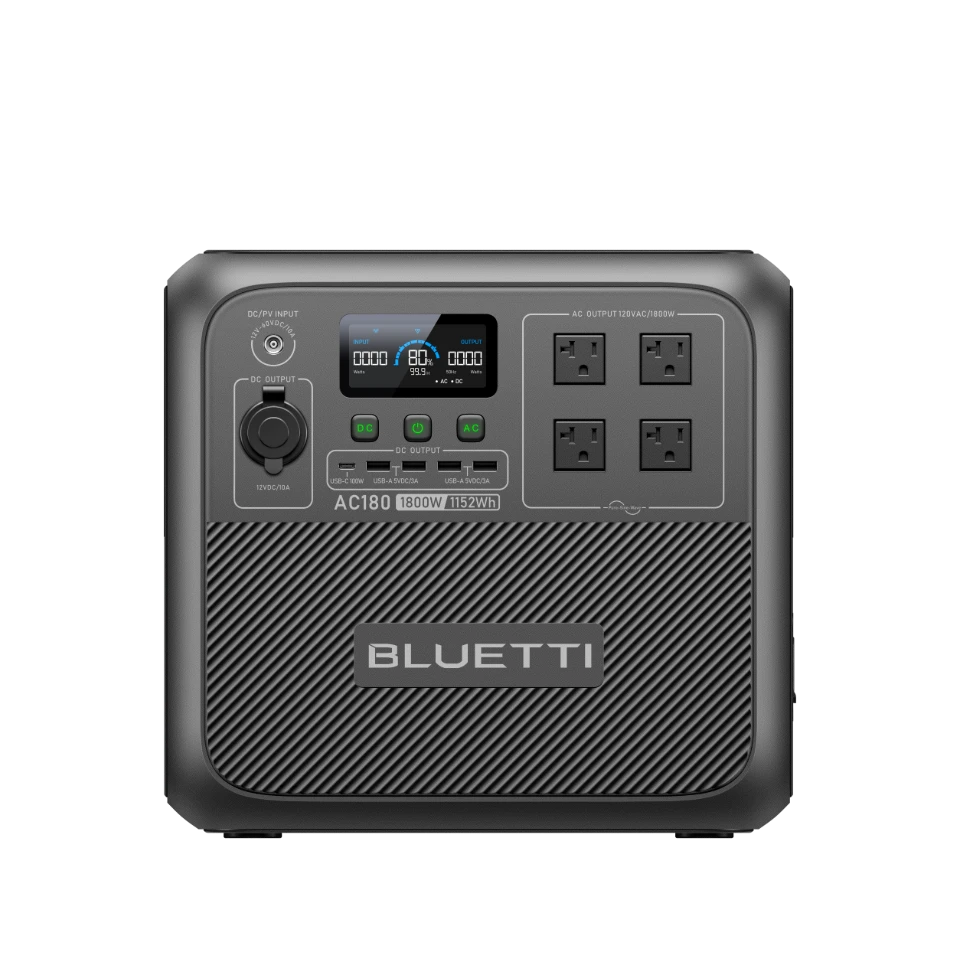
The AC180’s 96Wh capacity difference is nominal battery energy. After inverter and station losses, the usable AC difference cannot be read directly from the labels. Its 100W USB-C port, regulated 12V car outlet and wireless charging pad can simplify some small-device kits. BLUETTI lists Bluetooth app control and a 500W maximum solar input; neither guarantees a charging time in poor sun.
Pros
- More built-in nominal capacity than the original C1000.
- 100W USB-C, regulated car outlet and wireless pad are documented.
- Bluetooth control does not require a campsite Wi-Fi network.
Cons and trade-offs
- Its published 35.3 lb weight is more to carry than C1000’s 28.44 lb.
- The 500W solar-input ceiling is lower, subject to panel compatibility and sunlight.
- The unit is not waterproof; outdoor use still requires dry placement.
Choose another if: Weight or compatible higher-input solar charging matters more than the capacity margin.
Our recommendation
Choose AC180 when the load calculation makes extra built-in energy useful and the carry weight is acceptable. Check outlet layout and included cables on the actual listing.
Anker SOLIX C1000 A1761: lighter, with solar headroom
Best for: Frequent carrying, Wi-Fi app access or a compatible panel system that can use the 600W input ceiling.

The original C1000 A1761 is distinct from C1000 Gen 2. Its 1,056Wh rating is nominal battery capacity, not guaranteed AC energy at the wall outlets. The documented 100W and 30W USB-C outputs can serve different accessories. Anker lists a matching BP1000 expansion path to 2,112Wh, but that battery is a separate purchase and changes total weight and cost.
Pros
- The 28.44 lb published weight is lower than AC180’s.
- 600W maximum solar input offers more ceiling with the right panels.
- Wi-Fi and Bluetooth plus BP1000 expansion offer additional system options.
Cons and trade-offs
- Built-in nominal capacity is 96Wh below AC180.
- Expansion requires a compatible extra battery, not included in a basic station offer.
- The cited detailed A1761 manual is Canadian 120V documentation; verify exact US outlet layout and warranty.
Choose another if: You want the AC180’s larger built-in energy, wireless pad or its documented car-outlet arrangement.
Our recommendation
Choose original A1761 only after the retailer confirms that model and the intended US outlet configuration. A solar input number matters only with a compatible panel plan.
Check the load before choosing
First identify the appliance’s running watts and any startup demand. Then estimate energy in watt-hours from watts multiplied by operating hours. Conversion losses and the station’s own consumption reduce usable energy, so dividing nominal capacity by appliance watts is only a rough planning estimate.
Power Lifting and SurgePad are special operating modes with limitations. Treat the 1,800W rating as the basis for comparison, and check the manual before relying on a boost mode with voltage-sensitive equipment. A fast transfer feature also does not establish compatibility with every device that needs uninterrupted power.
For solar charging, match panel voltage, current and connectors to the station. A 600W input ceiling does not guarantee faster charging than a 500W unit when available panels, sunlight and placement differ. Include the panel and cable costs separately.
Find the exact models
Correction and related reading
Unsupported tests, scores, review totals and price claims have been removed. Read our methodology, affiliate disclosure and solar-kit buying guide.
Load and purchase checks
- List running and startup watts. Compare both with the 1,800W continuous rating, and use manufacturer guidance for surge or boost modes.
- Estimate energy conservatively. Multiply running watts by hours, then allow for inverter and standby losses.
- Map each output. Count AC, USB-C and 12V devices that operate simultaneously; check the exact regional panel.
- Match solar electrical limits. Verify panel voltage, current, connector and cable, not just rated panel watts.
- Check carry and storage. The listed weight difference is meaningful if the station must be moved repeatedly.
Portable station FAQ
Will 1,152Wh run a 1,152W load for an hour?
Not necessarily. Nominal battery energy is not delivered AC energy; inverter losses and changing appliance draw matter.
Does a 600W solar ceiling guarantee quicker charging?
No. Panels, weather, angle and station input limits all affect harvest.
Is C1000 Gen 2 the same as A1761?
No. This comparison covers original A1761, so confirm the full identifier.
Research method and sources
We checked BLUETTI AC180 information and Anker’s original A1761 manual on September 27, 2026. Capacity, output, input, weight and ports are manufacturer claims. Recommendations are editorial. We did not measure runtime, recharge speed, battery life or appliance compatibility. A1761 regional outlet and warranty details require confirmation on the exact US offer.
Primary sources: BLUETTI AC180 and Anker SOLIX A1761 manual. Read our methodology.
Amazon price cards, when available, apply only to the named model and configuration. Check the displayed update time, seller, condition and included items. Search links may return other variants. Customer star ratings are not shown when verified API data is unavailable.
Affiliate disclosure
As an Amazon Associate, The Gear Audit earns from qualifying purchases. We may earn an affiliate commission when you buy through our links, at no extra cost to you. Read our full affiliate disclosure.