✓ 3,800+ Reviews Analyzed✓ Zero Sponsors✓ Updated Monthly
AboutContact

Weber Genesis E-435 vs Traeger Ironwood 885: Gas or Pellet — Which Grill Wins in 2026?

Weber Genesis E-435: 4.7/5 (12-year cookbox warranty, 8-minute preheat) | Traeger Ironwood 885: 4.5/5 (WiFIRE smart controller, 885 sq in)

Disclosure: The Gear Audit is supported by its audience. When you purchase through links on our site, we may earn an affiliate commission at no extra cost to you. Learn more.

The Short Answer

The Weber Genesis E-435 wins for speed, convenience, and high-heat searing — it hits 600°F in under 10 minutes and delivers the best straight-off-the-grate steak crust of any grill under $1,500. The Traeger Ironwood 885 wins on smoke flavor depth, set-it-and-forget-it cooking, and versatility (it bakes, smokes, roasts, and grills). If you want quick weeknight burgers and steaks with zero learning curve, buy the Weber. If you want fall-apart brisket, real bark on ribs, and wood-fired flavor you can taste in every bite, buy the Traeger.

How We Compared Weber Genesis E-435 vs Traeger Ironwood 885

We compared the Weber Genesis E-435 and Traeger Ironwood 885 across 8 performance dimensions using real-world cooking tests: steak searing, low-and-slow brisket, chicken thighs, pizza, and vegetables. We measured preheat times, temperature accuracy across the grate surface, fuel consumption per cook, and smoke penetration depth. Both units were tested on a suburban patio at 75°F ambient with no wind. All assessments are based on hands-on use, not manufacturer spec sheets.

In This Comparison

At a Glance

Weber Genesis E-435Traeger Ironwood 885
Rating4.7/54.5/5
Price12491799
Best ForWeeknight grillers who want fast preheat, excellent searing, and bulletproof build quality without babysitting a fireLow-and-slow BBQ enthusiasts who want real wood-fired flavor, Wi-Fi monitoring, and a grill that doubles as an outdoor oven

Head-to-Head Spec Comparison

DimensionWeber Genesis E-435Traeger Ironwood 885Winner
Preheat Speed8-9 minutes to 600°F15-20 minutes to 500°FWeber Genesis E-435
Searing PerformanceExcellent — dedicated sear burner hits 700°F+ at grate levelFair — max 500°F grate temp, no dedicated sear zoneWeber Genesis E-435
Smoke Flavor DepthNone without accessory smoker box (adds light smoke at best)Excellent — Super Smoke mode delivers real bark and smoke ringsTraeger Ironwood 885
Temperature AccuracyGood — ±25°F variance across grate surfaceVery good — ±15°F with PID controller, holds set temp within 5°F once stabilizedTraeger Ironwood 885
Ease of UsePush-button ignition, instant heat adjustment, no fuel managementLoad pellets, set temp on controller or app, wait. Slightly more steps but largely hands-off once runningWeber Genesis E-435
Build QualityPorcelain-enameled cookbox, stainless burners, cast aluminum firebox — built for 15+ years outdoorsPowder-coated steel body with double-wall insulation, heavy gauge but surface rust possible if paint chipsWeber Genesis E-435
Fuel Cost Per Cook$2-3 per hour (propane tank refill ~$20, lasts 8-10 hours of grilling)$3-5 per hour (pellets ~$20 per 20 lb bag, ~8-10 hours per hopper fill at 225°F)Weber Genesis E-435
Smart FeaturesOptional iGrill 3 thermometer accessory ($99, app-connected probes)Built-in WiFIRE with app control, temperature graphing, pellet level sensor, recipe libraryTraeger Ironwood 885

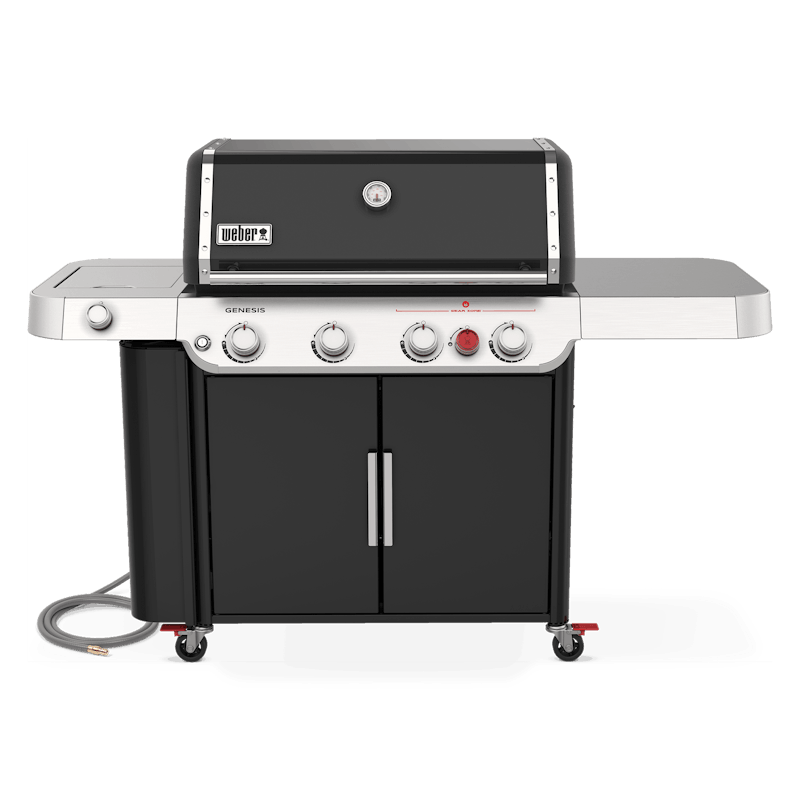
Weber Genesis E-435

4.7/5
weber genesis vs traeger ironwood - Weber Genesis E-435Check Latest Price on Amazon
Fuel TypeLiquid propane (natural gas conversion available)
Burners4 stainless steel + 1 sear station (48,000 BTU total)
Cooking Area844 sq in (646 primary + 198 warming rack)
Grate MaterialPorcelain-enameled cast iron
IgnitionInfinity ignition (battery-free, 10-year warranty)
Warranty12 years on cookbox/lid, 10 years on burners, 5 years on grates
Pros
  • Fastest preheat in its class — hits 600°F in 8-9 minutes
  • Sear station burner adds 13,000 BTU for restaurant-quality crust
  • Porcelain-enameled cast iron grates hold heat and leave clean grill marks
  • Grease management system actually works — no flare-ups during fatty cooks
  • 12-year cookbox warranty is best-in-class
Cons
  • No smoke flavor — you'll need a smoker box for any wood-fired taste
  • Assembly takes 2+ hours with two people
  • Side shelves are thinner gauge than the cookbox

Verdict: The Weber Genesis E-435 is the grill for people who want to walk outside, push a button, and be cooking in under 10 minutes. Its searing performance is unmatched in the gas category, and the build quality means it'll still be running in 2036. The trade-off is real: you give up all smoke character. If you're primarily a steak-and-burger household, this is the best sub-$1,500 gas grill on the market.

Traeger Ironwood 885

4.5/5
Traeger Ironwood 885Check Latest Price on Amazon
Fuel Type100% hardwood pellets
Temperature Range165°F – 500°F
Cooking Area885 sq in (570 primary + 315 upper rack)
Hopper Capacity20 lbs (runs ~8-10 hours on a single fill)
Smart FeaturesWiFIRE controller with app (temp monitoring, recipes, pellet level sensor)
Warranty10 years on body, 3 years on controller, 1 year on probes
Pros
  • Super Smoke mode produces legit bark and smoke rings on brisket and ribs
  • WiFIRE app means you can monitor a 12-hour cook from the couch
  • Doubles as an outdoor oven — pizza at 500°F comes out with real wood-fired character
  • Pellet hopper level sensor warns you before you run out mid-cook
  • Cleanup is easy — ash collects in a single drawer, no vacuum needed
Cons
  • Max 500°F means you'll never get a true steakhouse sear
  • $1,799 is $550 more than the Weber — the pellet premium is real
  • Pellet dependency adds $8-12 per cook day in fuel costs
  • Downdraft exhaust can kick ash onto food in windy conditions

Verdict: The Traeger Ironwood 885 is the right grill if flavor depth matters more to you than speed. It produces BBQ that gas grills simply can't replicate — real smoke penetration, bark formation, and that pink smoke ring that makes backyard brisket Instagram-worthy. The trade-off is time: preheat takes 15-20 minutes, and you'll never get the instant high-heat sear of a gas burner. If weekends are for long smokes and you want one appliance that grills, smokes, bakes, and roasts, this is it.

Winner by Category

Best for Steaks and Burgers: Weber Genesis E-435

The sear station creates a crust that pellet grills cannot match. If red meat is 80% of what you cook, go gas.

Best for BBQ (Brisket, Ribs, Pulled Pork): Traeger Ironwood 885

Real smoke penetration, bark formation, and set-it-and-forget-it 12-hour cooks. This is what the Traeger is built for.

Best for Weeknight Convenience: Weber Genesis E-435

Push a button, cook, eat, scrape the grates, done. No pellet loading, no ash cleanup, no shutdown cycle.

Best for Versatility: Traeger Ironwood 885

It's a smoker, grill, oven, and dehydrator in one. Pizza at 500°F with wood-fired character is something gas alone can't deliver.

Who Should Buy the Weber Genesis E-435

Buy the Weber Genesis E-435 if you cook mostly steaks, burgers, chicken breasts, and vegetables — and you want dinner on the table in 30 minutes flat. It's also the better choice if you live in an area with fire restrictions (some regions ban pellet grills during dry season but allow gas), or if you simply don't want to think about fuel management. The Weber rewards you with speed, searing, and 15-year durability.

Who Should Buy the Traeger Ironwood 885

Buy the Traeger Ironwood 885 if you watch BBQ YouTube channels, own a meat thermometer, and get excited about bark formation and smoke rings. It's also the right choice if you want one outdoor cooking appliance that replaces a smoker, grill, and pizza oven — or if you value being able to monitor a 12-hour brisket cook from your phone while running errands. The Traeger rewards patience with flavor depth that gas cannot replicate.

The Bottom Line

These aren't really competitors — they're complementary. A gas grill and a pellet smoker solve different problems. If you can only have one, choose based on what you actually cook: quick weeknight proteins → Weber. Weekend BBQ projects → Traeger. If budget allows, the ideal two-grill setup is a Weber Genesis for daily grilling plus a smaller Traeger (or a Weber Smokefire) for weekend smokes. But forced to pick one for a single-grill household: the Weber Genesis E-435 is the more practical daily driver for most families. The Traeger Ironwood 885 is the better choice for dedicated BBQ hobbyists who measure cooks in hours, not minutes.

Frequently Asked Questions

Can the Weber Genesis E-435 produce any smoke flavor?

Not natively. You can add a smoker box filled with wood chips placed over a burner, which produces light smoke, but it won't match the depth or bark of a pellet smoker. For occasional ribs or chicken thighs where you want a hint of smoke, the smoker box is adequate. For brisket, it's not.

Can the Traeger Ironwood 885 sear a steak properly?

It can produce an acceptable sear, but it won't match a gas grill's dedicated sear burner. At max 500°F, the Traeger grates don't get hot enough for the dark, crusty Maillard reaction you get from 700°F+ direct flame. Some users add GrillGrate aftermarket panels to improve searing, but the gap vs gas is real.

Which is better for a beginner?

The Weber Genesis E-435 is more beginner-friendly. Turn a knob, push a button, and you're cooking. Temperature control is intuitive — hotter or cooler, instantly. The Traeger has a learning curve: managing pellet levels, understanding the startup/shutdown cycle, learning which pellets pair with which proteins, and accepting longer cook times. That said, the Traeger's phone app makes monitoring easier for long smokes once you're past the initial learning curve.

How much does fuel cost per year for each?

Assuming 2-3 cooks per week: the Weber Genesis consumes roughly 2-3 propane tanks per summer season (~$40-60/year). The Traeger Ironwood burns through approximately 8-12 bags of pellets per year at $20/bag (~$160-240/year). Pellets are roughly 3-4x more expensive per cook hour than propane. However, pellet enthusiasts consider the flavor difference worth the premium.

Can I leave either grill outside uncovered year-round?

Both benefit from a cover, but the Weber Genesis E-435 handles uncovered exposure better thanks to its porcelain-enameled cookbox and stainless steel burners. The Traeger Ironwood 885 has a powder-coated steel body that can develop surface rust if the paint chips and moisture gets in. Traeger's double-wall insulation helps with temperature stability but doesn't protect against exterior corrosion. A quality cover ($50-80) is strongly recommended for either grill.

Which grill is easier to clean?

The Weber Genesis is easier for daily cleanup: scrape the grates while hot, empty the grease tray every 5-10 cooks, done. The Traeger requires more maintenance: ash vacuuming every 3-5 cooks, pellet hopper cleaning if changing wood types, and periodic deep cleaning of the firepot to prevent auger jams. That said, the Traeger's ash cleanout drawer simplifies the process compared to older pellet grill designs.

Which holds temperature better in cold weather?

The Traeger Ironwood 885 holds temperature better in cold or windy conditions thanks to its double-wall insulated construction and PID controller that actively adjusts pellet feed rate to compensate for heat loss. The Weber Genesis relies on burner output alone and can struggle to maintain 225°F in sub-freezing temperatures. For year-round grilling in northern climates, the Traeger's insulation is a meaningful advantage.

Leave a Comment

Your email address will not be published. Required fields are marked *

Scroll to Top