How to Choose a Pressure Washer: Complete Buyer’s Guide (2026)
A pressure washer that fits your patio can still be a poor choice for your deck, and a powerful machine won’t help if its hose can’t reach your driveway. Start with the surface you clean most often and check where the water and power will come from.
Quick answer
Start with corded electric for routine outdoor cleaning within reach of a suitable outlet and tap. Consider gas for frequent work on large, sound concrete surfaces. Choose a handheld cordless power cleaner for small rinsing jobs away from a tap or outlet. Check the surface maker’s care instructions first, then compare water flow at a stated pressure.
- Patio furniture or an ordinary patio: consider corded electric with a wide fan tip and a low pressure soap option where the surface allows it.
- Long concrete driveway: prioritize flow at working pressure and check whether a compatible surface cleaner fits your washer. Consider renting if this is a once-a-year job.
- Muddy bike at a trailhead: a cordless cleaner with a documented siphon option can make sense. Follow the bike maker’s instructions around bearings and seals.
- Car paint, wood or composite decking: check the exact care instructions before choosing a machine. A garden hose and soft brush may be the better fit.
1. Read PSI and GPM together
PSI (pounds per square inch) measures pressure. GPM (gallons per minute) measures water flow. Pressure helps loosen grime; flow carries it away. A narrower spray concentrates the jet on a smaller patch. On a large flat surface, that can mean more passes even when the jet is powerful.
Look for a stated operating pair. The Greenworks GPW2301, for example, lists a maximum pressure of 2,300 PSI at 1.2 GPM rated flow and 2.3 GPM at 100 PSI. Those are different operating points. A “cleaning units” figure (PSI × GPM) is at most a rough comparison when the two values are reported together. Multiplying separate maximums tells you little about the machine you’ll use. Even an honest pair won’t tell you how fast a particular stain will come off or whether a coating can take the spray.
2. Check water, reach and the nozzle kit
- Water supply: match your supply to the manual’s inlet flow and pressure requirements. The GPM printed on the box refers to outlet flow. A timed bucket fill at the end of your supply hose can screen for low flow; it cannot establish that inlet pressure is adequate while water is flowing. If you need to draw from a container, buy a model that expressly supports it.
- Reach: measure from the tap and, for electric, a suitable GFCI-protected outlet to where the machine can stand. Then check whether the high pressure hose reaches the far end of the job. The power cord and spray hose reach from different points. Check the manual before adding an extension cord or a longer pressure hose.
- Nozzles: if the surface permits pressure washing, start with the broadest suitable fan, at the distance the surface maker specifies, and test an inconspicuous spot. A 40° tip spreads the spray more widely than a 15° tip on the same setup. Avoid 0° and turbo jets on delicate surfaces. Select by marked angle and the manual rather than color alone.
- Soap and accessories: check whether the machine draws approved detergent through an onboard tank, siphon tube or separate applicator. Some systems draw soap only with the low pressure tip. For a surface cleaner, verify its supported PSI and GPM range as well as the connector. A matching fitting alone does not establish compatibility.
Surface rules vary even within one brand. Trex’s US care guide allows pressure washing for certain decking lines under specific conditions and advises against it for its early-generation decking. Use the directions for your exact boards, siding, paint or vehicle.
3. Compare three ways to clean
These US examples show the trade-off between setup, reach and flow. The output figures are manufacturer specifications, not side-by-side results.
| Decision | Greenworks GPW2301 | Simpson MS61495 | Ryobi PCLPC07K |
|---|---|---|---|
| Power | Corded electric | Gasoline, CRX 210 engine | 18V ONE+ battery kit |
| Published output | 2,300 PSI max at 1.2 GPM rated flow; 2.3 GPM max at 100 PSI | 3,400 PSI at 2.5 GPM, as listed by Simpson | 700 PSI and 0.8 GPM listed; Ryobi’s product page doesn’t specify a paired operating point |
| Water and reach | Cold mains water; 35 ft cord and 25 ft pressure hose | Cold water supply; 25 ft pressure hose; no power cord | Garden hose, included 20 ft fresh water siphon hose or bottle adapter |
| Best reason to choose it | Repeat cleaning near an outlet and tap, with several fan angles included | Higher specified high pressure flow for larger areas of suitable concrete | Short rinses when carrying a washer and finding a power outlet are impractical |
Corded example: Greenworks GPW2301 (5110302)

Pros
- A 25 ft pressure hose lets you move around a small work area without shifting the machine as often.
- The included 25° and 40° tips give you wider options than the 15° and turbo tips. A soap tip and an onboard tank handle detergent.
- The 10 in wheels let you roll the washer from storage instead of carrying it by hand.
Trade-offs
- The 35 ft power cord still ties the setup to a suitable outlet; the manual calls for cold mains water.
- Flow at 2,300 PSI is 1.2 GPM. Choose a higher paired flow if rinsing a broad, hard surface is your recurring bottleneck.
Our recommendation: shortlist it for a patio or short walkway where the tap and outlet are close enough to set up safely. If your main job is a long, sound concrete driveway and you have enough water, compare it with the gas example below. For more electric layouts, see our three electric pressure washer configurations.
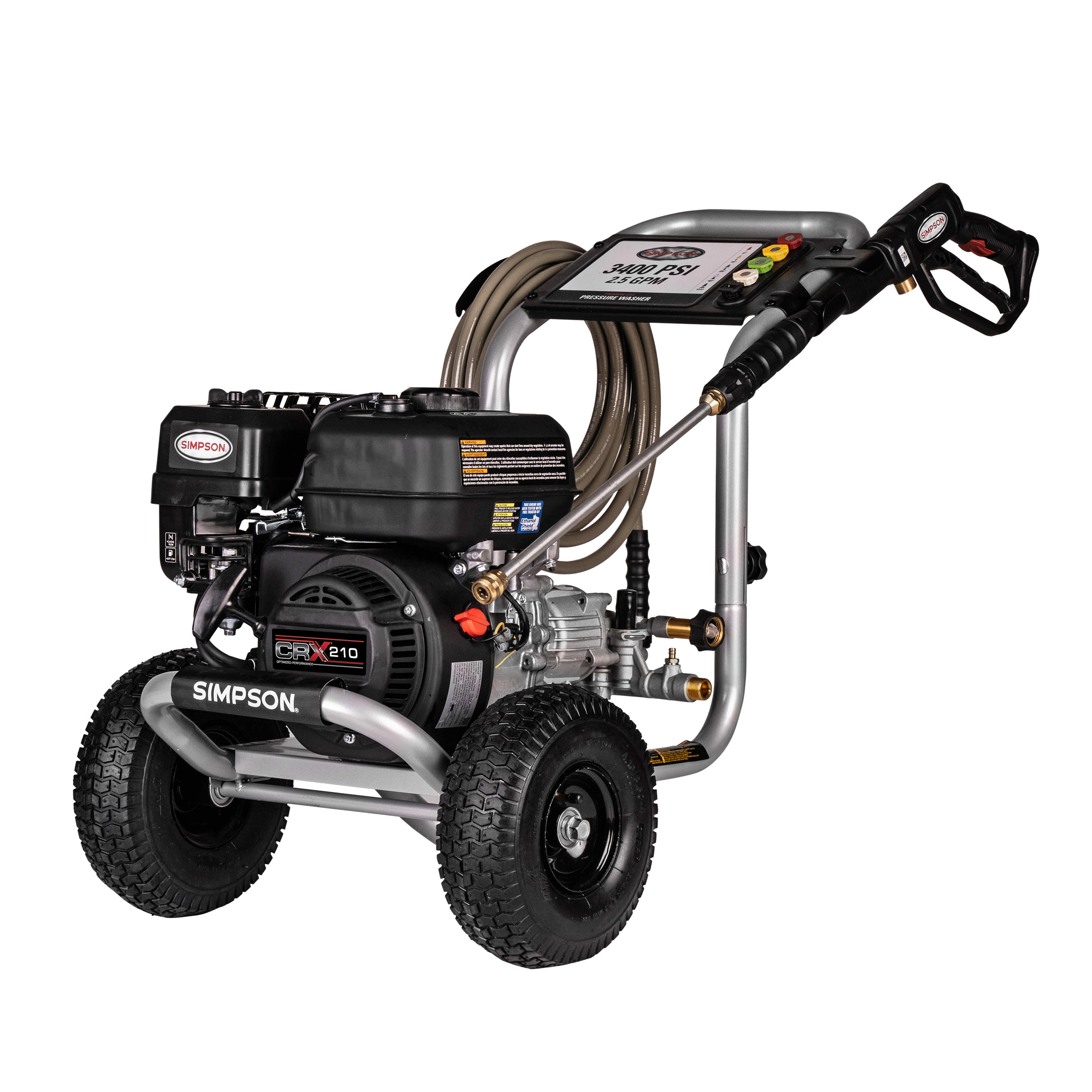
Gas example: Simpson MegaShot MS61495 (61495)
Pros
- Simpson lists 2.5 GPM at 3,400 PSI. That extra flow at high pressure is the reason to look at it for broad, hard surfaces.
- The CRX 210 engine removes the need for a nearby electrical outlet.
- The included 40° and soap tips give you broader and lower pressure options than the narrow tips. The frame rolls on 10 in pneumatic wheels.
Trade-offs
- At a listed 66 lb, it’s a machine to roll rather than lift routinely, and the supplied pressure hose is still only 25 ft.
- Gas adds fueling, engine service and outdoor exhaust clearance. You still need an adequate cold water supply.
- This much pressure is a poor reason to buy for cars or finished decking. Surface limits can rule it out regardless of the tips in the box.
Our recommendation: consider the 61495 if you regularly clean a large area of sound concrete and can place the engine safely outside, within reach of the water supply. For an occasional driveway clean, try renting a suitable washer and surface cleaner before committing to fuel and storage.
Cordless example: Ryobi ONE+ PCLPC07K power cleaner kit

Pros
- The included 20 ft siphon hose draws from a fresh water supply, such as a suitable bucket, without a fixed tap.
- The bottle adapter works for quick spot rinses, and the cleaner can also connect to a standard garden hose.
- This kit includes a 4 Ah battery and charger. Its included 40° fan gives you a wider spray option than the 15° or turbo tip.
Trade-offs
- At the advertised 700 PSI and 0.8 GPM, it is a small rinse tool. Choose a full washer for cleaning a large area of embedded dirt.
- Off tap, you must refill the water supply. A bottle is practical for spot rinses rather than a long wash.
- Long jobs depend on battery charge or a spare pack. You also hold the motor and battery while spraying.
Our recommendation: choose it for small gear rinses where an outlet or spigot is unavailable and the gear maker allows the spray. If you only need a light rinse beside a working tap, a garden hose nozzle may be all you need.
4. Plan for safe use and storage
Read the machine’s instructions before starting. Use eye protection, keep bystanders clear and never aim the spray at a person or animal. Stay on stable ground. Follow the manual to shut down and release trapped pressure before changing fittings or storing the washer. For electric models, test the GFCI as directed and keep connections out of runoff. The CDC’s pressure washer guidance says to run gas washers outdoors at least 20 feet from windows, doors and vents. A garage with the door open is still an enclosed work area.
Make room for the washer, hose and attachments where they won’t freeze. After use, flush detergent and drain the equipment as the manual directs. Follow its winterizing instructions and use a compatible pump protector if specified. With gas, check the engine’s separate oil, fuel and storage instructions.
Frequently asked questions
Is PSI or GPM more important?
Decide what the surface can tolerate first. Then compare GPM at a stated PSI: if a wide area takes a long time to rinse, flow at the pressure you’ll use is more useful than the highest PSI on the box.
Can I run a pressure washer from a bucket?
Only if the model supports drawing water from a container. The Ryobi example includes a fresh water siphon hose. The Greenworks example calls for a cold mains supply.
Can I use a pressure washer on a car?
Check the vehicle’s care instructions for the permitted pressure, distance and areas to avoid. Where pressure washing is allowed, use the approved low pressure setup and a wide fan; keep concentrated jets away from paint, seals and trim. If you can’t confirm the limits, use a garden hose and wash mitt.
Will any surface cleaner work on my driveway?
Match the attachment to the washer’s operating PSI and GPM range and connector. Verify that the driveway surface and finish allow pressure washing. A large attachment is a poor buy if the washer cannot supply the flow it needs.
Why won’t my washer draw soap?
Check the manual for the required nozzle and detergent setup. On systems that inject only at low pressure, switching from a high pressure tip to the designated soap tip is the first check.
Method and sources
We checked US manufacturer listings for model identity, output, power, hoses and included parts. We used manufacturer instructions for setup and surface limits and CDC guidance for safe operation. The recommendations apply those specifications to common jobs. We did not run cleaning, runtime, noise or durability tests, and did not score owner reviews.
- Greenworks GPW2301 / 5110302: US product page and paired flow figures; linked owner’s manual.
- Simpson MegaShot MS61495 / 61495: US product page; Simpson’s operating FAQs.
- Ryobi PCLPC07K: US kit, water connections and nozzle details.
- Trex’s US decking care guide and CDC’s pressure washer safety guide.