Budget Coffee Makers Compared in 2026: Match Features to the Full Cost
By The Gear Audit Team · Specification research September 9, 2026; buying-advice and manufacturer source check September 20, 2026.
Quick answer: decide which routine is worth paying for
Choose Hamilton Beach 49316R when you mainly brew ground-coffee carafes and can skip pod features. Ninja PB051 Black suits individual cups from pods or grounds with a built-in frother. Hamilton Beach FlexBrew Trio 49976 and Ninja DualBrew CFP101 serve households using both carafes and individual cups; the Ninja documents more size and style choices. This is a full-cost guide, not a promise that every model is currently under $100. Compare the exact current offer, coffee supplies, filters and cleanup needs.
Hamilton Beach 49316R uses a 12-cup glass carafe, cone basket and warming plate with few format decisions.
Ninja PB051 Black brews pods or grounds in individual sizes and adds a fold-away frother, useful only when those options see regular use.
FlexBrew Trio 49976 combines ground-coffee pot, ground-coffee single cup and compatible K-Cup path.
Ninja CFP101 adds nine grounds sizes, four pod sizes and Classic/Rich/Over Ice styles, with more parts to manage.
Buy the brewing path you will use
| Decision | Hamilton Beach 49316R | Ninja PB051 Black | FlexBrew Trio 49976 | Ninja CFP101 |
|---|---|---|---|---|
| Grounds-based carafe | 12-cup carafe | No carafe path | Full pot documented | Grounds sizes through full 12-cup carafe |
| Individual cup | Pour from carafe | Grounds or compatible pods | Grounds or compatible K-Cup pod | Grounds or compatible pods |
| Additional choices | Pause & Serve and water window | Classic, Rich, Over Ice, Specialty; fold-away frother | Three brewing routes; regular/bold documented for 49976 | Nine grounds sizes, four pod sizes; Classic, Rich, Over Ice |
| Supply and care | Ground coffee, cone filters, carafe | Grounds or pods, adapter/filter, frother | Grounds, carafe side, single-serve basket or pod holder | Grounds/pods, filter path, pod adapter and carafe |
| Best match | Several cups at once with a simple machine | One person, several single-cup styles | Household switching between pot and cup | Household that will use hybrid size/style controls |
“Budget” means matching total spending and work to actual use. Manufacturer list prices and retailer offers fluctuate; this table deliberately does not make a current under-$100 claim.
Hamilton Beach 49316R: uncomplicated ground-coffee carafes
Best for: A household regularly serving several cups together and content with a basic drip routine.
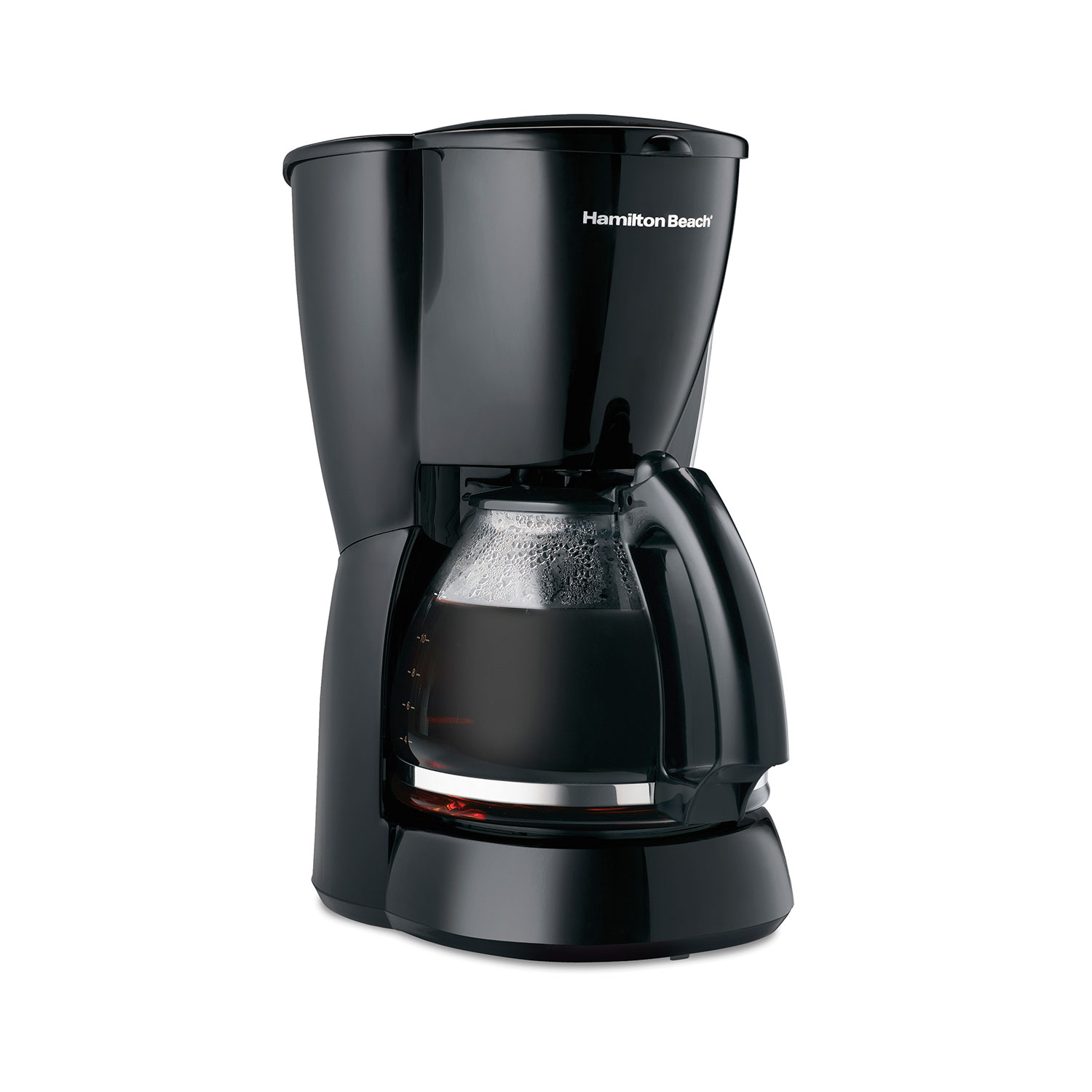
Hamilton Beach lists a 12-cup carafe, cone-shaped filter basket, Pause & Serve, a large water window and a nonstick warming plate. The filter basket and carafe are listed as dishwasher-safe. Its published body size is 13 × 8.5 × 10 inches. That focused design makes sense when coffee is brewed and shared in a pot; it does not require buying a pod supply.
Pros
- Batch brewing suits a shared morning. A carafe lets several people pour from the same grounds-based brew instead of making a sequence of pods.
- The equipment and supply path are simple. Ground coffee, an appropriate cone filter and the carafe are the main recurring items to plan.
- Pause & Serve accommodates an early cup. The manufacturer documents pouring during the brew cycle, which can matter when one person leaves before the pot is finished.
Cons and trade-offs
- A single cup still uses the carafe route. You can brew a smaller batch, but must use and wash the carafe; PB051 has a dedicated individual-cup path.
- No pod or espresso path is documented. A household switching between K-Cups and carafes needs a hybrid model rather than expecting this basic brewer to do both.
- The warmer plate is part of the routine. You must decide when to turn off, empty and clean the carafe; do not infer the controls or auto-off behavior of other Hamilton Beach models.
Choose something else if: Your household drinks one cup at scattered times or relies on compatible pods. Examine PB051 or one of the hybrids.
Our recommendation
Choose 49316R when you want a straightforward ground-coffee pot and can avoid paying for formats you will not use. Judge its value by how often a shared pot gets finished, not by a nominal 12-cup label.
Sources: Hamilton Beach 49316R product and care details. Recommendations are editorial interpretations of documented features.
Search Hamilton Beach 49316R on Amazon
Ninja PB051 Black: individual grounds or pods with a frother
Best for: One-person or staggered schedules where single cups, several styles and occasional frothed milk matter more than a pot.
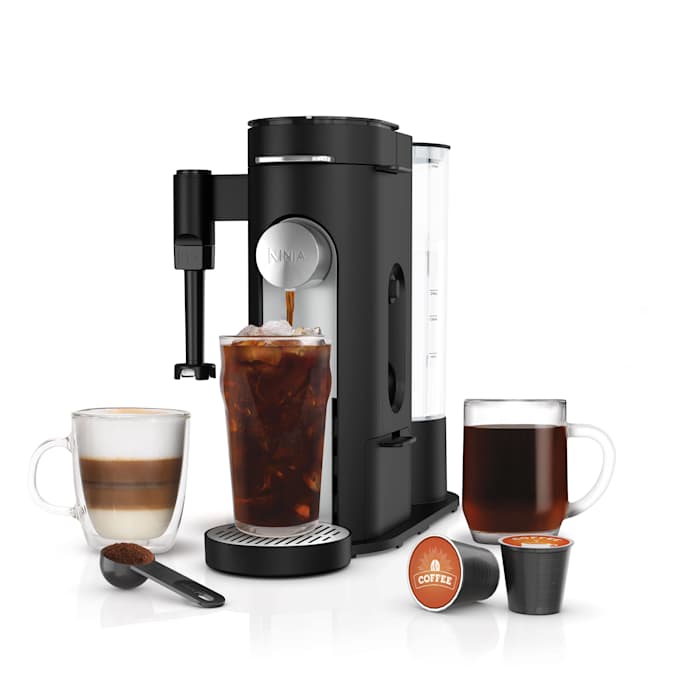
SharkNinja documents four pod sizes from 6 to 12 oz and seven grounds sizes from 6 to 24 oz, plus Classic, Rich, Over Ice and Specialty styles. The built-in fold-away frother handles hot or cold milk or alternatives; the box lists a 56 oz reservoir, permanent filter and pod adapter. Specialty is described as a rich coffee concentrate for milk-style drinks, not espresso from a portafilter.
Pros
- Pods and grounds fit one-person brewing. A household member can use a convenient pod on one day and ground coffee on another without a full pot.
- Grounds sizes reach a travel mug. The published 24 oz grounds setting and space for an up-to-8-inch mug suit taking a larger coffee out the door.
- The frother enables a different drink routine. If you regularly use milk, a built-in tool avoids buying and storing a separate handheld frother.
Cons and trade-offs
- It cannot serve a grounds-based carafe. Making several guests’ cups means repeating the single-serve cycle; 49316R or a hybrid is more practical.
- Frother and adapters add parts to clean. If you only want a plain grounds-based cup, those extra components may be unnecessary work.
- The Specialty concentrate is not manual espresso. Buyers looking for a portafilter and adjustable extraction should use an espresso-machine guide.
Choose something else if: You usually brew several cups together or want fewer components than a pod/grounds/frother system. Compare 49316R for a pot or a hybrid for mixed use.
Our recommendation
Choose PB051 Black if individual coffee is the routine and you will use both its formats or frother. For plain daily coffee from one supply, count the extra parts before deciding it is better value.
Sources: SharkNinja PB051 Black specifications and box contents. Recommendations are editorial interpretations of documented features.
Hamilton Beach FlexBrew Trio 49976: three routes without extra style menus
Best for: A household that needs a ground-coffee pot plus an occasional single cup from grounds or a compatible K-Cup pod.
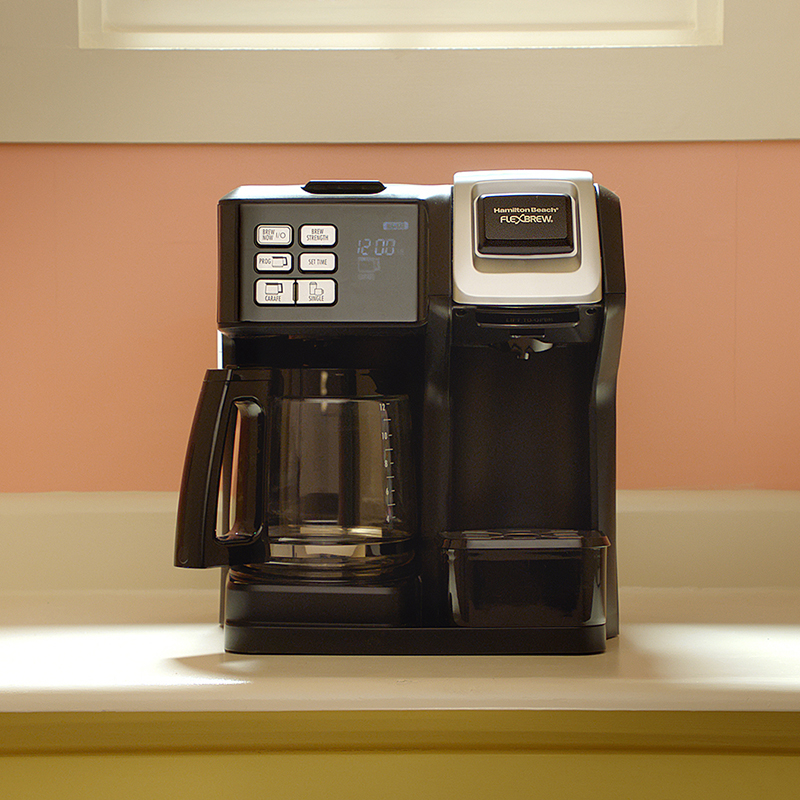
Hamilton Beach’s current coffee-maker catalog identifies 49976 as a three-way FlexBrew: grounds for a full pot, grounds for a single cup or a compatible K-Cup pod. Its use-and-care guide lists model 49976 among the covered models and diagrams the separate carafe, single-serve grounds and pod routes. A manufacturer article also names 49976 for regular/bold strength selection. We do not transfer newer FlexBrew reservoir, speed or size claims to this model.
Pros
- It covers the two common household quantities. A full grounds-based pot serves a group while the single-serve side suits staggered mornings.
- Grounds can be used on both sides. A buyer can keep one main coffee supply and use K-Cup pods only when their convenience is useful.
- The three paths are easy to explain. Pot from grounds, cup from grounds or cup from pod is a clear buying proposition without the Ninja CFP101 size/style menu.
Cons and trade-offs
- Two brewing areas mean two care routines. The carafe and single-serve basket or pod holder require attention even if one route is rarely used.
- It is still a drip/pod hybrid. It does not provide portafilter espresso or a built-in milk frother.
Choose something else if: You never use one of the two quantities or specifically want documented over-ice and multiple size controls. The simpler 49316R or more configurable Ninja CFP101 may fit better.
Our recommendation
Choose 49976 when a weekly pot-and-cup mix is real and a straightforward three-way brewer is sufficient. Verify the exact model label and included carafe, baskets and pod parts in a current offer because the FlexBrew family contains materially different revisions.
Sources: Hamilton Beach catalog identification, model-inclusive use-and-care guide and manufacturer 49976 workflow article. Recommendations are editorial interpretations of documented features.
Price listing: Hamilton Beach FlexBrew Trio 49976.
Ninja DualBrew CFP101: hybrid with more drink controls
Best for: A household switching between grounds carafes and compatible pods and willing to manage size and brew-style choices.
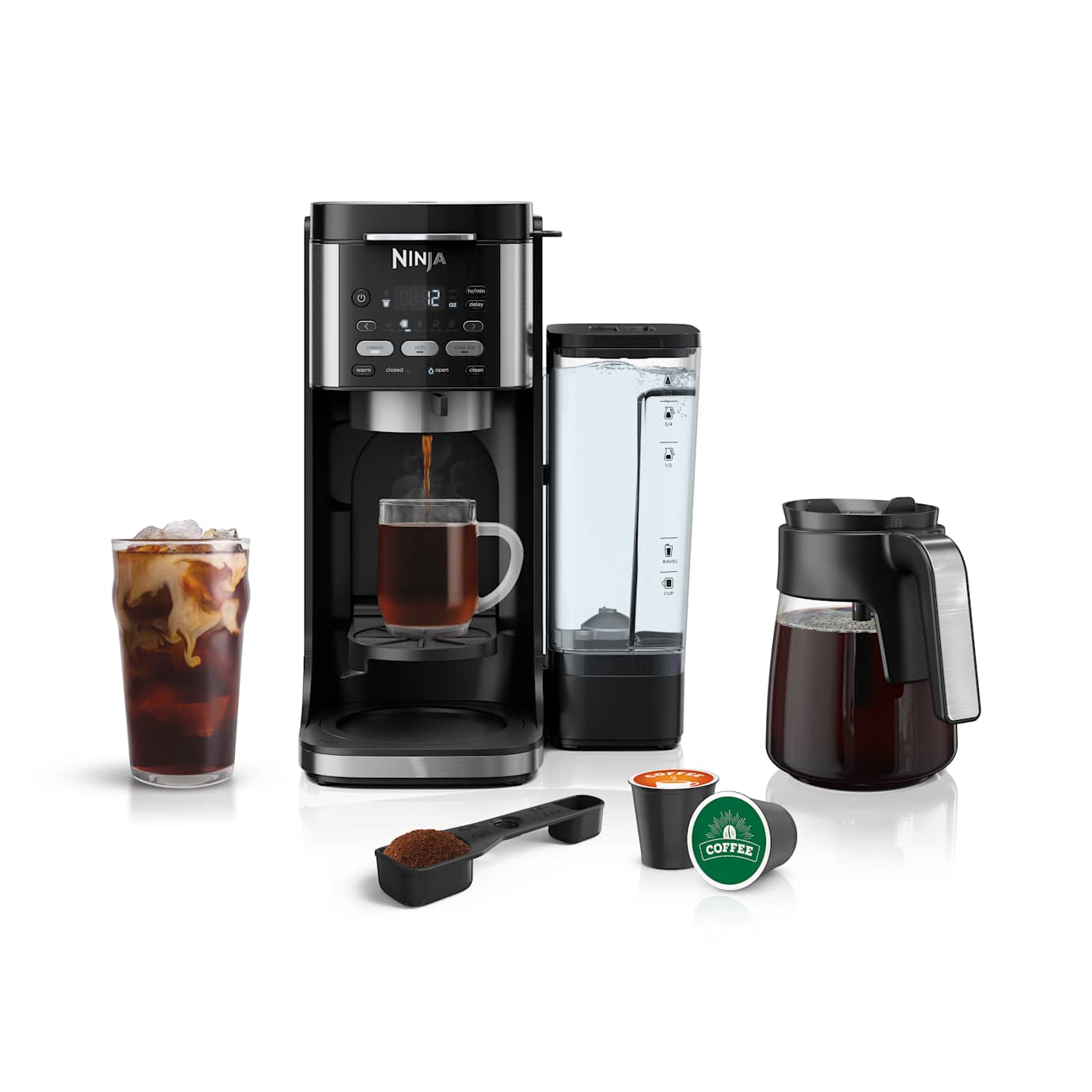
The CFP101 has nine grounds sizes from small cup to full carafe, four pod sizes from 6 to 12 oz, and Classic, Rich and Over Ice brew styles. SharkNinja lists a 60 oz removable reservoir, Delay Brew, Keep Warm, a pod adapter and a 12-cup glass carafe. Those options are useful only if the household regularly changes both quantity and format.
Pros
- Its grounds path is flexible within one appliance. The nine settings allow a grounds-based cup, partial carafe or full pot rather than forcing one quantity.
- Pod sizes offer a quick individual option. Compatible pods can cover a different person or schedule without making a whole pot.
- Over Ice and timing controls support specific habits. A regular iced-coffee drinker or household that uses Delay Brew may get practical value from these functions.
Cons and trade-offs
- More components need cleaning and storage. Carafe, grounds/filter route and pod adapter are part of the purchase even when one format gets little use.
- The body takes meaningful counter height. The published 17.4-inch height deserves a cabinet-clearance check.
- Its controls do not make espresso. Rich and Over Ice are coffee styles, not a substitute for a grinder, portafilter or steam wand.
Choose something else if: Your routine is consistently a shared pot or consistently one plain cup. The extra controls then may add little value over 49316R or PB051.
Our recommendation
Choose CFP101 if you can name regular uses for both its quantities and its styles. Its greater published control range than 49976 is a functional reason to consider it; it is not evidence of better taste or lower cost.
Sources: SharkNinja CFP101 product details. Recommendations are editorial interpretations of documented features.
Price listing: Ninja DualBrew CFP101 — Black.
Compare full cost with a normal week of coffee
- Count cups by occasion. Note how many are shared from one pot, made separately, carried out and brewed over ice. Coffee left in a carafe is part of the real cost.
- Price the chosen coffee path. Use current prices for the grounds or compatible pods you would actually buy. For hybrids, decide whether both formats are worth keeping stocked.
- Add filters and care supplies. Check the exact filter basket, adapter and cleaning instructions; do not assume every version includes a permanent filter.
- Measure the working clearance. Include filling the reservoir, lifting a lid, moving the carafe and storing unused adapters.
- Compare current exact-model offers. Cards identify the offered configuration; links labelled Search open model searches. Check model number, condition, included parts, seller and final price; no current under-$100 promise is made.
For the broader decision among capsule, carafe and espresso systems, read our coffee-maker format guide.
Buying FAQ
Are all four guaranteed to cost under $100?
No. The original URL reflects budget-shopping intent, but prices and bundles change. Compare current exact-model offers and include coffee, filters and care supplies.
Can Hamilton Beach 49316R make one cup?
You can pour a cup from its carafe, including during brewing through Pause & Serve. It is a 12-cup drip brewer, not a documented single-serve pod machine.
Does Ninja PB051 make espresso?
SharkNinja describes a Specialty coffee concentrate and frother for milk-style drinks. It does not document portafilter espresso extraction.
What is the practical difference between FlexBrew 49976 and Ninja CFP101?
Both cover a grounds-based pot and compatible pod single cups. Ninja documents nine grounds sizes, four pod sizes and Classic/Rich/Over Ice styles for CFP101; Hamilton Beach documents three format routes for 49976. Do not assume the reservoir or controls of a different FlexBrew revision.
Amazon prices: Cards show the named US configuration and an eligible current new USD offer when available, with its check time. Unavailable or expired offers use a labelled search link. Confirm the model, included parts and final checkout price. Numerical Amazon ratings are omitted when usable review data is unavailable.
Research method, sources and limitations
We used US manufacturer material for exact Hamilton Beach 49316R, Ninja PB051 Black, Hamilton Beach FlexBrew Trio 49976 and Ninja DualBrew CFP101. Model functions are manufacturer descriptions; use-case and cost advice is editorial judgment. We did not test coffee flavor, brewing speed, reliability or cleaning effort, analyze customer reviews, or independently price long-term supplies. The older 49976 manufacturer image is labelled as historical; current catalog wording establishes the three brew routes, while current retail revision and included parts need confirmation at purchase.
Original specification research: September 9, 2026. Buying-advice and cited source check: September 20, 2026. The prior fixed under-$100 and unsupported test/ranking claims are omitted.
Primary sources: Hamilton Beach 49316R; Ninja PB051 Black; Hamilton Beach 49976 catalog, manufacturer workflow article and historical photo; Ninja CFP101. Read our methodology.
CERTAIN CONTENT THAT APPEARS ON THIS SITE COMES FROM AMAZON. THIS CONTENT IS PROVIDED “AS IS” AND IS SUBJECT TO CHANGE OR REMOVAL AT ANY TIME.
Affiliate disclosure
As an Amazon Associate, The Gear Audit earns from qualifying purchases. We may earn an affiliate commission when you buy through our links, at no extra cost to you. Read our full affiliate disclosure.