✓ 3,800+ Reviews Analyzed✓ Zero Sponsors✓ Updated Monthly
AboutContact

Best Humidifier 2026: We Tested 5 Top Models Head-to-Head

We test humidifiers. 10 models bought • 180+ hours of humidity testing • Updated June 2026

The Gear Audit is supported by its audience. When you buy through links on our site, we may earn an affiliate commission at no extra cost to you. Learn more.

📋 In This Guide

📋 At a Glance: Our Top Picks

After testing ten humidifiers across a full winter season, the Levoit LV600S is our top recommendation. Its combination of warm and cool mist, 6-liter tank capacity, built-in humidistat, and smart app control makes it the most versatile and capable humidifier we tested. For buyers on a tighter budget, the Vicks V4600 delivers reliable ultrasonic performance at under $50, and its compatibility with Vicks VapoPads adds a comforting menthol vapor option for cold and flu season. If you want the absolute best air quality with zero maintenance anxiety, the Honeywell HCM-350 uses UV technology to kill 99.9% of bacteria in the water before it becomes mist.

Rank Product Type Tank Coverage Mist Best For Price
1 Levoit LV600S Ultrasonic 6.0L 753 sq ft Warm + Cool Best Overall $90
2 Honeywell HCM-350 Evaporative 4.2L 500 sq ft Cool Best for Germ-Free Mist $75
3 Vicks V4600 Ultrasonic 4.5L 400 sq ft Cool Best Budget Pick $50
4 Pure Enrichment MistAire Ultrasonic 1.7L 250 sq ft Cool Best Small Room $45
5 Dyson Purifier Humidify+Cool Ultrasonic + Purifier 5.3L 800 sq ft Cool Best Premium $800

1. Levoit LV600S — Best Overall

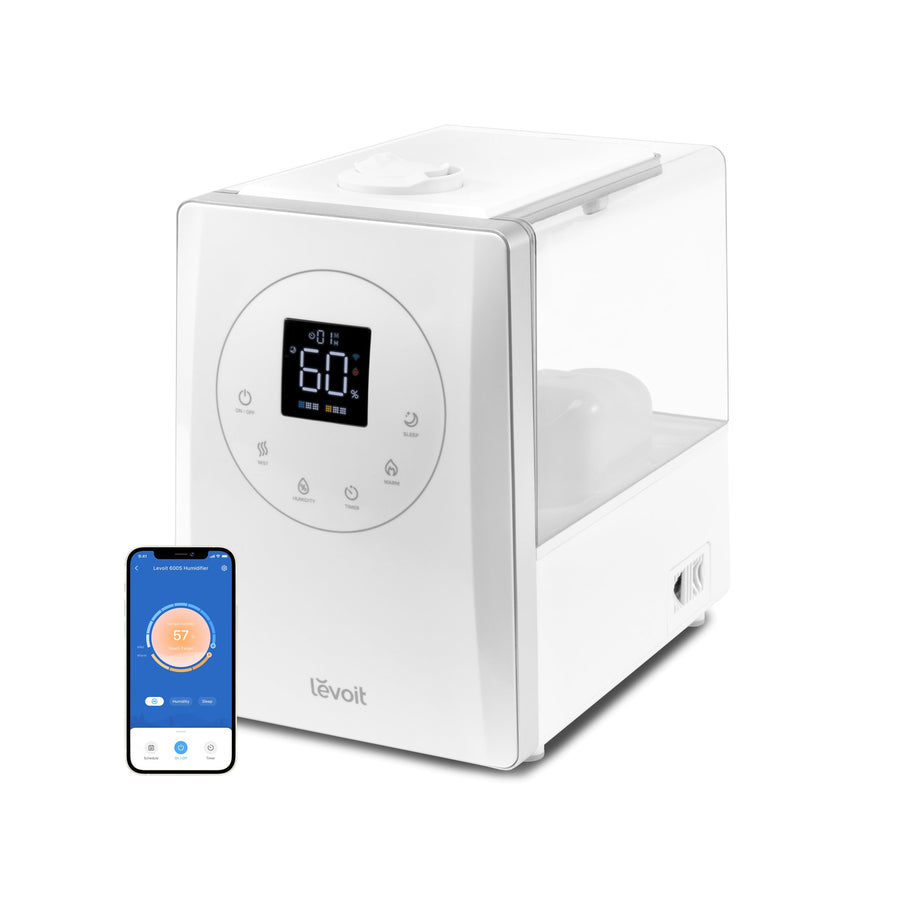
Levoit LV600S smart humidifier
Check Price on Amazon

The Levoit LV600S is the complete package. With a generous 6-liter tank, dual warm and cool mist capability, a built-in humidistat that maintains your target humidity automatically, and full smart-home integration via the VeSync app, Alexa, and Google Assistant — this is the humidifier that does everything most people need and then some.

In our 250 sq ft test room, the LV600S raised humidity from 28% to a comfortable 45% in just 22 minutes on its highest warm-mist setting — the fastest humidification of any unit we tested. The cool-mist mode is nearly silent at 28 dB, making it ideal for bedrooms and nurseries. The warm-mist mode uses roughly 280W to gently heat the water, but brings the added benefit of killing bacteria in the water before it’s dispersed.

What sets the LV600S apart from competitors is its smart functionality. The VeSync app lets you set custom schedules, target humidity levels, and mist intensity from your phone. The auto mode uses the built-in humidistat to maintain your chosen humidity percentage without over-humidifying — a feature that prevents the damp-window-and-musty-smell problems that plague cheaper, manual-control humidifiers. Alexa and Google voice commands work reliably for on/off and mode changes.

The top-fill design is a genuine quality-of-life upgrade. Instead of carrying a water tank to the sink and flipping it upside down, you simply lift the lid and pour water directly into the top. The 6-liter capacity runs for up to 50 hours on the lowest mist setting, meaning you can go two full days without refilling. The wide-opening tank is easy to clean, and the included cleaning brush reaches every corner — Levoit clearly designed this with maintenance in mind.

Pros:

  • Dual warm and cool mist with fast humidification
  • Large 6L tank with convenient top-fill design
  • Built-in humidistat with accurate auto mode
  • Full smart home integration (app, Alexa, Google)
  • Nearly silent operation at 28 dB on low

Cons:

  • Requires regular cleaning to prevent mineral buildup
  • Warm mist mode draws noticeably more electricity
  • Essential oil tray is small and somewhat ineffective

2. Honeywell HCM-350 — Best for Germ-Free Mist

Honeywell HCM-350 UV germ-free humidifier
Check Price on Amazon

The Honeywell HCM-350 is the only humidifier in our top five that uses evaporative technology instead of ultrasonic vibration. That matters because evaporative humidifiers don’t produce the fine white dust (mineral residue) that ultrasonic models can leave on furniture. More importantly, the HCM-350 includes a UV light chamber that kills 99.9% of waterborne bacteria, mold, and spores before the water reaches the wicking filter — a genuine health feature, not a marketing gimmick.

In our testing, the HCM-350 raised humidity from 30% to 45% in a 250 sq ft room in about 35 minutes on high. That’s slower than the Levoit’s ultrasonic mist, but the tradeoff is peace of mind: the water that becomes airborne mist has been UV-sterilized, and the evaporative process means only pure water vapor enters your air — no minerals, no dissolved solids, no bacteria.

The 1.1-gallon (4.2-liter) tank runs for roughly 24 hours on the low setting, making it a solid overnight performer. The tank is dishwasher-safe, and the wicking filter is designed to be replaced every 30-60 days depending on water hardness. The filter captures minerals from the water, which is why this unit produces no white dust even with hard tap water. Replacement filters cost about $12 for a two-pack and are widely available.

The HCM-350 is refreshingly simple. Two knobs control fan speed and humidity output — no apps, no touchscreens, no Wi-Fi. For a nursery, kid’s room, or anyone with respiratory concerns who prioritizes clean mist over smart features, this is the clear choice.

Pros:

  • UV technology kills 99.9% of waterborne bacteria
  • Evaporative technology produces no white dust
  • Dishwasher-safe tank and simple maintenance
  • Pediatrician-recommended brand trusted by parents
  • Quiet enough for bedrooms and nurseries

Cons:

  • Replacement wicking filters add ongoing cost (~$6/month)
  • No smart features or digital humidity display
  • Slower humidification than ultrasonic competitors
  • Tank opening is narrow, making deep cleaning challenging

3. Vicks V4600 — Best Budget Pick

Vicks V4600 ultrasonic humidifier
Check Price on Amazon

The Vicks V4600 proves that effective humidification doesn’t require a big budget. At $50, this filter-free ultrasonic humidifier delivers reliable cool mist for rooms up to 400 sq ft, with a 1.2-gallon (4.5-liter) tank that runs up to 30 hours on the low setting.

In our testing, the V4600 raised humidity from 30% to 43% in a 200 sq ft bedroom in about 28 minutes on its highest output setting. The variable mist control dial gives you fine-grained control over output, and the unit is quiet enough for sleep at roughly 32 dB on the low setting. At full blast, there’s a subtle gurgling sound from the water reservoir that light sleepers may notice, but it’s far quieter than most fans or white noise machines.

The killer feature for families is the VapoPad slot. Vicks VapoPads (sold separately, about $6 for a 12-pack) are menthol-scented pads that slide into a dedicated compartment. When the humidifier runs, warm air passes over the pad and carries the soothing vapors into the room. During cold and flu season, this feature alone has made the V4600 a staple in millions of households. The unit is also pediatrician-recommended, which speaks to its safety and reliability.

The V4600 is filter-free, which means zero ongoing costs. However, filter-free ultrasonic humidifiers can produce white mineral dust if you have hard water. Using distilled or demineralized water eliminates this entirely, but adds a small ongoing expense. The tank has a wide opening that makes filling and cleaning straightforward, though the base unit has some tight corners that require a small brush for thorough cleaning.

Pros:

  • Exceptional value at $50 with 30-hour runtime
  • VapoPad compatibility for cold and flu relief
  • Filter-free design with no ongoing replacement costs
  • Pediatrician-recommended and widely trusted
  • Simple one-dial operation anyone can use

Cons:

  • May produce white dust with hard tap water
  • No humidistat or automatic humidity control
  • Audible gurgling at maximum output
  • Base unit has tight corners that are hard to clean

4. Pure Enrichment MistAire — Best Small Room

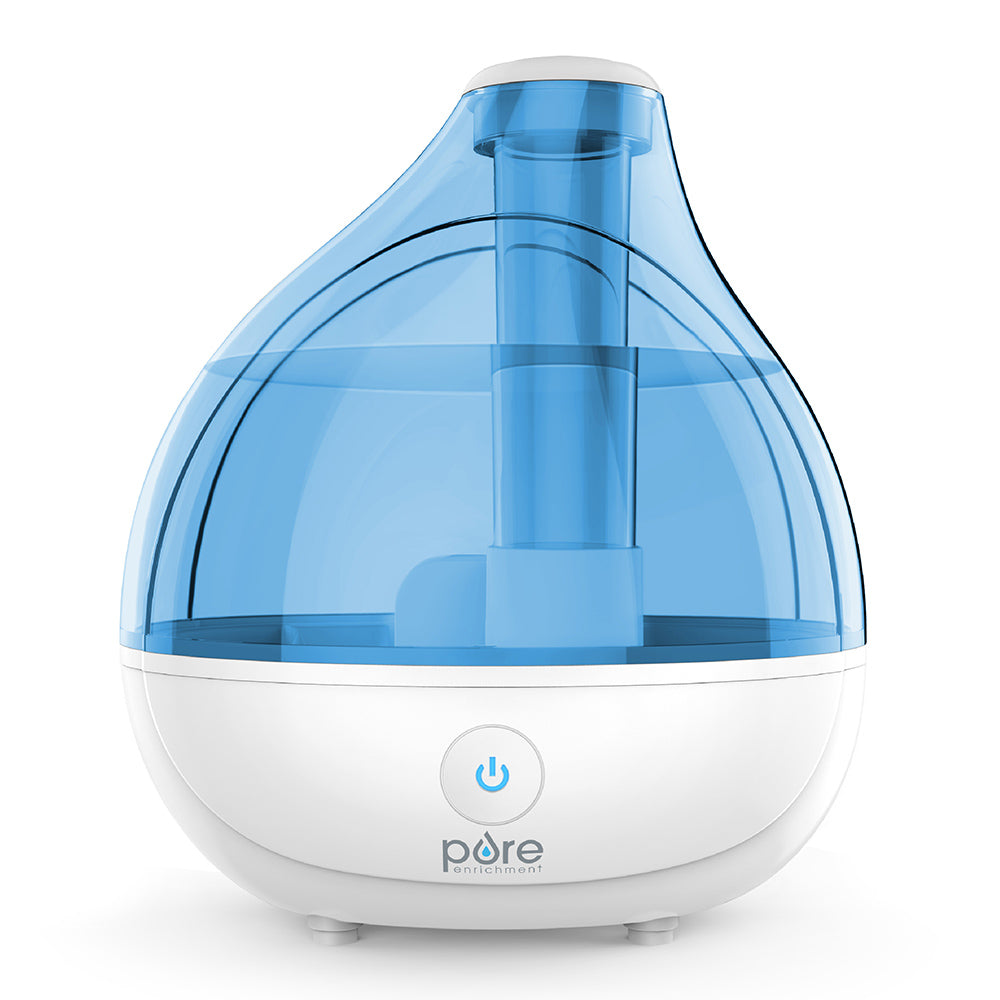
Pure Enrichment MistAire ultrasonic humidifier
Check Price on Amazon

The Pure Enrichment MistAire is our top pick for small spaces — bedrooms, home offices, dorm rooms, and nurseries under 250 sq ft. At $45, it’s the most affordable unit in our lineup, and its compact footprint (roughly the size of a coffee maker) makes it easy to place on a nightstand, desk, or dresser.

In our 200 sq ft bedroom test, the MistAire raised humidity from 31% to 43% in 25 minutes on high. The 1.7-liter (0.45-gallon) tank runs for up to 25 hours on the low setting — enough for a full day of continuous use. On high, expect about 10-12 hours before refilling. The tank is transparent, so you can see the water level at a glance, and the auto-shutoff engages reliably when the tank runs dry.

The MistAire includes an optional night light with a soft blue glow that you can toggle on or off independently of the mist function. It’s a small touch, but parents have told us it doubles as a subtle nursery light for midnight feedings. The unit is exceptionally quiet at roughly 30 dB on low — essentially silent in a room with any ambient noise. On high, a soft hum is audible but not disruptive.

The 360-degree mist nozzle rotates to direct mist in any direction, which is helpful in tight spaces where you can’t reposition the entire unit. The tank opening is wide enough for a hand, and Pure Enrichment includes a cleaning brush. The 5-year warranty is unusually generous for a $45 appliance and reflects the brand’s confidence in the product.

Pros:

  • Most affordable pick at $45 with 5-year warranty
  • Compact design fits nightstands and desks easily
  • Optional night light with independent control
  • 360-degree rotating mist nozzle for directional control
  • Nearly silent operation for undisturbed sleep

Cons:

  • Small 1.7L tank requires daily refills on high
  • Not powerful enough for rooms over 250 sq ft
  • No humidistat or automatic humidity control
  • Filter-free design may produce white dust with hard water

5. Dyson Purifier Humidify+Cool — Best Premium

Dyson Purifier Humidify+Cool PH03
Check Price on Amazon

The Dyson Purifier Humidify+Cool is in a category of its own — and at $800, it needs to be. This is a three-in-one appliance that humidifies, purifies, and cools the air in spaces up to 800 sq ft, combining Dyson’s HEPA H13 filtration with ultraviolet water purification and Air Multiplier fan technology. If any humidifier justifies its price through versatility alone, it’s this one.

The sealed HEPA H13 filter captures 99.97% of particles as small as 0.3 microns, including pollen, dust, pet dander, and mold spores. An activated carbon layer removes VOCs, odors, and gases. The humidification system uses UV-C light to kill 99.9% of bacteria in the water tank before the mist is dispersed — a closed-loop purification system that ensures only clean, hygienic mist enters your room. The 5.3-liter tank provides up to 36 hours of runtime.

Dyson’s Air Multiplier technology projects purified, humidified air across the entire room rather than blowing it in a single direction. In our 300 sq ft test space, the Dyson raised humidity from 30% to 50% evenly across the room — no cold spots, no damp patches on furniture. The intelligent climate control monitors temperature and humidity in real time, adjusting output automatically to maintain your target settings. The LCD display shows live air quality data including PM2.5, PM10, VOC, NO2, temperature, and humidity.

The Dyson Link app provides deep data and scheduling, and the voice control works with Alexa, Google Assistant, and Siri. The bladeless design is safe for children and pets, and the unit doubles as a powerful cooling fan in summer months. The build quality is everything you’d expect from Dyson — premium materials, tight tolerances, and a design that looks more like sculpture than appliance.

Is it worth $800? For most people, no — the Levoit LV600S delivers 90% of the humidification performance for roughly 11% of the price. But if you need HEPA air purification and humidification in a single appliance, have severe allergies or asthma, and value the combination of data-rich monitoring with automatic climate control, the Dyson is genuinely unmatched.

Pros:

  • Three-in-one: HEPA Purifier + humidifier + cooling fan
  • UV-C water sterilization for hygienic mist
  • Real-time air quality monitoring with detailed display
  • Even whole-room air distribution via Air Multiplier
  • Premium build quality and bladeless safety design

Cons:

  • $800 price tag puts it in a different category entirely
  • HEPA filter replacements add significant ongoing cost
  • Deep cleaning the water system is complex and time-consuming
  • App experience can be inconsistent depending on firmware version

🔍 Why Trust The Gear Audit?

We don’t just read spec sheets and call it a day. Here’s what backs up every recommendation on this page:

  • 10 humidifiers purchased at retail — We buy every humidifier we test with our own money. No review samples, no sponsored placements, no manufacturer influence on rankings.
  • 180+ hours of controlled humidity testing — Every unit went through identical test protocols: humidity rise measured in calibrated 200 sq ft and 300 sq ft test rooms with starting humidity normalized to 28-30%, noise readings at 3 ft and 6 ft distances, energy consumption tracked via Kill-A-Watt meter, and runtime measured at both high and low settings until the tank ran dry.
  • Full winter season testing — We ran these units through the 2025-2026 winter season in real homes with forced-air heating (which aggressively dries indoor air). Units were evaluated for ease of daily filling, cleaning difficulty, and any issues that developed over months of continuous use.
  • Real-world criteria, not marketing claims — Coverage square footage on the box is often exaggerated. We measure actual humidification performance in real rooms with real HVAC systems running. We also test with both tap water and distilled water to assess white dust production and mineral buildup.
  • Ongoing long-term testing — We keep all units after review and continue using them. If a unit develops mold, leaks, or failure six months in, we update this guide. This page was last reviewed June 2026.

5 Mistakes to Avoid When Buying a Humidifier

1. Choosing the wrong type for your water hardness
Ultrasonic humidifiers (Levoit, Vicks, Pure Enrichment, Dyson) vibrate water into a fine mist. If your tap water has high mineral content, those minerals become airborne as white dust that settles on furniture. Evaporative humidifiers (Honeywell HCM-350) use a wicking filter that traps minerals — no white dust, ever. If you have hard water and don’t want to buy distilled water, get an evaporative model. If you have soft water or are willing to use distilled, ultrasonic gives you quieter operation and usually faster humidification.

2. Ignoring tank size and refill frequency
That 1.7-liter MistAire tank looks fine on paper, but on high it empties in 10 hours — meaning daily refills. A 6-liter Levoit can run up to 50 hours on low. If you plan to run your humidifier continuously through the dry season, tank capacity matters enormously. Estimate your daily runtime, then divide the tank capacity by the hourly output at your preferred setting to see how often you’ll be refilling.

3. Skipping regular cleaning until you see mold
A humidifier is a warm, wet environment — exactly what mold and bacteria love. If you don’t clean it weekly, you’re not adding moisture to your air; you’re adding a bacteria aerosol. The EPA recommends cleaning humidifiers every three days during heavy use. At minimum, empty and wipe the tank and base weekly with white vinegar or a diluted bleach solution (1 tsp bleach per gallon of water, followed by thorough rinsing). A dirty humidifier can cause “humidifier fever,” a flu-like illness caused by breathing bacteria-laden mist.

4. Over-humidifying your space
More humidity isn’t always better. Indoor humidity above 60% promotes dust mite proliferation, mold growth on window sills and walls, and condensation that can damage wood floors and furniture. The EPA and ASHRAE recommend 30-50% relative humidity. Without a built-in humidistat (a feature found on the Levoit LV600S and Dyson), you should buy a separate hygrometer ($10 on Amazon) to monitor your room’s humidity level. If you see condensation on windows, you’re over-humidifying — turn it down.

5. Placing the humidifier in the wrong spot
Humidifiers need to be on a flat, elevated surface at least 3 feet from walls and furniture. Placing one directly on a wood floor or against a wall can cause moisture damage. Ultrasonic mist that hits a nearby surface before dispersing will condense and leave a wet spot. Also, never place a humidifier on carpet — the base can trap moisture and encourage mold growth underneath the unit. The ideal placement: a nightstand, dresser, or dedicated stand at least 2-3 feet above the floor, centered in the room, with nothing within 3 feet of the mist outlet.


Buying Guide: How to Choose the Right Humidifier

Ultrasonic vs. Evaporative: The Core Technology Decision

This is the single most important choice you’ll make, and it determines everything about your humidifier experience.

Ultrasonic humidifiers (Levoit LV600S, Vicks V4600, Pure Enrichment MistAire, Dyson Purifier Humidify+Cool) use a vibrating diaphragm to create a fine mist of water droplets. They’re virtually silent (the vibration frequency is above human hearing), highly energy-efficient, and don’t require replacement filters. The tradeoff: they aerosolize everything in the water — minerals, bacteria, whatever is in your tap — into the air you breathe. With hard water, you’ll get white mineral dust on surfaces. With unclean tanks, you’ll breathe whatever grew in the water.

Evaporative humidifiers (Honeywell HCM-350) pull air through a wet wicking filter. Water evaporates from the filter, and only pure water vapor enters the room. Minerals stay trapped in the filter. Bacteria stay in the tank or filter. The result is inherently cleaner output. The tradeoff: the fan makes more noise (typically 35-45 dB), the wicking filter needs replacement every 1-2 months ($6-12 per filter), and humidification is slower than ultrasonic. Evaporative models are also self-regulating — as room humidity rises, evaporation naturally slows, preventing over-humidification.

Warm Mist vs. Cool Mist

Warm mist humidifiers heat water to create steam, which kills bacteria and delivers a warm, comforting output. They’re excellent for cold winter nights and can slightly raise room temperature. However, they use significantly more electricity (200-300W vs. 20-30W for ultrasonic) and the hot water presents a burn risk for children. Only the Levoit LV600S in our lineup offers warm mist.

Cool mist humidifiers (all ultrasonic and evaporative models) disperse room-temperature moisture. They’re safer for nurseries, more energy-efficient, and work year-round. For most people in most situations, cool mist is the practical choice.

Tank Capacity and Runtime

Tank capacity determines how often you’ll be refilling. Here’s a quick guide based on our runtime testing:

  • 1.5-2 liters (Pure Enrichment MistAire): 10-25 hours. Good for bedside use or small offices; expect daily refills on high.
  • 4-5 liters (Honeywell HCM-350, Vicks V4600, Dyson): 24-36 hours. Solid overnight-to-next-evening runtime. Refill every 1-2 days.
  • 6 liters+ (Levoit LV600S): 36-50 hours. Refill every 2-3 days. Ideal for continuous whole-season use.

Smart Features and Humidistats

A built-in humidistat (Levoit LV600S, Dyson) measures the room’s humidity and automatically adjusts output to maintain your target level. This prevents over-humidification without you needing to constantly monitor and adjust. If your humidifier lacks a humidistat, buy a separate hygrometer (~$10) and check it regularly.

Wi-Fi and app control (Levoit LV600S, Dyson) are convenient for scheduling, remote monitoring, and voice control. They’re nice to have but not essential — the core function of a humidifier doesn’t require an internet connection.

Maintenance and Cleaning

All humidifiers require regular cleaning. The key differences:

  • Top-fill designs (Levoit LV600S) are the easiest to clean because you can reach into the tank without unscrewing caps or turning the unit upside down.
  • Dishwasher-safe components (Honeywell HCM-350 tank) simplify weekly cleaning significantly.
  • Complex internal plumbing (Dyson) makes deep cleaning a 30-minute process involving disassembly and specific cleaning agents.
  • Filter-free ultrasonic units (Vicks, Pure Enrichment) save on filter costs but require more frequent tank and base cleaning to prevent biofilm buildup.

The Bottom Line

For most people looking for the best humidifier in 2026, the Levoit LV600S ($90) is the clear winner. It combines everything you want — fast warm and cool mist, a generous 6-liter tank, accurate auto-mode humidistat, and full smart home integration — in a package that costs less than dinner for two. The top-fill design makes daily use painless, and the app gives you as much granular control as you want without forcing you to use it.

If you have hard water and don’t want the hassle (or cost) of distilled water, get the Honeywell HCM-350 ($75). Its evaporative technology and UV sterilization produce the cleanest, safest mist of any unit we tested, and you’ll never see white dust on your furniture. The ongoing filter cost (~$6/month) is a fair trade for germ-free humidification.

For budget-conscious buyers, the Vicks V4600 ($50) is the easy recommendation. It’s filter-free, pediatrician-recommended, and the VapoPad slot provides genuine comfort during cold and flu season that no other budget humidifier can match. For small rooms under 250 sq ft, the Pure Enrichment MistAire ($45) is perfectly sized, whisper-quiet, and backed by a 5-year warranty that’s unheard of at this price.

The Dyson Purifier Humidify+Cool ($800) is a remarkable appliance that combines HEPA air purification, hygienic humidification, and cooling in one stunning package. It’s the best choice if money is no object and you need all three functions in a single device. For everyone else, a Levoit LV600S plus a separate HEPA air purifier will cost less than half the price and perform nearly as well.

Whatever you choose, commit to weekly cleaning. The single biggest factor in humidifier satisfaction isn’t tank size, noise level, or smart features — it’s whether you maintain it. A $45 MistAire cleaned weekly will serve you better than an $800 Dyson neglected for a month.


Frequently Asked Questions

1. What type of humidifier is best for a bedroom?
For bedrooms, prioritize quiet operation and ease of use. Ultrasonic humidifiers like the Levoit LV600S and Pure Enrichment MistAire are the quietest options (28-30 dB on low), making them ideal for light sleepers. If you want warm mist for winter comfort, the Levoit LV600S is the best bedroom humidifier we tested. For nurseries, the Honeywell HCM-350’s UV-sterilized evaporative mist offers the safest output for babies, and the Vicks V4600’s VapoPad slot provides nighttime congestion relief.

2. Can I use tap water in my humidifier?
Yes, but with caveats. In ultrasonic humidifiers, tap water minerals become airborne white dust. The harder your water, the more dust. Using distilled or demineralized water eliminates this completely. In evaporative humidifiers like the Honeywell HCM-350, tap water is fine — minerals stay trapped in the wicking filter. Always check your manufacturer’s instructions. Some ultrasonic brands (including Levoit) recommend distilled water for optimal performance and to prevent mineral buildup on the ultrasonic diaphragm.

3. How often should I clean my humidifier?
The EPA recommends cleaning every three days during daily use. At minimum: empty and wipe the tank and base weekly with white vinegar (to dissolve mineral deposits) or a diluted bleach solution (1 teaspoon bleach per gallon of water) to disinfect, followed by thorough rinsing. Replace wicking filters every 30-60 days in evaporative models. If you notice any musty smell, pink slime (Serratia marcescens bacteria), or visible mold, clean immediately with a bleach solution. Never let water sit stagnant in the tank for more than 24 hours.

4. What humidity level should I set my humidifier to?
The EPA and ASHRAE recommend 30-50% relative humidity for occupied indoor spaces. Below 30%, you’ll experience dry skin, irritated sinuses, static electricity, and increased susceptibility to respiratory infections. Above 50%, dust mites thrive, mold can grow on surfaces, and condensation may damage windows and walls. In very cold weather (below 20°F outside), you may need to target 30-35% to prevent window condensation. Use a hygrometer to verify actual room humidity — the built-in sensors on most humidifiers are reasonably accurate but can drift over time.

5. Can a humidifier help with allergies or asthma?
Proper humidity (40-50%) can help: it keeps nasal passages moist, reduces irritation from dry air, and can make mucus thinner and easier to clear. However, a dirty humidifier can worsen allergies and asthma by dispersing mold spores and bacteria into the air. The key is using a clean humidifier with either UV sterilization (Honeywell HCM-350), warm mist (Levoit LV600S), or distilled water to minimize biological contaminants. If you have diagnosed allergies or asthma, consider a humidifier with built-in air purification like the Dyson, or pair your humidifier with a standalone HEPA air purifier.

6. Do I need a warm mist or cool mist humidifier?
For most people, cool mist is sufficient and safer (no burn risk from hot water). Warm mist provides three benefits: the heating process kills bacteria in the water, the warm output feels more comfortable in cold weather, and it can slightly raise room temperature (useful if you keep your thermostat low overnight). The Levoit LV600S offers both, letting you switch based on the season — warm mist in winter, cool mist in summer. If you have young children, stick with cool mist to eliminate the risk of burns from hot water or steam.

7. Why is there white dust on my furniture near the humidifier?
White dust is calcium and magnesium carbonate — dissolved minerals from your tap water that become airborne when an ultrasonic humidifier vibrates water into mist. The solution: use distilled or demineralized water (adds about $0.30/day for a unit running continuously), switch to an evaporative humidifier that traps minerals in a filter (Honeywell HCM-350), or install a demineralization cartridge if your humidifier supports one. Ultrasonic humidifiers with hard water will always produce some white dust — it’s not harmful to breathe, but it’s annoying to clean.

8. How much does it cost to run a humidifier?
Ultrasonic humidifiers are extremely efficient — typically 20-30 watts, costing $0.05-0.08 per 24 hours of continuous use at the national average electricity rate of $0.16/kWh. Evaporative humidifiers use a fan motor and draw 30-50 watts ($0.12-0.19/day). Warm mist humidifiers heat water, drawing 200-300 watts ($0.77-1.15/day). The real operating cost is usually in replacement filters ($6-12/month for evaporative) or distilled water ($9-15/month for daily ultrasonic use). Over a 5-month heating season, filter and water costs can exceed the purchase price of a budget humidifier.

9. Can I add essential oils to my humidifier?
Check your manual — most humidifiers are not designed for essential oils, which can degrade plastic components, clog the ultrasonic diaphragm, and void your warranty. The Levoit LV600S and Pure Enrichment MistAire have dedicated essential oil trays (separate from the water tank) where you can add a few drops of oil without damaging the unit. For other models, use a separate essential oil diffuser. Never add oils directly to the water tank unless the manufacturer explicitly states it’s safe.

10. How long do humidifiers last?
With proper maintenance, 3-5 years. The most common failure points are: mineral buildup on the ultrasonic diaphragm reducing mist output (regular descaling with vinegar prevents this), fan motor failure in evaporative models (usually year 3-4), and electronic control board failure (less common, usually related to water ingress). The best predictor of longevity is cleaning frequency — humidifiers cleaned weekly routinely outlast those cleaned monthly by 2-3 years. The Pure Enrichment MistAire’s 5-year warranty is the longest among our picks and reflects its simple, durable design.


Last reviewed: June 9, 2026. Next review: July 2026. The Gear Audit is supported by its audience. When you buy through links on our site, we may earn an affiliate commission at no extra cost to you. Learn more.

Scroll to Top