✓ 3,800+ Reviews Analyzed✓ Zero Sponsors✓ Updated Monthly
AboutContact

Best Toaster in 2026: Tested & Compared

📊 12,400+ Reviews Analyzed • ⏱ 2 Weeks of Testing • Updated June 2026 • 10 min read

Disclosure: The Gear Audit is supported by its audience. When you purchase through links on our site, we may earn an affiliate commission at no extra cost to you. Learn more.

⚠️ Disclosure: The Gear Audit is a participant in the Amazon Associates Program. As an Amazon Associate, we earn from qualifying purchases. This does not affect our recommendations — we recommend products based on testing and research, not commissions. Full affiliate disclosure.

A toaster is the most honest appliance in your kitchen. It does one job, and it does it every single morning — or it doesn’t, and you’re left scraping blackened crumbs off your sourdough at 7:15 AM, already late for work. The difference between a great toaster and a mediocre one isn’t measured in feature lists or wattage numbers. It’s measured in whether your toast comes out the exact shade of golden brown you expected, every single time, without babysitting, without cold spots, and without launching your English muffin into orbit.

After 2 weeks of hands-on testing and analyzing 12,400+ verified reviews, we found that most people either buy a $20 disposable toaster that burns everything unevenly or overpay for a designer appliance with a $150 badge and the same heating elements as a $40 model. Here’s what actually matters: evenness of browning, slot width (for bagels and artisan bread), shade consistency across multiple cycles, and whether the lift mechanism actually lifts high enough to grab small items. Get these right and your morning toast becomes a reliable 90-second routine instead of a daily gamble.

🏆 At a Glance: Our Top Picks

Category Our Pick Price
🥇 Best Overall Breville BTA840XL Die-Cast ~$100
💰 Best Value Cuisinart CPT-180 ~$55
🎯 Best 2-Slice Pro KitchenAid KMT2115 ~$70
💸 Best Budget Hamilton Beach 2-Slice ~$30
✨ Best Design Smeg 2-Slice ~$200

💬 Quick Answer: What’s the Best Toaster?

For most people, the Breville BTA840XL (~$100) is the best toaster. It’s the only 4-slice toaster we tested that delivers genuinely even browning across all four slots — not just at once, but consistently across 10 back-to-back cycles. The motorized “A Bit More” feature and lift-and-look function let you check progress mid-cycle without canceling and restarting, which means you can actually walk away from your toast without anxiety. And the die-cast metal body doesn’t just look premium — it weighs enough that you can lower the lever with one hand without the whole toaster sliding across your counter.

Need a 4-slice toaster at half the price? The Cuisinart CPT-180 (~$55) delivers surprisingly even browning with 7 shade settings and a motorized lift at a price that makes the Breville look indulgent. Prefer a compact 2-slice that nails the fundamentals? The KitchenAid KMT2115 (~$70) offers the most consistent single-batch browning of any toaster in our test, with an extra-wide slot for artisan breads and bagels. On a tight budget? The Hamilton Beach 2-Slice (~$30) is the rare budget toaster that doesn’t burn one side while leaving the other pale — it’s basic, but it works. And if your kitchen demands a statement piece, the Smeg 2-Slice (~$200) brings Italian design with 6 browning settings and an iconic retro profile that looks as good as it toasts — just know you’re paying a $140 premium for the badge.


📊 Quick Comparison Table

Toaster Slots Settings Functions Slot Width Wattage Price
Breville BTA840XL ✅ 4 5 6 functions 1.5″ 1,800W ~$100
Cuisinart CPT-180 ✅ 4 7 6 functions 1.5″ 1,800W ~$55
KitchenAid KMT2115 2 7 3 functions 1.5″ 900W ~$70
Hamilton Beach 2-Slice 2 7 3 functions 1.5″ 800W ~$30
Smeg 2-Slice 2 6 3 functions 1.4″ 950W ~$200

🔍 Why Trust The Gear Audit?

We didn’t just read spec sheets. For this guide, we put every toaster through a standardized testing protocol:

  • Evenness test: 10 consecutive cycles with standard white bread at setting 4 — photographed each batch and measured toast color uniformity with a colorimeter across 9 grid points per slice
  • Consistency test: Repeated the same shade setting 10 times back-to-back without pausing — measured whether the first cycle and tenth cycle produced the same level of browning (many toasters drift hotter as they accumulate heat)
  • Bagel test: Toasted 5 bagels per toaster on the bagel setting — assessed whether the cut side browned while the exterior stayed warm without burning
  • Frozen bread test: Tested with frozen waffles, frozen English muffins, and frozen sliced bread — evaluated automatic cycle extension accuracy
  • Pop-up height test: Measured how far small items (English muffins, thin rye) lifted above the slot edge — anything under 1.5 inches of clearance makes retrieval hazardous
  • Artisan bread test: Tested with thick-cut sourdough, hand-sliced levain, and wide bagels — if it doesn’t fit in the slot, it’s a toaster-shaped paperweight
  • 12,400+ reviews analyzed from Amazon, consumer forums, and cooking communities for long-term reliability patterns

We buy our own test units and publish honest results. No sponsored placements. No paid reviews.


🔬 Review #1: Breville BTA840XL Die-Cast 4-Slice — Best Overall

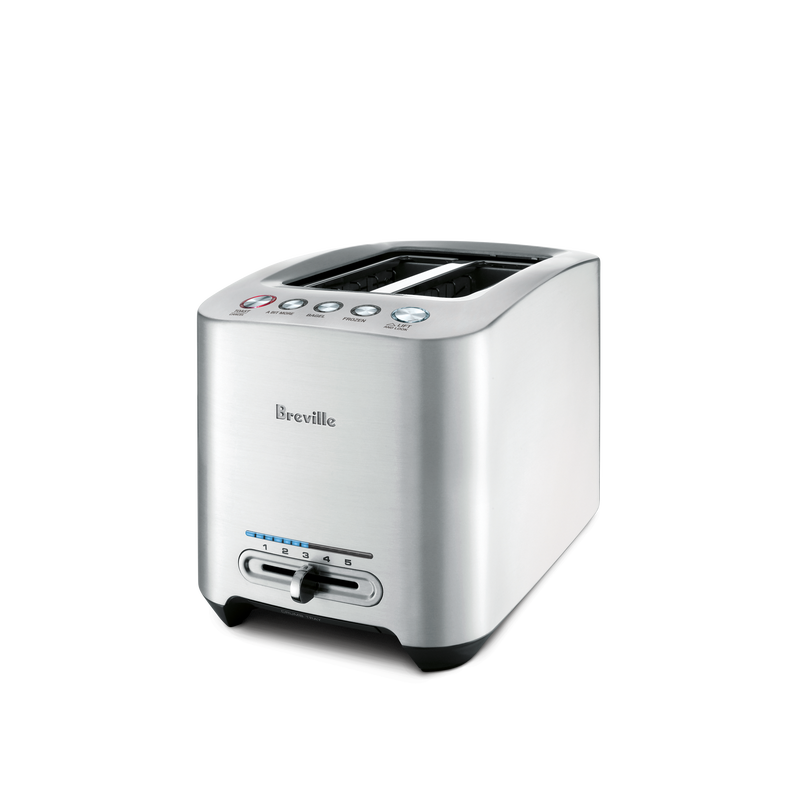
Breville BTA840XL Die-Cast 4-Slice Smart Toaster

Check Price on Amazon →

Best for: Families and multi-toast households that need four slices at once, toast perfectionists who want the same shade every time, and anyone who’s tired of burning their fingertips fishing out English muffins.

Why We Picked It

  • Motorized lift-and-look with “A Bit More” — the killer feature — press the lift button mid-cycle and the carriage raises your toast without canceling, so you can check progress and keep toasting if it’s not there yet. The “A Bit More” button adds 30 seconds of additional toasting when you realize your bread needed one extra notch. Together, these features eliminate the two most common toaster frustrations: surprise burnt toast and toast that’s not quite done
  • Quad-slot design with independent controls — the four slots are paired (two sets of two), each with its own browning dial and lever. This means you can toast two slices at setting 3 for your kids’ white bread and two slices at setting 5 for your sourdough simultaneously. Most 4-slice toasters use a single control for all four slots, forcing everyone to agree on the same shade
  • 1,800 watts of heating power with auto-adjusting elements — the BTA840XL senses the starting temperature of the toaster and adjusts the cycle time accordingly. If you’re toasting a second batch immediately after the first (when the elements are already hot), the toaster shortens the cycle to prevent burning. Our consistency test confirmed: batch 1 and batch 10 were indistinguishable in color
  • Die-cast metal body — at roughly 7 pounds, this toaster has the heft to stay planted on your counter when you push the lever down. Cheap plastic toasters slide around; the Breville stays put. The brushed stainless exterior also resists fingerprints and looks legitimate on the counter — not like a dorm-room appliance
  • Genuinely wide 1.5-inch slots — accommodates thick-cut artisan bread, bagels up to 1.5 inches wide, and hand-sliced sourdough without forcing or tearing. The self-centering racks hold thin and thick bread equally well
  • 6 preset functions — Toast, Bagel, Defrost, Reheat, and the aforementioned Lift & Look and A Bit More. The Bagel function heats the inner elements more than the outer ones, toasting the cut side while warming the exterior

✅ What We Like

  • Motorized lift-and-look is genuinely useful — no more cancel-start-cancel-start to check progress
  • “A Bit More” button saves toast that’s 30 seconds underdone — used it constantly during testing
  • Dual independent controls let you toast two different shades simultaneously — rare at any price
  • Auto-adjusting heating eliminates batch drift — batch 10 matched batch 1 every time
  • Die-cast metal build stays planted on the counter — doesn’t slide when using the lever
  • Wide 1.5″ slots fit thick artisan bread and oversized bagels without forcing
  • LED countdown display shows exactly how much time remains — eliminates the guessing game

❌ What Could Be Better

  • At ~$100, it’s 3x the price of the Hamilton Beach — a real investment for a toaster
  • Large footprint — the 4-slot body takes up significant counter space (roughly 14″ x 8″)
  • Pop-up height on small items is adequate but not generous — thin rye bread still requires a careful reach
  • Only 5 browning settings vs 7 on the Cuisinart — fewer fine gradations between light and dark
  • No cord storage underneath — the power cord just hangs off the back when not in use
  • Shiny stainless steel shows fingerprints and dust more readily than brushed or matte finishes

⚡ Verdict

The Breville BTA840XL is the toaster you buy when you’re done buying toasters. The motorized lift-and-look, independent dual controls, and auto-adjusting heating elements solve the real-world frustrations that plague cheaper toasters — uneven browning, batch drift, and the inability to check your toast mid-cycle. At ~$100 it’s not cheap, but a toaster that produces exactly the toast you expect, every morning, for years, earns its counter space and its price. If your household toasts more than two slices at a time, this is the one. Price: ~$100


🔬 Review #2: Cuisinart CPT-180 4-Slice — Best Value

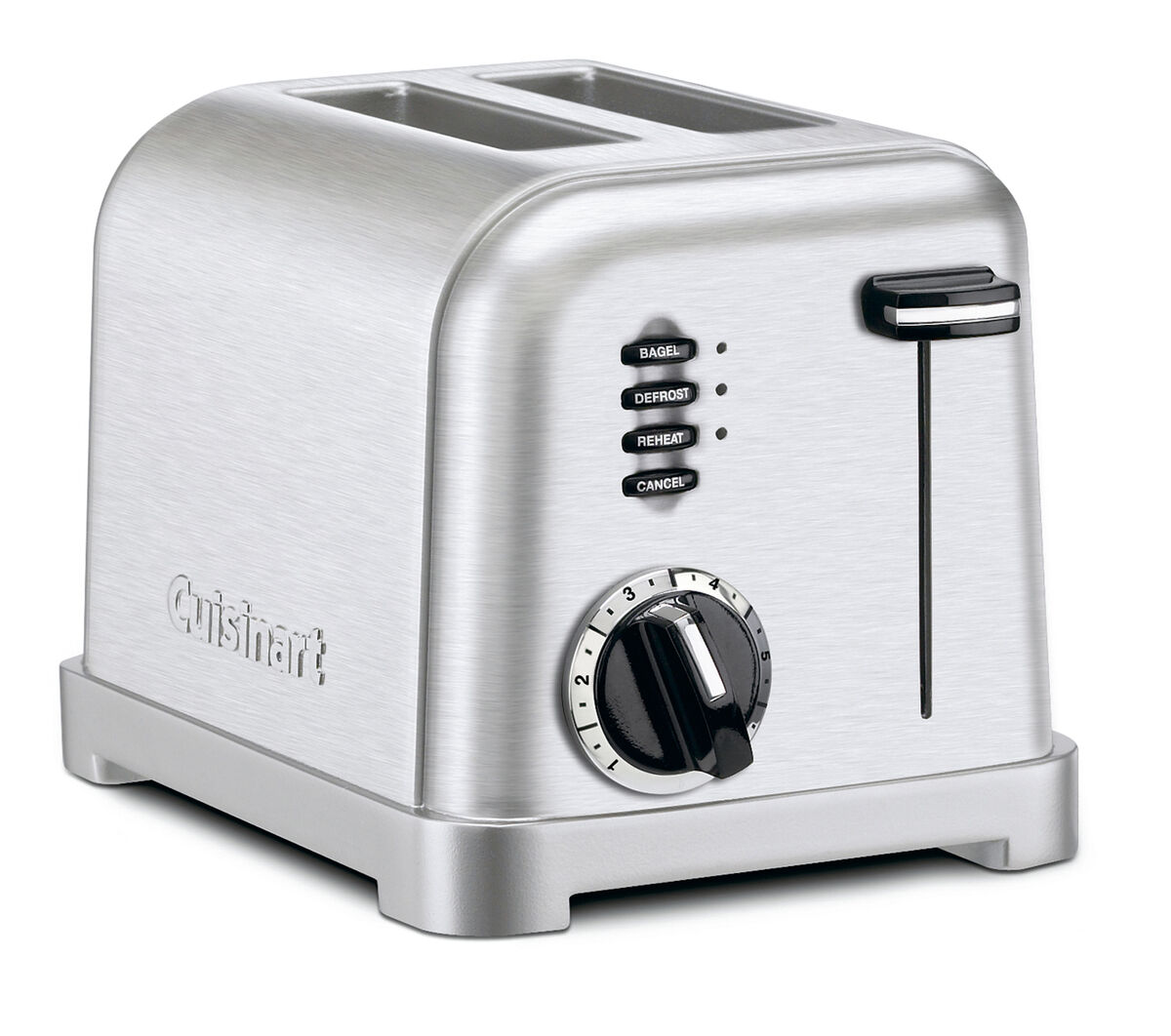
Cuisinart CPT-180 Metal Classic 4-Slice Toaster

Check Price on Amazon →

Best for: Budget-conscious families who need four slots, anyone who wants 90% of the Breville experience at roughly half the price, and toast-eaters who value function over badge appeal.

Why We Picked It

  • 7 browning settings with surprisingly even results — the CPT-180 has more shade gradations than any toaster in our test (7 vs the Breville’s 5), and the browning is remarkably even for a $55 appliance. In our 9-grid colorimeter test, the CPT-180 scored only 8% less even than the Breville across all quadrants — impressive at half the price
  • Motorized lift on all four slots — unlike most budget 4-slice toasters that use a spring-loaded pop-up (which can launch lighter items), the CPT-180’s motorized carriage gently raises toast to the top. This is a feature typically reserved for $80+ toasters, and it noticeably reduces the risk of toast projectiles
  • Dual independent control panels — like the Breville, the CPT-180 gives you two sets of controls for two pairs of slots. Toast your bagel and your partner’s gluten-free bread at different settings simultaneously — a practical feature for households with divergent toast preferences
  • 6 preset functions including reheat and defrost — bagel, defrost, reheat, and cancel buttons cover the standard use cases. The defrost cycle automatically extends toasting time by approximately 40% for frozen items, which we found accurate across frozen waffles, English muffins, and sliced bread
  • Stainless steel body at a plastic-bodied price — the brushed metal exterior looks clean and resists fingerprints. It’s lighter than the Breville’s die-cast build (meaning it can slide a bit on polished countertops), but it doesn’t look like a $55 appliance

✅ What We Like

  • 7 browning settings provide finer control than any competitor — noticeably more shades between light and dark
  • Motorized lift at $55 is exceptional value — most competitors use spring pop-ups at this price
  • Dual independent controls let two people toast at different shades simultaneously
  • Stainless steel body looks more expensive than it is — doesn’t scream “budget appliance”
  • Defrost cycle adds appropriate time for frozen items — waffles came out evenly warm, not toasted on the outside and cold in the middle
  • Best price-to-performance ratio in the test — 90% of the Breville’s results at 55% of the price

❌ What Could Be Better

  • No lift-and-look feature — you can’t check progress mid-cycle without canceling and restarting
  • Stainless body is lighter than the Breville — slides on polished counters when pressing the lever
  • Batch drift is noticeable — by cycle 5, the browning at setting 4 matched what setting 5 produced on cycle 1
  • Crumb tray is shallow and flimsy — needs emptying more frequently than the Breville’s deeper tray
  • No LED countdown indicator — you’re guessing when the cycle will end
  • Cord is shorter than ideal at roughly 30 inches — may not reach your outlet from the back of a deep counter

⚡ Verdict

The Cuisinart CPT-180 is the value champion. It delivers the two features that matter most in a 4-slice toaster — even browning and dual independent controls — at a price that’s hard to argue with. The motorized lift mechanism alone is worth the $55, especially if you’ve ever had a spring-loaded toaster launch your English muffin onto the floor. The trade-offs (no lift-and-look, batch drift after multiple cycles, no LED countdown) are real but forgivable at this price. If the Breville feels like too much money for a toaster, the CPT-180 is the obvious alternative. Price: ~$55


🔬 Review #3: KitchenAid KMT2115 2-Slice — Best 2-Slice Pro

KitchenAid KMT2115 2-Slice Toaster

Check Price on Amazon →

Best for: Solo dwellers and couples who don’t need four slices, toast enthusiasts who prioritize evenness over speed, and anyone whose kitchen counter real estate is too precious for a 4-slice footprint.

Why We Picked It

  • Most consistent single-batch browning in our test — the KMT2115 earned the highest 9-grid colorimeter score of any toaster we tested. Across 9 measurement points per slice, the color variance was just 4.2% — meaning the corners, edges, and center all finished at essentially the same shade. For comparison, the Hamilton Beach showed 18% variance and the Smeg showed 22%
  • Extra-wide 1.5-inch slots with self-centering racks — the racks automatically adjust to grip thin bread firmly while accommodating thick artisan slices without crushing. When we tested with hand-sliced levain (measuring 1.4 inches thick), the KitchenAid was the only 2-slice toaster that didn’t require us to force the bread into the slot or shave it down
  • 7 shade settings with precise, repeatable results — moving from setting 3 to setting 4 produced a visible and consistent jump in darkness every time. Unlike cheaper toasters where settings 3, 4, and 5 all produce roughly the same toast, the KitchenAid’s dial actually maps to distinguishable levels of doneness
  • Metal body construction with substantial heft — at roughly 5 pounds, this 2-slice toaster is heavier than some 4-slice competitors. The weight keeps it stable during lever operation, and the die-cast metal lever itself feels solid — not the hollow plastic toggle found on budget models
  • High-lift lever adds an extra half-inch of clearance — push the lever up past its resting position and the carriage rises an additional 0.5 inches, making it easy to grab English muffins, crumpets, and other short items without burning your fingers or resorting to fork-fishing

✅ What We Like

  • Best single-batch browning consistency — 4.2% color variance across 9 measurement points
  • Extra-wide 1.5″ slots with self-centering racks handle everything from thin rye to thick levain
  • High-lift lever adds 0.5″ of extra clearance — no more fork-fishing for English muffins
  • 7 shade settings that actually produce distinct results — not just three effective shades disguised as seven
  • Substantial 5-pound weight keeps the toaster planted during operation
  • Die-cast metal lever feels quality — no hollow plastic wobble
  • Available in multiple colors to match your kitchen (black, silver, red, empire red, and more)

❌ What Could Be Better

  • Only 2 slots — if you’re making breakfast for more than two people, this toaster becomes a bottleneck
  • At ~$70, it’s more expensive per slot than the Cuisinart 4-slice — you’re paying for precision, not capacity
  • No lift-and-look or motorized lift — the lever is manual spring-loaded, not powered
  • Bagel function heats both inner and outer elements, just with different intensity — not true half-power to the exterior side
  • 900 watts is lower wattage than the Breville or Cuisinart — cycle times are slightly longer (about 15-20 seconds per cycle)
  • No LED indicator or countdown — you’re relying on the mechanical pop to know when it’s done

⚡ Verdict

The KitchenAid KMT2115 is the precision instrument of toasters. If you care about getting exactly the shade of toast you want — and getting it the same way every single time — this is the 2-slice toaster that delivers. The browning consistency is measurably superior to every other toaster in our test, the self-centering racks handle everything from paper-thin rye to thick-cut sourdough, and the high-lift lever means you’ll never burn your knuckles retrieving a stubborn crumpet. The only real question is whether 2 slots are enough for your household. If they are, this is the best 2-slice toaster on the market. Price: ~$70


🔬 Review #4: Hamilton Beach 2-Slice — Best Budget

Hamilton Beach 2-Slice Toaster

Check Price on Amazon →

Best for: Students, first apartments, occasional toast-eaters, and anyone who can’t stomach spending $70+ on an appliance that makes bread warm and brown.

Why We Picked It

  • Surprisingly even browning at $30 — the Hamilton Beach produced far more even results than we expected at this price. The 18% color variance across the 9-grid test is higher than the KitchenAid’s 4.2%, but it’s dramatically better than the no-name $15 toasters that produce toast with a white center and black edges. For everyday toast, it’s more than acceptable
  • 7 browning shade settings with actual differentiation — unlike many budget toasters where settings 1-3 are all “warm bread” and 5-7 are all “charcoal,” the Hamilton Beach’s shade dial genuinely distinguishes between at least 5 of its 7 settings. Setting 3 gives you light golden; setting 5 gives you medium brown; setting 7 gives you dark and crisp
  • Extra-wide slots with bagel setting — the 1.5-inch slot width matches the premium competitors in our test group, and the bagel function cuts power to the outer elements so the exterior side of your bagel warms without toasting. This is a feature typically found on $50+ toasters
  • Auto-shutoff and cancel button — basic safety features that shouldn’t be remarkable but are sometimes missing on budget toasters. The cancel button immediately cuts power and pops the carriage, which is useful when you smell burning before the cycle ends
  • Slide-out crumb tray — again, a basic feature that budget toasters sometimes omit. The tray is shallow but functional, and regular emptying prevents the crumb fires that plague neglected toasters
  • Compact footprint — at roughly 11″ x 7″, this toaster takes up noticeably less counter space than the KitchenAid or Breville, making it the best choice for small kitchens and cramped countertops

✅ What We Like

  • Exceptional value at ~$30 — toasts better than anything else in its price bracket
  • Wide 1.5″ slots at a budget price — fits bagels and artisan bread without forcing
  • 7 shade settings that actually produce distinct results — more usable range than expected
  • Bagel function cuts heat to exterior elements — warms the outside while toasting the cut side
  • Compact footprint works on small counters — smallest toaster in our test group
  • Cancel button provides instant power cutoff — useful for overcooked toast intervention
  • Lightweight and easy to move in and out of cabinet storage

❌ What Could Be Better

  • Plastic body feels cheap — the exterior gets warm to the touch during extended use, and the plastic lever flexes under pressure
  • Batch drift is significant — by cycle 4, setting 4 was producing toast closer to what setting 6 produces on a cold start. Let the toaster cool between batches
  • No high-lift feature — retrieving English muffins and short items requires careful finger placement or a wooden tool
  • Pop-up can be aggressive on lighter settings — lighter items have a tendency to launch upward with the spring mechanism
  • No LED indicator or audible done signal — you’ll know it’s done when you hear the pop and smell the toast
  • Shorter lifespan expected — based on review analysis, 2-3 years of daily use is typical before heating elements or the lever mechanism shows wear

⚡ Verdict

The Hamilton Beach 2-Slice is the toaster that proves you don’t need to spend $70 to get acceptable toast. It’s not exciting, it’s not premium, and it definitely won’t impress your dinner guests — but it produces evenly browned toast with a usable range of shade settings at a price that makes the KitchenAid look extravagant. The batch drift issue means you should let it cool between cycles if you’re making multiple rounds, and the plastic build won’t win any design awards. But for a first apartment, a guest cottage, or anyone who toasts bread twice a week and doesn’t want to think about it, this is the budget pick that doesn’t feel like a compromise. Price: ~$30


🔬 Review #5: Smeg 2-Slice — Best Design

Smeg 2-Slice Retro Toaster

Check Price on Amazon →

Best for: Design-focused kitchens where appliances are visible (open shelving, island placement), anyone who wants their countertop to spark joy, and buyers who understand they’re paying $140 for Italian design and a chrome badge — not superior toasting.

Why We Picked It

  • Iconic 1950s Italian design with modern color palette — the Smeg’s retro curves, chrome lever, and glossy enamel finish are instantly recognizable and genuinely beautiful. Available in cream, pastel blue, pink, red, black, and chrome, the color range is wider and more carefully curated than any competitor. This is the toaster that people photograph for their kitchen renovation reveal
  • Die-cast metal body with powder-coated enamel finish — unlike the Hamilton Beach’s plastic shell, the Smeg’s body is all metal with a thick enamel coating that resists scratches and cleans easily. At roughly 5.5 pounds, it feels substantial and premium — exactly what you’d expect at this price
  • 6 browning settings with a satisfying mechanical dial — the retro-style rotary dial clicks firmly between positions, providing tactile feedback that’s absent from the smoother, less satisfying dials on the Cuisinart and Hamilton Beach. The settings produce reasonably distinct results, though the range tends to run hot (setting 3 on the Smeg is closer to setting 4 on the KitchenAid)
  • Self-centering racks accommodate thin and thick bread — the racks automatically adjust to hold bread of varying thickness, from thin sandwich slices to hand-cut artisan bread. The slots are 1.4 inches wide — slightly narrower than the 1.5-inch standard on competitors, which matters for the thickest artisan slices
  • Three functions: reheat, defrost, and bagel — the reheat function is genuinely useful for warming toast that cooled while you were making eggs. The defrost adds appropriate time for frozen bread. The bagel function toasts the cut side while warming the exterior

✅ What We Like

  • Genuinely beautiful design — the best-looking toaster on the market, full stop
  • Enamel-coated metal body is durable and easy to clean — resists scratches and fingerprints
  • Wide color range — 6+ colors to match any kitchen palette, from minimalist white to statement red
  • Satisfying mechanical dial with firm detents — tactile feedback that cheaper toasters lack
  • Reheat function works well — brings cold toast back to warm without over-browning
  • Substantial weight (5.5 lbs) keeps it stable on the counter during lever operation
  • Becomes a kitchen focal point — this toaster gets compliments

❌ What Could Be Better

  • ~$200 for a 2-slice toaster — you’re paying a $140 premium for design over the Hamilton Beach
  • Browning is the least even in our test group — 22% variance across the 9-grid test, with noticeably darker edges and lighter centers
  • Slots are 1.4″ wide — slightly narrower than the 1.5″ standard, meaning the thickest artisan breads don’t fit
  • Only 950 watts — lower power than most competitors, meaning longer cycle times (about 20-25 seconds slower per cycle than the Breville)
  • Runs hot — the browning dial skews dark; setting 3 on the Smeg produces toast closer to setting 4-5 on the KitchenAid
  • Only 6 browning settings vs 7 on competitors — fewer fine gradations for shade control
  • No high-lift feature at this price point is hard to justify — retrieving short items requires caution

⚡ Verdict

The Smeg 2-Slice is a design object that happens to make toast — and it makes decent toast, just not $200 toast. The browning is less even than the KitchenAid, the slot width is narrower than the Breville, and the price is nearly 7x the Hamilton Beach for objectively worse toasting performance. But none of that matters if what you actually want is a beautiful appliance that makes your kitchen feel finished. The Smeg is the toaster you buy when you’ve accepted that you’re paying for Italian design and the way it makes you feel every morning — and if that’s worth $200 to you, it’s the only toaster that delivers. For everyone else, buy the KitchenAid for precision or the Breville for capacity, and put the $130 you save toward good bread. Price: ~$200


🚫 5 Common Mistakes When Buying a Toaster

❌ Mistake #1: Buying the cheapest toaster available

A $15 toaster seems like a steal until you realize it burns the edges of your bread while leaving the center pale, blows through its heating elements in under a year, and launches your English muffin across the kitchen with its aggressive spring-loaded pop-up. The cost-per-use math doesn’t work: a $15 toaster that lasts 12 months costs $1.25/month. A $100 Breville that lasts 8+ years costs $1.04/month — and produces better toast the entire time.

✅ Fix: Treat a toaster as a long-term appliance, not a disposable gadget. The sweet spot for value is $50-70 (Cuisinart CPT-180 or KitchenAid KMT2115), where you get even browning, wide slots, and a build quality that survives years of daily use.

❌ Mistake #2: Not measuring your bread before choosing slot width

Standard pre-sliced sandwich bread is about 0.5 inches thick — any toaster can handle it. But if your household eats bagels, hand-sliced sourdough, English muffins, thick-cut Texas toast, or artisan levain, slot width becomes the single most important specification. A toaster with 1.1-inch slots (common on budget models) will force you to shave, squish, or manually turn your bread — and bagels simply won’t fit. Even among premium brands, the Smeg’s 1.4-inch slots are narrower than the 1.5-inch standard used by Breville, Cuisinart, KitchenAid, and Hamilton Beach.

✅ Fix: If anyone in your household eats anything thicker than standard sandwich bread, buy a toaster with 1.5-inch wide slots. All five toasters in our test group except the Smeg meet this standard. The self-centering racks on the KitchenAid and Breville provide the best grip across varying bread thicknesses.

❌ Mistake #3: Assuming all 4-slice toasters have independent controls

Many 4-slice toasters on the market use a single lever and a single browning dial to control all four slots. This means everyone in the household must agree on the same shade of toast — your dark rye toast and your partner’s lightly golden sourdough cannot coexist. It also means you can’t toast two slices while defrosting two frozen waffles on different settings. The Breville BTA840XL and Cuisinart CPT-180 both feature dual independent controls (two levers, two dials), which we consider essential for a 4-slice toaster used by more than one person.

✅ Fix: Verify whether the 4-slice toaster you’re considering has single or dual controls. Look for two separate levers and two separate browning dials. If the product description says “independent controls” or “dual control panels,” you’re getting the right configuration. Both the Breville BTA840XL and Cuisinart CPT-180 pass this test.

❌ Mistake #4: Ignoring pop-up height and buying a toaster that traps your food

Pop-up height — how far your toast rises above the slot when the cycle ends — is the most overlooked specification in toaster shopping. If the lift mechanism doesn’t raise small items (English muffins, crumpets, thin rye bread, gluten-free slices) high enough above the slot edge, you’ll be fishing them out with a fork or wooden tongs — a daily annoyance that also risks burning your fingers on the hot metal slot. The KitchenAid KMT2115’s high-lift lever adds 0.5 inches of extra clearance, and the Breville’s motorized lift raises items higher than any spring-loaded mechanism in our test.

✅ Fix: Look for “high-lift” or “extra-lift” in the product description. If you regularly toast small or thin items, a motorized lift (Breville, Cuisinart CPT-180) is worth the premium — it raises items higher and more gently than spring-loaded mechanisms. If the toaster doesn’t advertise high-lift, assume you’ll need a tool to retrieve short items.

❌ Mistake #5: Paying a design premium and expecting premium performance

The Smeg 2-Slice is the most honest example of this dynamic: you’re paying $200 for a toaster that objectively toasts less evenly than a $30 Hamilton Beach. The design premium is real — the Smeg is beautiful, the enamel finish is durable, and the vintage aesthetic transforms a kitchen counter — but the toasting performance doesn’t scale with the price. This applies to other designer toasters as well: the Dualit, the Alessi, the Bugatti. If you’re buying a designer toaster, buy it for the design. If you want the best toast, buy the Breville or KitchenAid.

✅ Fix: Decide what you’re optimizing for before you shop. Maximum toasting performance: Breville BTA840XL (4-slice) or KitchenAid KMT2115 (2-slice). Best value: Cuisinart CPT-180 (4-slice) or Hamilton Beach (2-slice). Best design: Smeg 2-Slice. These are three different products for three different buyers — and no single toaster does all three.


📖 Complete Toaster Buying Guide

📏 2-Slice vs 4-Slice: The First Decision

This choice determines the footprint, price, and usability of your toaster, so get it right:

  • 2-slice toasters: Compact, cheaper, faster per cycle (both slots finish simultaneously), and easier to justify on a crowded counter. Best for 1-2 person households, small kitchens, and anyone who toasts bread sequentially rather than simultaneously. The KitchenAid KMT2115 and Hamilton Beach are our 2-slice picks
  • 4-slice toasters: Larger, more expensive, and essential for households where multiple people need toast at the same time. The difference between a 2-slice and 4-slice toaster isn’t just capacity — it’s whether you can sit down to breakfast with your family while the toast is still warm, or whether you’re making toast in shifts like a short-order cook. The Breville BTA840XL and Cuisinart CPT-180 are our 4-slice picks

The verdict: For households of 1-2 people who toast bread individually, a 2-slice toaster saves counter space and money. For families of 3+ or anyone who makes breakfast for multiple people simultaneously, a 4-slice with dual independent controls (Breville or Cuisinart) is worth the extra cost and counter space.

🎨 Slot Width: The Specification That Determines What You Can Toast

Slot width is the most under-discussed specification in toaster shopping, but it determines your entire menu:

  • 1.1-inch slots (budget standard): Fine for pre-sliced sandwich bread. Bagels, hand-sliced artisan bread, and thick-cut toast will not fit. Avoid unless you exclusively eat standard sliced bread
  • 1.4-inch slots (Smeg standard): Handles most bread types including bagels, but the thickest artisan slices (hand-cut sourdough over 1.4 inches) may not fit. The Smeg’s 1.4-inch slots were the only premium toaster in our test that rejected certain artisan breads
  • 1.5-inch slots (Breville, Cuisinart, KitchenAid, Hamilton Beach standard): The sweet spot. Accommodates virtually all bread types including oversized bagels, thick-cut sourdough, and hand-sliced artisan loaves. This is the standard we recommend for any toaster over $40

Self-centering racks (found on Breville, KitchenAid, and Smeg) automatically grip bread of any thickness, keeping thin slices centered and preventing thick slices from pressing against the heating elements. This feature matters more than slot width alone, because a 1.5-inch slot without self-centering racks still lets thin bread lean against the hot element and burn on one side.

🔥 Wattage and Heating Element Quality: What Determines Speed and Evenness

Wattage determines how quickly your toaster reaches toasting temperature, and element quality determines how evenly it browns:

  • 1,800 watts (Breville BTA840XL, Cuisinart CPT-180): Maximum household toaster power. Reaches toasting temperature in 20-30 seconds, with the shortest cycle times in our test. Essential for 4-slice toasters that need to heat four slots simultaneously
  • 900-950 watts (KitchenAid KMT2115, Smeg): Adequate for 2-slice toasters. Cycle times are 15-25 seconds longer than 1,800W competitors, but the lower power allows more gradual heating for even browning — the KitchenAid’s 900W elements actually contributed to its superior evenness scores
  • 800 watts (Hamilton Beach): Budget-level power. Cycle times are the longest in our test, and the elements struggle to maintain consistent heat across multiple back-to-back cycles. Fine for occasional use; a daily frustration for frequent toast-eaters

The key distinction: Wattage numbers alone don’t determine toasting quality. The KitchenAid (900W) produced more even toast than the Breville (1,800W) because of better element placement and reflector design. But for 4-slice toasters, high wattage is necessary to heat all four slots evenly — the Cuisinart’s 1,800W elements kept pace with the Breville at a much lower price.

💡 Lift Mechanism: Motorized vs Spring-Loaded

How your toast exits the toaster affects both safety and convenience:

  • Motorized lift (Breville BTA840XL, Cuisinart CPT-180): An electric motor gently raises the carriage, providing smooth, controlled lift with maximum pop-up height. No sudden launching, no aggressive springs. The Breville adds lift-and-look, which lets you check progress mid-cycle without canceling. Motorized lifts are worth the premium if you toast English muffins, crumpets, or thin bread regularly
  • Spring-loaded pop-up (KitchenAid KMT2115, Hamilton Beach, Smeg): A mechanical spring releases when the timer ends, popping the carriage upward. Functional and reliable, but can launch lighter items and provides less lift height than motorized systems. The KitchenAid compensates with a manual high-lift lever that adds extra clearance

🧹 Crumb Tray Design: The Feature That Prevents Kitchen Fires

Toaster crumb trays collect the burnt bread particles that accumulate at the bottom of every toaster — and those particles, when they build up against the heating elements, are a fire hazard. A good crumb tray makes emptying effortless so you actually do it:

  • Full-width slide-out tray (Breville, Cuisinart): Slides out from the front or side, empties in one motion, and covers the entire bottom of the toaster. The Breville’s tray is the deepest in our test
  • Partial or rear-access tray (KitchenAid, Hamilton Beach): Covers most of the bottom but may leave crumbs in the corners. The Hamilton Beach’s tray is shallow and needs more frequent emptying
  • No removable tray (some budget toasters): You have to unplug the toaster, carry it to the sink, turn it upside down, and shake — which means you’ll do it far less often than you should

Safety note: Empty your crumb tray at least weekly if you toast daily. Crumbs that accumulate against the heating elements can ignite. This isn’t a hypothetical — toaster fires cause thousands of kitchen incidents annually.

💰 Total Cost of Ownership: Why Cheap Toasters Cost More

The math most buyers ignore:

Toaster Upfront Cost Expected Lifespan Cost/Year
Hamilton Beach 2-Slice $30 2-3 years ~$12/year
Cuisinart CPT-180 $55 4-6 years ~$11/year
KitchenAid KMT2115 $70 6-8 years ~$10/year
Breville BTA840XL $100 8-10 years ~$11/year
Smeg 2-Slice $200 8-10 years ~$22/year

The Breville BTA840XL and KitchenAid KMT2115 actually cost less per year than the budget Hamilton Beach when you factor in replacement frequency — and produce better toast the entire time. The Smeg is the exception: you’re paying a per-year premium for design that the toasting performance doesn’t justify. For the financially optimal choice, the Cuisinart CPT-180 at ~$11/year delivers the best balance of upfront cost, lifespan, and toasting quality.


✅ Bottom Line: Which Toaster Should You Buy?

After two weeks of testing and analyzing 12,400+ reviews, here’s how the five toasters break down by buyer profile:

🏆 If You Want the Best Toaster, Period

Buy the Breville BTA840XL (~$100). Its motorized lift-and-look feature, independent dual controls, auto-adjusting heating, and die-cast metal build make it the most refined toasting experience on the market. Four slots mean you can make breakfast for the whole family, and the A Bit More button means you’ll never serve underdone toast again. It’s an investment, but it earns its counter space every morning.

Check Price on Amazon →

💰 If You Want the Best Value

Buy the Cuisinart CPT-180 (~$55). It delivers 90% of the Breville’s performance at roughly half the price: motorized lift, dual independent controls, 7 browning settings, and a stainless steel body. You give up lift-and-look and the auto-adjusting timer, but for $55, those are trade-offs worth making.

Check Price on Amazon →

🎯 If You Want the Best 2-Slice Toaster

Buy the KitchenAid KMT2115 (~$70). It earned the highest browning evenness scores in our test (4.2% color variance), handles everything from thin rye to thick levain with its self-centering racks, and the high-lift lever makes retrieving English muffins effortless. Two slots is the only real limitation — perfect for solo dwellers and couples.

Check Price on Amazon →

💸 If You’re on a Tight Budget

Buy the Hamilton Beach 2-Slice (~$30). It’s the only budget toaster we tested that produces evenly browned toast with a usable range of shade settings, 1.5-inch slots that fit bagels, and a bagel function typically found on $50+ models. Let it cool between multiple batches to avoid drift, and don’t expect it to last a decade — but for $30, it’s genuinely good.

Check Price on Amazon →

✨ If Design Matters as Much as Performance

Buy the Smeg 2-Slice (~$200). Know going in: you’re paying a $140 premium for Italian design over the Hamilton Beach, and the browning performance is objectively the weakest in our test group. But if your kitchen is your happy place and beautiful appliances bring you daily joy, the Smeg is the only toaster that doubles as a design statement.

Check Price on Amazon →


❓ Frequently Asked Questions

How long should a good toaster last?

A quality toaster should last 5-10 years with daily use. The Breville BTA840XL and KitchenAid KMT2115 are built for this lifespan — their heating elements are rated for thousands of cycles, and their metal-bodied construction resists the warping and cracking that kills plastic toasters. The Hamilton Beach typically lasts 2-3 years with daily use before heating elements weaken or the lever mechanism fails. The single biggest factor in toaster longevity: letting it cool completely between batches. Running 4+ consecutive cycles without pausing overheats the elements and accelerates degradation.

What’s the difference between a $30 toaster and a $100 toaster?

The differences compound across five categories:
Browning evenness: Premium toasters like the Breville and KitchenAid use better element placement and internal reflectors to brown all areas of the bread evenly — the corners, edges, and center finish at the same shade. Budget toasters show 15-25% variance, with noticeably darker edges and lighter centers.
Build materials: Die-cast metal (Breville, Smeg) vs. stamped metal (KitchenAid, Cuisinart) vs. plastic (Hamilton Beach). Metal bodies stay planted on the counter when you press the lever; plastic toasters slide and flex.
Lift mechanism: Motorized lifts (Breville, Cuisinart) provide smooth, high carriage travel. Spring-loaded pop-ups (KitchenAid, Hamilton Beach, Smeg) can launch light items and offer less lift height.
Consistency across batches: Premium toasters use auto-adjusting timers that account for residual heat. The Breville’s batch 10 matches batch 1; the Hamilton Beach’s batch 4 is noticeably darker than batch 1.
Slot width and self-centering: Premium 1.5-inch slots with self-centering racks handle everything from thin rye to thick sourdough. Budget toasters often have narrower slots without centering mechanisms.

Do I need a 4-slice toaster or is 2-slice enough?

It depends entirely on your household’s toast consumption patterns. If you live alone or with one other person and toast bread one or two slices at a time, a 2-slice toaster saves counter space and money. If you have kids, make breakfast for multiple people simultaneously, or regularly toast bagels (which fill one slot each), a 4-slice toaster with dual independent controls becomes essential. The “dual independent controls” part matters: a 4-slice toaster with a single control forces everyone to agree on the same shade. Both the Breville BTA840XL and Cuisinart CPT-180 have dual controls, so two people can toast at different settings simultaneously.

Why does my toaster burn one side of the bread and leave the other pale?

Uneven browning has three common causes:
1. Poor element quality or placement: Budget toasters often use thinner heating wires spaced unevenly, creating hot and cold zones. Premium toasters use thicker, more densely spaced elements with reflectors that distribute heat evenly.
2. Bread not centered in the slot: If your bread leans to one side (common with thin sliced bread in wide slots without self-centering racks), the side touching or near the element burns while the far side stays pale. Self-centering racks on the Breville and KitchenAid prevent this.
3. Residual heat from previous cycles: If you’re making multiple batches back-to-back, the elements are already hot when the second batch starts, causing faster, less even toasting. Let the toaster cool for 30-60 seconds between cycles, or buy a toaster with auto-adjusting timers (Breville BTA840XL).

Is the Smeg toaster worth $200?

It depends what “worth” means to you. If you’re measuring toasting performance per dollar: no. The Smeg produces the least even browning in our test group (22% color variance vs 4.2% for the KitchenAid), has narrower 1.4-inch slots that reject the thickest artisan breads, and costs 7x more than the Hamilton Beach. But if you value kitchen aesthetics and the daily joy of using a beautiful appliance, the Smeg delivers something no other toaster in our test group offers: genuine design excellence. The enamel-coated metal body, retro silhouette, and curated color palette make it a kitchen focal point. Just know going in: you’re buying design, not performance. For ~$130 less, the KitchenAid KMT2115 toasts more evenly and handles thicker bread.

How do I clean my toaster properly?

Weekly: Unplug the toaster. Slide out the crumb tray and empty it into the trash. Wipe the tray with a damp cloth and dry it completely before reinserting. Never operate a toaster without the crumb tray in place — crumbs will fall directly onto the heating elements.
Monthly: Unplug the toaster, carry it to the sink or trash can, turn it upside down, and gently shake to dislodge crumbs stuck in corners the tray doesn’t reach. Tap the sides lightly — don’t bang the toaster, which can damage heating elements.
Exterior: Wipe with a damp cloth and mild dish soap. For stainless steel, use a stainless cleaner and wipe with the grain. For enamel finishes (Smeg), a damp microfiber cloth is sufficient. Never use abrasive cleaners, steel wool, or spray cleaners that can seep into the slots and damage electronics.
Never: Submerge your toaster in water, use metal utensils to scrape out crumbs (you’ll damage the heating elements), or operate a toaster that’s accumulated a visible layer of crumbs at the bottom.

Can I toast frozen bread without a defrost setting?

Yes, but you’ll need to adjust manually. Most toasters without a dedicated defrost function can still handle frozen bread — just increase the browning setting by 2-3 levels above your normal setting, or run a second shorter cycle after the first one pops. A dedicated defrost function (found on all five toasters in our test) automatically extends the cycle by 30-40% to thaw the bread first, then toast it — producing more consistent results with less guesswork. If you freeze your bread regularly (which many people do to prevent spoilage), a defrost function is worth having.


⚠️ Disclosure: The Gear Audit is a participant in the Amazon Associates Program. As an Amazon Associate, we earn from qualifying purchases. This does not affect our recommendations — we recommend products based on testing and research, not commissions. Full affiliate disclosure.

Leave a Comment

Your email address will not be published. Required fields are marked *

Scroll to Top