Flashlights Compared for Everyday and Outdoor Use (2026)
Quick answer
For a balanced distance light, start with Fenix PD36R PRO. Olight Seeker 4 Pro spreads light across a wider area, while Nitecore MH12 Pro prioritizes throw. Streamlight ProTac HL-X handheld offers multi-fuel flexibility; Wurkkos FC11C suits close everyday tasks. Check the exact suffix and battery kit before ordering.
A flood beam, a throw beam and a small everyday carry light solve different jobs. Compare sustained output, battery format and controls after choosing the beam you need.
Compare the configurations
| Model | Role | Choose another when… |
|---|---|---|
| Fenix PD36R PRO | balanced rechargeable distance light | You need wide near-field flood or a much smaller pocket light. |
| Olight Seeker 4 Pro | wide-beam light with rotary control | You require long throw or assume the optional magnetic cable ships in the box. |
| Nitecore MH12 Pro | compact long-throw tactical-format light | You need an easy broad work light or prefer fewer mode controls. |
| Streamlight ProTac HL-X handheld | multi-fuel work and duty-style light | You want built-in USB-C charging on the flashlight body or a tiny EDC format. |
| Wurkkos FC11C | small USB-C everyday carry light | You need the farthest beam or a larger flood for a whole outdoor area. |
Fenix PD36R PRO: balanced rechargeable distance light

The old guide named the original PD36R while its photo visibly shows PD36R PRO. The PRO is the model documented here: Fenix lists a 2,800-lumen peak, 380 m rated throw, included 21700 battery, USB-C charging and IP68 protection. Those maxima are manufacturer laboratory specifications, not our field results or sustained output. The dual tail switches give immediate on/off and mode selection without searching for a side control. Its narrow head and pocket clip make it a versatile carry light for seeing farther down a path, though its beam is less flood-oriented than the Olight.
Pros
- Dual tail controls provide direct activation and mode changes, including momentary use.
- Included rechargeable 21700 cell and USB-C charging simplify a regular-use kit.
Cons and trade-offs
- Rated 2,800-lumen turbo is a peak level; the thermal step-down and lower modes matter more for a long task.
- A distance-oriented hotspot will not illuminate a wide work area like a broad flood beam.
Best for: Walking, inspection and general outdoor use where both carry size and beam reach matter.
Choose another if: You need wide near-field flood or a much smaller pocket light.
Our recommendation
Choose the PD36R PRO as a balanced distance-first option, after verifying the PRO label and kit.
Search Amazon for Fenix PD36R PRO
Olight Seeker 4 Pro: wide-beam light with rotary control

Olight specifies a 4,600-lumen turbo peak, 260 m maximum distance, 5,000 mAh rechargeable cell and IPX8 water rating for the Seeker 4 Pro. Its broad beam and rotary side switch suit close-to-mid-range searches or a dark yard. The official manual says the vertical holster and USB-C charging cable are in the box; the magnetic charging cable is an optional accessory, not a standard inclusion. Olight’s runtime table shows full turbo for 2.5 minutes before stepping down, so buy for its useful modes and interface rather than treating the peak as continuous output.
Pros
- Broad illumination and rotary side control help light a nearby area without aiming a tight hotspot.
- Included holster offers a practical carry and USB-C charging arrangement.
Cons and trade-offs
- The 4,600-lumen maximum steps down quickly in the maker runtime table.
- Its larger 35 mm head and 205 g listed weight are less pocket-friendly than the smaller FC11C.
Best for: A home or campsite user who values broad coverage and an easy rotary interface.
Choose another if: You require long throw or assume the optional magnetic cable ships in the box.
Our recommendation
Choose Seeker 4 Pro for flood-style area light; check the exact charging accessories in the offer.
Search Amazon for Olight Seeker 4 Pro
Nitecore MH12 Pro: compact long-throw tactical-format light

The former article discussed MH12S, but the pictured flashlight reads MH12 Pro, while Nitecore labels MH12S discontinued. We therefore compare the exact pictured MH12 Pro. Nitecore lists a 3,300-lumen peak, 505 m rated throw, 21700 battery, USB-C port, tail switch and separate mode button. Its high candela is useful when a smaller distant target matters more than lighting a whole yard. The maximum throw is a maker rating under its test method, not a claim that every object is easily identifiable at that distance.
Pros
- Highest maker-rated throw in this shortlist makes the beam useful for distant landmarks.
- Tail activation plus separate mode button and battery indicators support quick control and charge checks.
Cons and trade-offs
- Tight long-distance beam covers less nearby area than the Olight flood.
- Special modes and two user interfaces take more familiarization than a simple single-button light.
Best for: Someone who prioritizes reach in a compact handheld format.
Choose another if: You need an easy broad work light or prefer fewer mode controls.
Our recommendation
Choose MH12 Pro for throw, checking the Pro name; do not apply discontinued MH12S specifications to this photo.
Search Amazon for Nitecore MH12 Pro
Streamlight ProTac HL-X handheld: multi-fuel work and duty-style light
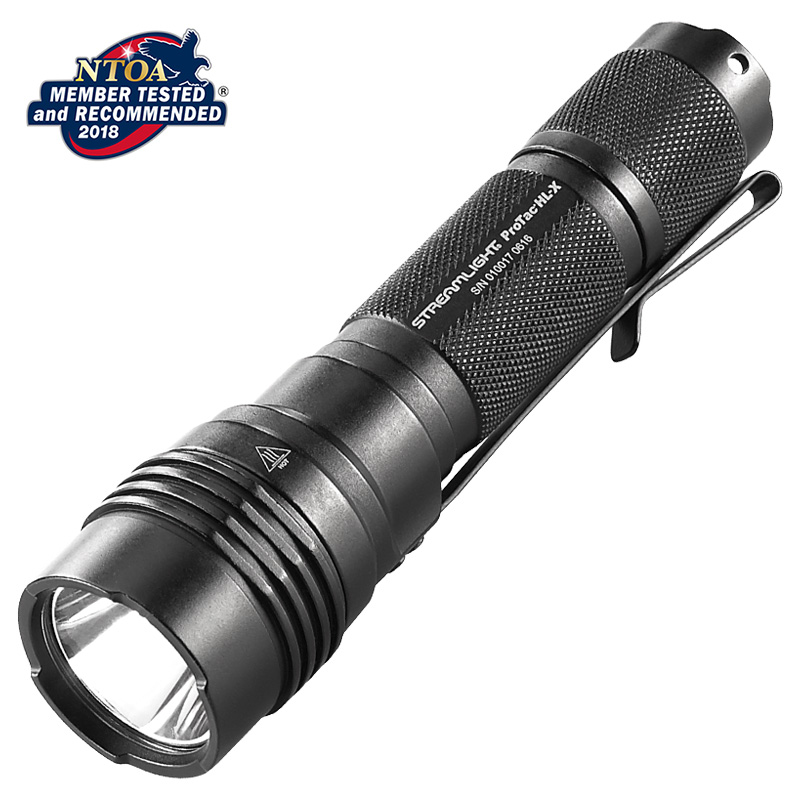
The original image was a rail-mounted long-gun kit, not the handheld ProTac HL-X being compared. The official handheld photo and current Streamlight sheet anchor this entry. The latest maker sheet lists 1,300 lumens on the SL-B26 rechargeable pack or 1,000 lumens on two CR123A cells, with TEN-TAP mode programming and IP68 protection. This battery flexibility is its practical edge for a glove box or work bag, though the output and bundle differ by power choice. The rechargeable system includes an SL-B26 battery and USB cord; the non-rechargeable kit has CR123A cells instead.
Pros
- SL-B26 or CR123A power gives a useful backup path when recharging is inconvenient.
- TEN-TAP programming offers high-only or stepped modes to match work habits.
Cons and trade-offs
- Different cell choices produce different rated brightness and runtime, so specs require the correct configuration.
- The handheld and rail-mount HL-X share a name; marketplace listings can easily show the wrong product.
Best for: A work-bag light where battery flexibility and a straightforward grip matter.
Choose another if: You want built-in USB-C charging on the flashlight body or a tiny EDC format.
Our recommendation
Choose the handheld ProTac HL-X only after matching the maker part number and battery kit.
Search Amazon for Streamlight ProTac HL-X handheld
Wurkkos FC11C: small USB-C everyday carry light

The original text used the FC11 name and a 1,300-lumen rating, but the pictured body appears to be FC11C, a distinct current Wurkkos model. Wurkkos describes the FC11C with a Nichia 519A emitter, buck driver, 1,200-lumen maximum, 18650 battery format, USB-C charging and magnetic tail. That combination makes it a practical nearby task light: the magnetic tail can free a hand near steel, and the side switch avoids a tactical tail interface. Confirm whether the selected seller bundle includes an 18650 cell, as Wurkkos offers kit variants.
Pros
- Magnetic tail and compact format suit hands-free close work on a vehicle or metal surface.
- Nichia 519A and buck-driver configuration focus on usable everyday light rather than maximum throw.
Cons and trade-offs
- Shorter rated reach than PD36R PRO or MH12 Pro; it is not the distance pick.
- FC11 and FC11C are different models with different output specifications and driver designs.
Best for: Pocket or household carry for close tasks and occasional magnetic mounting.
Choose another if: You need the farthest beam or a larger flood for a whole outdoor area.
Our recommendation
Choose FC11C for compact daily utility; verify the C suffix and battery-in-box option.
Buying guide
- Start with beam shape, not the biggest lumen number. A throw-oriented light concentrates intensity on a distant target; a flood light covers a wide nearby area. Fenix and Nitecore favor reach, Olight favors spread, and FC11C is for close tasks.
- Read the complete runtime curve. Peak/turbo figures are short-duration maker ratings because heat and battery limits cause step-down. Compare high and medium modes for the time you actually need, and keep a charged spare where appropriate.
- Match the battery and charging method. Fenix and Nitecore use 21700 cells with USB-C charging; FC11C uses 18650. Olight includes a USB-C holster and lists the magnetic cable as optional. Streamlight has different rechargeable and CR123A kits. Do not assume similarly named cells or chargers are interchangeable.
- Check the ingress rating for your use. IP68 and IPX8 ratings have defined maker test conditions, not unlimited underwater use. Dry and maintain contacts and seals according to the manual, particularly after rain.
- Buy the exact suffix and format. PD36R PRO differs from PD36R/V2.0, MH12 Pro differs from discontinued MH12S, FC11C differs from FC11, and ProTac HL-X handheld differs from rail mount. Compare the printed model and included accessories.
- Build a practical emergency kit. A car flashlight works with a charged power bank and our dash-cam guide covers another road-use tool. Store cells safely and check charge periodically.
FAQ
Are these flashlight outputs independently measured?
No. Lumen, throw and ingress values here come from manufacturer documentation. We have no original field or runtime test records.
Why does the Olight need USB-C if it is said to support magnetic charging?
Its current manual lists the USB-C vertical holster and cable in the box. A magnetic charging cable is optional, so confirm any bundle that advertises it.
Are PD36R and PD36R PRO the same?
No. The previous photo showed PRO; this comparison uses the PRO’s exact maker specifications. PD36R and V2.0 have different output and controls.
Is the Streamlight a weapon light?
No. This entry is the handheld ProTac HL-X. The older article pictured a rail-mounted kit, which has been replaced with Streamlight’s handheld image.
What matters most for long use?
The useful high or medium setting and its duration, battery supply, and beam shape. A short turbo peak rarely describes the entire task.
Sources and method
We checked the current maker product pages, manuals and Streamlight product sheet. This is a source-based comparison without original output, beam-distance, drop, ingress or runtime tests. Read our research methodology.
- Fenix PD36R PRO manufacturer documentation
- Olight Seeker 4 Pro manufacturer documentation
- Nitecore MH12 Pro manufacturer documentation
- Streamlight ProTac HL-X handheld manufacturer documentation
- Wurkkos FC11C manufacturer documentation
As an Amazon Associate, The Gear Audit earns from qualifying purchases. We may earn an affiliate commission when you buy through our links, at no extra cost to you. See our affiliate disclosure.