Best Window Air Conditioners 2026: Five Current Models Compared
Quick answer
Start with Midea U MAW08U1QWT if your sash and support arrangement fit its U-shaped design. For a conventional chassis, compare LG LW8017ERSM1 for straightforward controls, Frigidaire FHWW085WE1 or Hisense AW0823TW1W for inverter cooling, and Windmill 8K WhisperTech for its installation-focused design. All require a compatible window and safe support; no maker quiet-mode figure is a measured result from us.
Compare the options
| Model | Best use | Main tradeoff |
|---|---|---|
| Midea U MAW08U1QWT | U-shaped inverter for a compatible sash | Special U-shaped installation takes more fitting than a conventional box |
| LG LW8017ERSM1 | Conventional smart window unit | Conventional chassis occupies more of the window opening |
| Frigidaire FHWW085WE1 | Inverter with app and filter option | PureAir RAC-10 advanced filter is a separate purchase |
| Hisense AW0823TW1W | Simple inverter with ConnectLife | Ordinary chassis blocks part of the window view |
| Windmill AC 8K WhisperTech | Design-led inverter and installation kit | Appearance-focused design costs more than basic rectangular units |
Our recommendation
The Midea U is the most distinct choice for a compatible double-hung window, but fit takes priority. If that geometry fails, Frigidaire FHWW085WE1 gives a current standard-format inverter with clear window dimensions; LG is simpler but lacks a listed inverter. Hisense is another inverter option with physical controls, and Windmill earns its place when design and included sealing details matter. We have not measured cooling speed, sound or long-term reliability, so choose by capacity, window fit, features you will use and service availability.
Midea U MAW08U1QWT: U-shaped inverter for a compatible sash

Best for: A 350-square-foot-or-smaller room with a double-hung window suitable for its U-shaped installation.
Pros
- U-shaped body separates much compressor noise outside the sash
- Variable-speed inverter and 8,000 BTU cooling
- SmartHome controls plus on-unit operation
Cons and trade-offs
- Special U-shaped installation takes more fitting than a conventional box
- Window and support-bracket compatibility must be checked closely
- Smart features add app and Wi-Fi setup
Our recommendation
This is Midea’s current 8,000-BTU MAW08U1QWT, distinct from the older MAW08V1QWT named in the legacy article. The U-shaped chassis lets a compatible sash close between indoor and outdoor portions, while its inverter adjusts speed. Midea reports noise as low as 32 dBA, a controlled maker figure rather than our bedroom measurement. Its shape is the buying reason, but it also makes window measurements and support instructions decisive. Read the exact installation guide before assuming a standard sliding or casement window will work.
Choose another if: Your window type, sill or building rules cannot accommodate its bracket and sash arrangement.
Search Amazon US for Midea U MAW08U1QWT (confirm exact model and configuration).
LG LW8017ERSM1: Conventional smart window unit
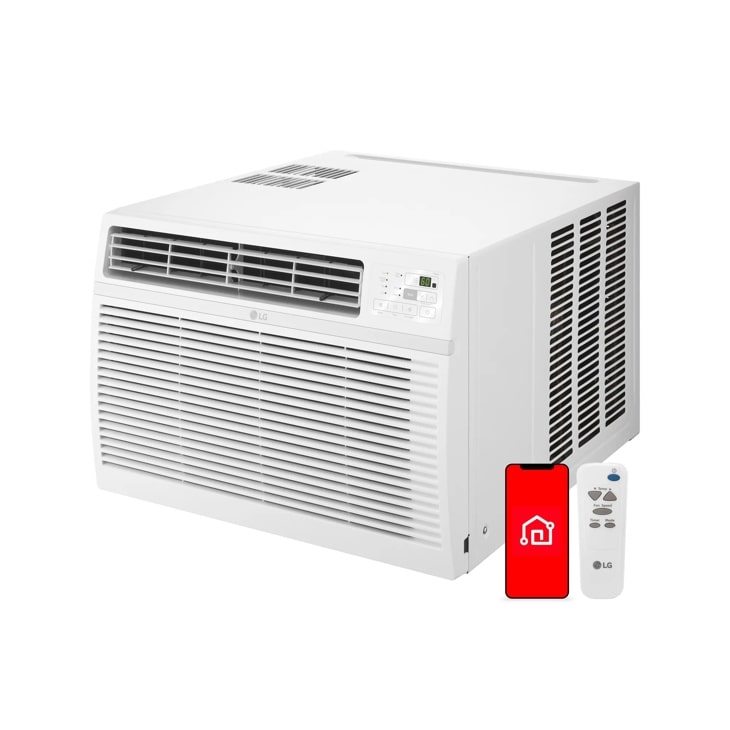
Best for: A room up to LG’s listed 340 square feet where ordinary rectangular installation and app control appeal.
Pros
- 8,000 BTU and ThinQ remote control
- Energy Saver, timer and auto-restart features
- Four-way air deflection and washable filter
Cons and trade-offs
- Conventional chassis occupies more of the window opening
- LG lists 52 dBA on low, above some inverter maker low-mode claims
- No variable-speed inverter is listed for this model
Our recommendation
LG’s LW8017ERSM1 keeps the familiar rectangular window-unit format and adds ThinQ control. Its published 8,000-BTU capacity targets up to 340 square feet; the energy-saver mode and timer may help schedule cooling, but savings depend on climate and use. LG’s low-mode sound figure is 52 dBA, so call it a straightforward smart option rather than a measured quiet champion. Confirm the full model suffix “1” when ordering; the original LW8017ERSM page refers to an earlier variant.
Choose another if: You need an inverter or the lowest published bedroom noise.
Frigidaire FHWW085WE1: Inverter with app and filter option
Best for: An 8,000-BTU room where variable-speed control and a standard window-unit form matter.
Pros
- Variable-speed inverter with 8,000 BTU cooling
- Frigidaire app and included remote
- Optional compatible advanced filter
Cons and trade-offs
- PureAir RAC-10 advanced filter is a separate purchase
- Minimum window width is 24 inches
- Maker’s 42-dBA figure applies to a specified low setting, not every cooling mode
Our recommendation
FHWW085WE1 replaces the old FFRE083WAE in this comparison. Frigidaire lists a variable-speed compressor, Wi-Fi, six-way airflow and a 251–350-square-foot room band. Its optional PureAir RAC-10 filter is an accessory, not a reason to claim the basic unit is an air purifier. The maker quotes 42 dBA for a low setting; a hotter room at higher fan and compressor speed will sound different. Confirm the 24–36-inch window width and 14-inch minimum height before ordering.
Choose another if: Your opening is narrower than the maker’s 24-inch minimum or you expect its optional PureAir filter in the base box.
Hisense AW0823TW1W: Simple inverter with ConnectLife

Best for: A 350-square-foot-or-smaller room where an inverter and optional remote app control are useful.
Pros
- 8,000-BTU variable-speed inverter
- ConnectLife app plus remote and panel controls
- Washable removable filter and cooling/fan/dry modes
Cons and trade-offs
- Ordinary chassis blocks part of the window view
- ConnectLife requires compatible Wi-Fi and phone for remote features
- Filter still needs regular removal and cleaning
Our recommendation
Hisense lists AW0823TW1W as an 8,000-BTU inverter model with ConnectLife remote controls and a washable filter. Its standard shape is less specialized than Midea’s U but leaves more of the window filled. The maker calls it ENERGY STAR Most Efficient, a certification claim to confirm for the exact production year rather than a guarantee of lower bills. This is a sensible alternative if local retailer availability and the exact model suffix are clear, especially when you prefer panel and remote controls as well as app access.
Choose another if: You require U-shaped window preservation or a self-contained unit with no app setup.
Search Amazon US for Hisense AW0823TW1W (confirm exact model and configuration).
Windmill AC 8K WhisperTech: Design-led inverter and installation kit

Best for: A room in the maker’s 8,000-BTU band where appearance and the installation package matter.
Pros
- 8K WhisperTech variant uses inverter cooling
- Front upward airflow and understated display
- Insulating side panels and installation kit are central to design
Cons and trade-offs
- Appearance-focused design costs more than basic rectangular units
- Optional carbon-filter refills add an ongoing cost if used
- Must select 8K WhisperTech, not 8K Original or 12K size
Our recommendation
Windmill sells several capacities and two technology families on one page. Select the 8K WhisperTech inverter variant; the 8K Original is a different machine, and page imagery can change with the selector. Windmill emphasizes its included installation kit, side insulation and angled airflow. Those features can make a window installation tidier, but verify sash width, mounting rules and total cost. Its optional carbon-filter plan is not required for cooling and should not be confused with a dedicated air purifier.
Choose another if: You prioritize the lowest total cost or your window does not fit the maker’s kit.
Search Amazon US for Windmill AC 8K WhisperTech (confirm exact model and configuration).
Buying guide
Size cooling to the room, then check the window
The 8,000-BTU models here generally target roughly 340–350 square feet according to their makers, but strong sun, ceiling height, insulation, cooking loads and occupancy alter demand. Too little capacity struggles; oversizing can cool quickly without comfortable moisture control. Measure the opening’s clear width and height, sill depth and nearby outlet. A landlord or building may require a support bracket or prohibit exterior projections. Read the exact manual before buying.
Compare efficiency by the label, not a savings slogan
Window air conditioners use the CEER efficiency metric on the U.S. EnergyGuide label. Compare models of similar capacity and the expected operating hours, because annual cost estimates depend on assumed electricity prices and use. Inverter compressors can vary speed rather than cycling only on and off, but actual energy and sound depend on conditions. An ENERGY STAR badge does not mean every model or model year has the same consumption.
Know what a published decibel number means
Maker sound figures are typically for specific low or quiet settings and test conditions. A unit on high fan in a hot room will not sound like a low-mode specification. U-shaped units position the compressor farther outside the sash; conventional inverters can also reduce cycling. If you sleep near the window, compare placement, vibration isolation and return terms along with decibels. We have no original sound measurements.
Plan installation and drainage
Use the supplied or approved bracket, tilt and sealing method in the model manual. Do not improvise a support that could let the unit fall. Keep exterior vents clear and direct condensate where allowed by the building. Check whether the outlet and circuit match the rating; avoid unapproved extension cords. Clean the washable filter on the maker’s schedule and remove the unit or weatherproof it as instructed in the off-season.
Treat apps as a convenience
Wi-Fi scheduling and energy reporting can be useful, but the AC should still have accessible physical or remote controls. Check network requirements, whether the app account is necessary for your preferred features, and how a power outage is handled. A “smart” label does not change the cooling capacity or installation constraints. For more sizing and type choices, see our air-conditioner buying guide and portable AC comparison.
Frequently asked questions
Is a U-shaped window AC always quieter?
Its compressor placement can help, and Midea publishes a low-mode figure, but room acoustics, fan speed, window vibration and installation change what you hear. We have no measured head-to-head sound results.
Can I put a window AC in a casement window?
Only if the exact model and approved installation kit permit it. Most listed units expect a sash-style opening; check the manual and building rules before purchase.
What does 8,000 BTU mean for room size?
It is cooling capacity, not a fixed room-size guarantee. The makers here generally list about 340–350 square feet; solar gain, insulation and ceiling height can change sizing needs.
Will an AC replace a dehumidifier?
Cooling removes some moisture, but a dedicated dehumidifier gives independent humidity control. If humidity is the main problem when the room is already cool, compare our dehumidifier guide.
Is the optional Frigidaire filter included?
No. Frigidaire lists the PureAir RAC-10 advanced filter as a separate accessory. The unit has a washable dust filter.
Do all Windmill AC variants have WhisperTech?
No. Select the specific 8K WhisperTech variant; the Original and other capacity choices differ.
Research method and primary sources
We compared current primary manufacturer pages, exact models and practical use-case tradeoffs. We have no original hands-on or durability test records. Recommendations are editorial judgments, while product specifications remain manufacturer claims.
Primary sources: Midea U MAW08U1QWT manufacturer page; LG LW8017ERSM1 manufacturer page; Frigidaire FHWW085WE1 manufacturer page; Hisense AW0823TW1W manufacturer page; Windmill AC 8K WhisperTech manufacturer page; Midea air-conditioner guide; Frigidaire advanced filter compatibility. Our methodology.
Affiliate disclosure
As an Amazon Associate, The Gear Audit earns from qualifying purchases. We may earn an affiliate commission when you buy through our links, at no extra cost to you. Full affiliate disclosure.