EcoFlow DELTA 2 vs Jackery Explorer 1000 v2 (2026)
By The Gear Audit Team · Manufacturer-specification comparison updated September 27, 2026.
Quick answer: match output first, then the carry
Choose the EcoFlow DELTA 2 when you need its documented 1,800W continuous AC limit, six US AC receptacles or two USB-C outputs rated up to 100W each. Choose the Jackery Explorer 1000 v2 when 1,500W and three US receptacles cover the load and its lower 23.8 lb published weight makes a difference on repeated trips. Their nominal capacities, 1,024Wh and 1,070Wh, are close enough that the 46Wh difference alone cannot predict real appliance runtime. These are conclusions from manufacturer specifications, not measured performance.
More continuous AC output and more AC/100W USB-C connections; 27 lb published weight.
About 3.2 lb lighter, with a 1,070Wh battery; less continuous AC output and one 100W USB-C port.
The published differences that affect a purchase
| US configuration | EcoFlow DELTA 2 | Jackery Explorer 1000 v2 |
|---|---|---|
| Battery chemistry and nominal energy | LFP; 1,024Wh | LiFePO4; 1,070Wh |
| AC outlets and rated total | Six; 1,800W continuous total, 2,700W surge | Three; 1,500W continuous total, 3,000W surge peak |
| USB-C outputs | Two, each up to 100W | One up to 100W and one up to 30W |
| Solar input ceiling | 500W, 11–60V and 15A maximum | 400W across two DC inputs, subject to Jackery’s voltage/current rules |
| Published net weight | 27 lb | About 23.8 lb |
| Capacity expansion | EcoFlow lists compatible extra batteries; check the exact battery and cable | No expansion battery identified for this exact station on the cited US page |
The wattage on an AC outlet is a shared system limit, not an allowance for every receptacle at once. Likewise, a surge figure is a short transient limit, not the continuous power available to a heater or other steady load. Both manufacturers describe special operating modes; we use their ordinary rated AC figures for the comparison because they are the safer starting point for choosing a load.
EcoFlow DELTA 2: more output and connection room
Best for: A stationary or car-supported backup plan with several small AC devices, or a planned load above 1,500W but within the DELTA 2’s documented 1,800W continuous rating.
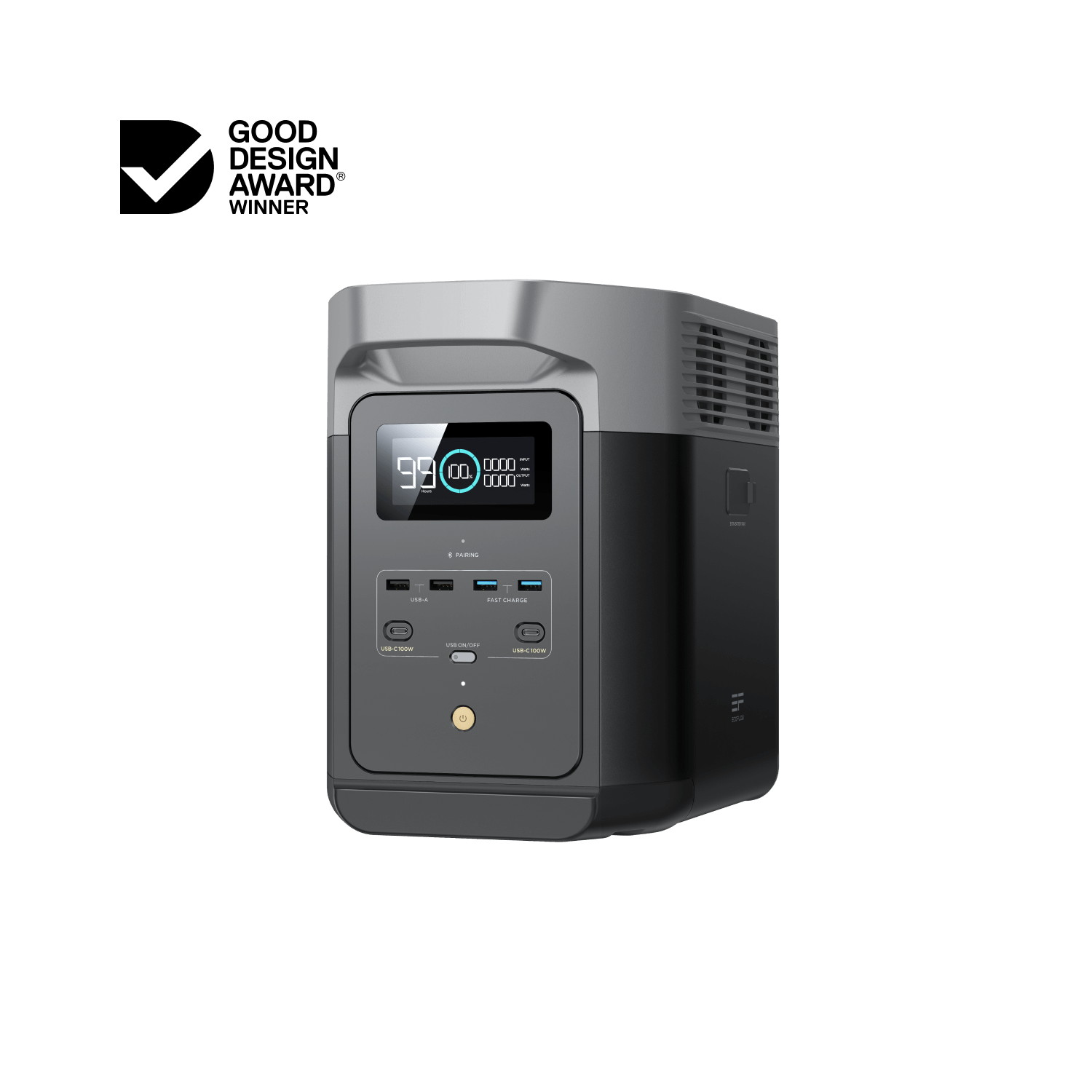
EcoFlow lists six US AC outlets, two 100W USB-C ports, four USB-A ports in two groups, a car socket and two DC5521 outputs. This layout may reduce the need for a separate power strip or USB charger, provided the combined load respects the applicable totals. The two USB-C ports are particularly useful when two compatible laptops or other USB-C devices need power at once. Each device still negotiates its own supported profile, and a 100W port does not guarantee that every laptop will accept 100W.
EcoFlow also lists a 500W maximum solar input, with 11–60V and 15A limits. A panel or panel string must satisfy all three constraints and use the correct connector. The station’s 500W ceiling says nothing about the output of a single included panel; the station-only package and solar bundles differ. Confirm the solar cable or adapter in the actual offer; a station-only package should not be assumed to include a panel or every panel-connection accessory.
Pros
- Higher ordinary continuous AC rating. The 1,800W total gives 300W more published headroom than the Jackery for a qualifying load.
- Six AC receptacles and two 100W USB-C outputs. The connection layout serves multiple moderate-power devices without treating outlets as separate inverters.
- Documented extra-battery route. EcoFlow names compatible expansion batteries when longer energy storage matters.
Cons and trade-offs
- Heavier to move. EcoFlow’s 27 lb figure exceeds Jackery’s approximately 23.8 lb figure before any accessories.
- Nominal capacity is slightly lower. Its 1,024Wh label does not imply shorter measured runtime for every load, but there is no paper-capacity advantage here.
- Special modes need qualification. EcoFlow’s X-Boost language does not convert the normal 1,800W AC rating into a continuous 2,200W allowance for every appliance.
Choose another if: You expect to carry the station frequently, need only three AC outlets and remain comfortably below 1,500W, or cannot accommodate the DELTA 2’s size and weight.
Our recommendation
Pick the DELTA 2 when its extra output or port count solves a documented need. Draw the proposed device list first; unused outlets and a higher limit are not benefits that offset carrying weight for every buyer.
Manufacturer claims: EcoFlow DELTA 2 US manual portal. Buying judgment is editorial.
Search EcoFlow DELTA 2 on Amazon US
Jackery Explorer 1000 v2: lower carrying weight
Best for: A regular campsite or vehicle-to-site carry where a 1,500W shared AC limit and three outlets meet your appliance list.
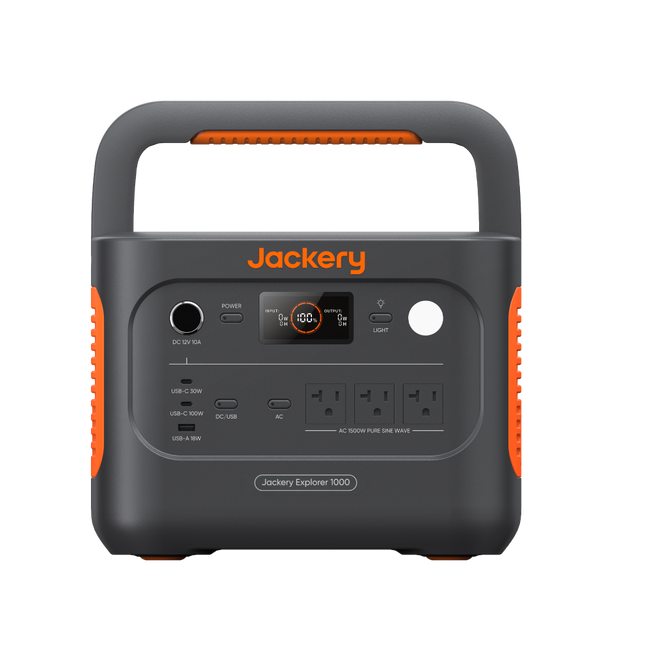
Jackery lists about 23.8 lb, 1,070Wh nominal capacity, three 120V AC outlets sharing a 1,500W rated output, and two USB-C ports with different ceilings: 100W and 30W. If you pack one laptop, checking which USB-C receptacle supplies 100W is straightforward. If you pack two laptops that each require close to 100W, the asymmetry matters. The Jackery also has a USB-A output and a car-style DC socket.
The US page describes a station-only package and solar-panel bundles. The base package lists an AC charging cable; do not assume that a pictured panel or solar charging cable ships with it. Jackery’s one-hour charging statement refers to its emergency super-charge mode, which is a specific app-controlled mode. We would plan ordinary charging around the manufacturer’s separately stated normal mode and the time available rather than promise a one-hour result in every setting.
Pros
- Lower published station weight. A difference of about 3.2 lb can matter when the unit is moved repeatedly.
- Three AC outlets cover a simple campsite load. That is enough physical connections for several small devices without assuming a power strip.
- 1,070Wh nominal capacity. It carries a modest paper energy advantage within the same general 1kWh class.
Cons and trade-offs
- Lower continuous AC rating. A load that truly needs between 1,500W and 1,800W points toward the EcoFlow, after checking start-up demand.
- Only one USB-C port reaches 100W. The second is rated up to 30W, so two high-draw USB-C devices need a plan.
- Three AC outlets constrain layout. More plugs or bulky adapters may require a different connection arrangement while staying under the shared rating.
Choose another if: Your measured load exceeds 1,500W continuously, you need two 100W USB-C outputs at the same time, or the three AC sockets do not fit the plug layout.
Our recommendation
Choose the Explorer 1000 v2 for a carry-focused plan with known moderate loads. Verify the v2 identity and the North American outlet configuration: the older Explorer 1000 and other regional editions are different buying decisions.
Manufacturer claims: Jackery US Explorer 1000 v2 product and technical specifications. Buying judgment is editorial.
Build a load and runtime estimate before shopping
List each device’s measured or nameplate running watts, possible starting surge, hours per day and socket type. Add loads you expect to run simultaneously, then compare that sum to the station’s continuous AC rating. A compressor, pump or motor may briefly ask for more when starting. Neither station’s surge specification guarantees every specific motor will start, because start-up duration and waveform also matter. If a critical appliance is involved, seek its electrical data and the station maker’s compatibility guidance.
For an energy estimate, multiply watts by planned hours to get watt-hours, then allow for AC conversion losses, idle draw, temperature and changing appliance duty cycles. A 100W device for five hours calls for about 500Wh at the device, before station losses. Nominal battery watt-hours are not guaranteed AC watt-hours at the receptacle. This arithmetic helps eliminate an obvious mismatch; it is not a claim that we measured either station’s runtime.
For solar, record panel voltage and current as well as wattage. A 500W input ceiling is useful only if a compatible panel arrangement and sunlight can approach it. Shade, angle, season and cloud cover reduce output; never promise a recharge time from the station input maximum alone. For indoor backup, keep portable solar panels outdoors as directed and do not connect a portable station to home wiring without the specified transfer equipment and a qualified installation.
Five checks before placing an order
- Identify the exact generation. EcoFlow DELTA 2 is not the older DELTA or DELTA 2 Max. Jackery Explorer 1000 v2 is not the first Explorer 1000.
- Map every plug. Count AC sockets and check adapter clearance. Confirm the USB-C profile and cable your laptop needs.
- Check all power limits. Compare steady and start-up loads with the normal AC rating and the manual’s limits.
- Read package contents. Station-only and panel bundles have different panels, cables and carrying weights. Match the selected listing to the manufacturer’s named configuration.
- Check support and offer details. Warranty and availability vary by seller and region. Inspect the exact listing, seller, outlet layout and current terms; links labelled Search Amazon may include other variants.
For a solar kit rather than the bare station, see our BLUETTI and Jackery kit comparison. For smaller loads, our portable power-station guide covers a different capacity class.
Power-station questions
Does 1,070Wh guarantee longer runtime than 1,024Wh?
No. The figures are nominal battery energy. AC conversion, idle consumption, temperature and the actual load can overwhelm a 46Wh label difference. We have no controlled runtime measurement for these two units.
Can six EcoFlow outlets each supply 1,800W?
No. EcoFlow states 1,800W total normal AC output. Use the sum of simultaneously running loads and check start-up demand.
Is the Jackery’s fastest charge its everyday default?
Jackery describes the one-hour claim as Emergency Super Charge, a specific mode. Follow the product’s charging instructions and distinguish it from ordinary-mode timing.
Can either be connected directly to a house circuit?
Do not improvise a connection to household wiring. Use only the station maker’s supported equipment and an appropriate qualified installation for any transfer setup.
Research method, sources and limits
We checked the EcoFlow DELTA 2 US manual portal, EcoFlow manufacturer model image and current Jackery Explorer 1000 v2 US specifications on September 27, 2026. EcoFlow now redirects its older US DELTA 2 retail URL to DELTA 3, so that retail page is not used as live DELTA 2 evidence. Ratings, weights and connector details in this article are manufacturer claims. Our Best for and recommendation sections are editorial judgments based on those documented differences. We did not test either station, measure runtime, output, charging speed, acoustic noise, conversion efficiency or long-term reliability. Links labelled Search Amazon are model searches; inspect the exact listing, bundle, seller and current offer.
Primary sources: EcoFlow DELTA 2 US manual portal and Jackery Explorer 1000 v2 US product specifications. Read our methodology.
Amazon price cards, when available, apply only to the named model and configuration. Check the displayed update time, seller, condition and included items. Search links may return other variants. Customer star ratings are not shown when verified API data is unavailable.
Affiliate disclosure
As an Amazon Associate, The Gear Audit earns from qualifying purchases. We may earn an affiliate commission when you buy through our links, at no extra cost to you. Read our full affiliate disclosure.