Herman Miller Aeron vs. Steelcase Leap: Choose by Fit and Configuration
By The Gear Audit Team · Specification research September 9, 2026; buying-advice structure and manufacturer source check September 13, 2026.
Quick answer: choose a sized suspension chair or tune an upholstered seat?
Choose the Herman Miller Aeron when selecting among three chair sizes is central to fit and you prefer an 8Z Pellicle suspension seat and back. Choose the Steelcase Leap when adjustable seat depth, an upholstered seat with flexible edges, four recline stops and detailed back/arm tuning better match how you sit. We do not name a universal comfort winner. Our recommendation is to try the exact size and configuration under a useful return policy, because neither brand name guarantees fit.
Sizes A, B and C change seat depth and chair dimensions. Pick the size first, then specify support, tilt, arms and casters.
The standard work chair combines adjustable seat depth with LiveBack, lower-back firmness, lumbar and four-dimensional arm adjustments.
Fit begins with different decisions
| Buying question | Herman Miller Aeron work chair | Steelcase Leap work chair |
|---|---|---|
| Primary fit decision | Choose Size A, B or C before support and arm options | One standard work-chair format with adjustable seat depth |
| Contact surface | 8Z Pellicle suspension seat and back | Upholstered seat with flexible edges; upholstered or 3D Knit back configurations |
| Back adjustment | PostureFit SL or lumbar options, plus tilt-package choices | LiveBack, height-adjustable lumbar and lower-back firmness dial |
| Recline approach | Confirm basic or tilt-limiter/seat-angle package | Four recline-angle stops plus upright lock and upper-back force |
| Arms | Fixed, height-adjustable or fully adjustable packages; pad depth is separately specified | Four-dimensional arms described by Steelcase; confirm the actual order configuration |
| Best match | Buyer who values a size-specific suspension shell | Buyer who wants to tune seat depth, back resistance and upholstered contact |
Aeron asks you to commit to a shell size, then choose the mechanisms attached to it. Leap uses a broad adjustable range within its standard work-chair format. That makes the first fitting question different: Aeron buyers should validate size; Leap buyers should validate whether the seat-depth and back controls can be adjusted to a stable, comfortable position.
Herman Miller Aeron: choose the chair size before the options
Best for: A buyer who prefers a suspension seat and back, can verify the right A/B/C size, and knows which lumbar, tilt and arm adjustments belong in the order.
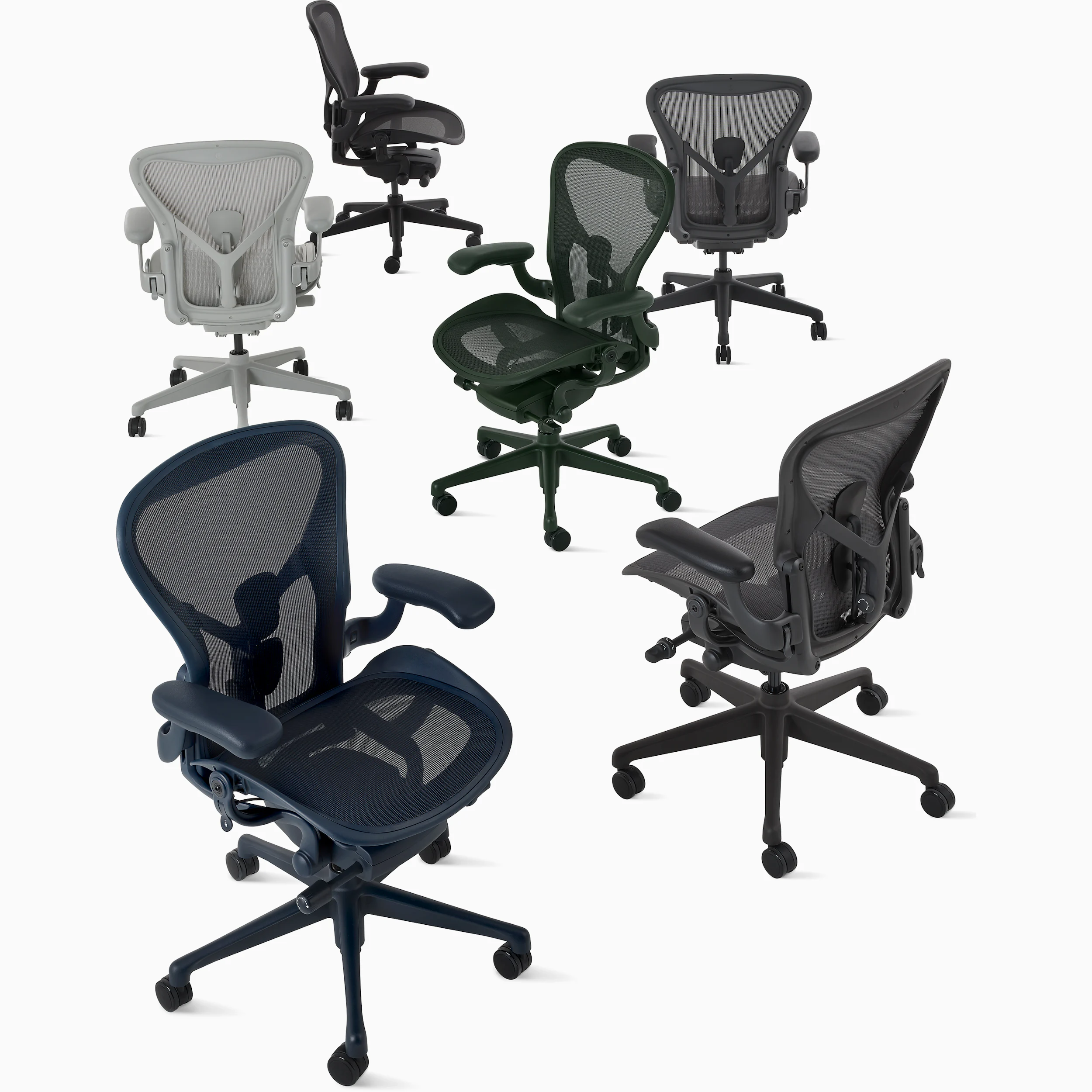
Herman Miller publishes different seat depths for the three sizes: 16.4 inches for A, 17 inches for B and 18.9 inches for C. Those are seat measurements, not total floor clearance. The maker’s fit chart is a starting point, but the size in the cart and on the chair label should match the size you tried or selected.
After size, the decision moves to PostureFit or lumbar support, tilt controls, arms and casters. The 2026 product sheet distinguishes fully adjustable arms from a version that also adds arm-pad depth. Descriptions such as “fully loaded” do not identify those functions.
Pros
- Three chair sizes provide a deliberate fit choice. Buyers at different body dimensions are not all placed into one shell and asked to solve fit only through adjustment range.
- The 8Z Pellicle seat and back create a distinct suspension feel. Buyers who prefer tensioned support over a padded seat have a clear material reason to choose Aeron.
- Support, tilt and arm packages can be matched to the task. A buyer can specify lumbar or PostureFit support and choose the recline and arm functions that will actually be used.
Cons and trade-offs
- Seat depth changes with chair size rather than a sliding seat pan. Choosing the wrong A/B/C size cannot be corrected through the kind of seat-depth adjustment Leap provides.
- The suspension surface is a strong contact preference. Someone who wants a cushioned, upholstered seat may not like Pellicle even if the dimensions are appropriate.
- Useful adjustments are divided among option packages. A basic listing may lack the tilt limiter, seat angle, arm range or pad-depth function expected from a showroom chair.
Choose something else if: You want to alter seat depth after the chair arrives or strongly prefer an upholstered seat. Leap puts those priorities into the standard adjustment and material story.
Our recommendation
We recommend Aeron when you can verify size and the suspension surface feels right in person. Write the selected size, support, tilt, arms and casters into one configuration list before comparing offers. The chair’s value depends on those choices, not the Aeron name alone.
Sources: Herman Miller Aeron buying guide and Aeron product sheet.
Search Amazon US for the Herman Miller Aeron chairTagged model search; confirm size, configuration, condition, seller and warranty. No exact Amazon listing or price is asserted.
Steelcase Leap: tune seat depth and back response
Best for: A buyer who wants an upholstered seat, adjustable seat depth, a flexible seat edge and several controls for lower-back support, recline and arm position.
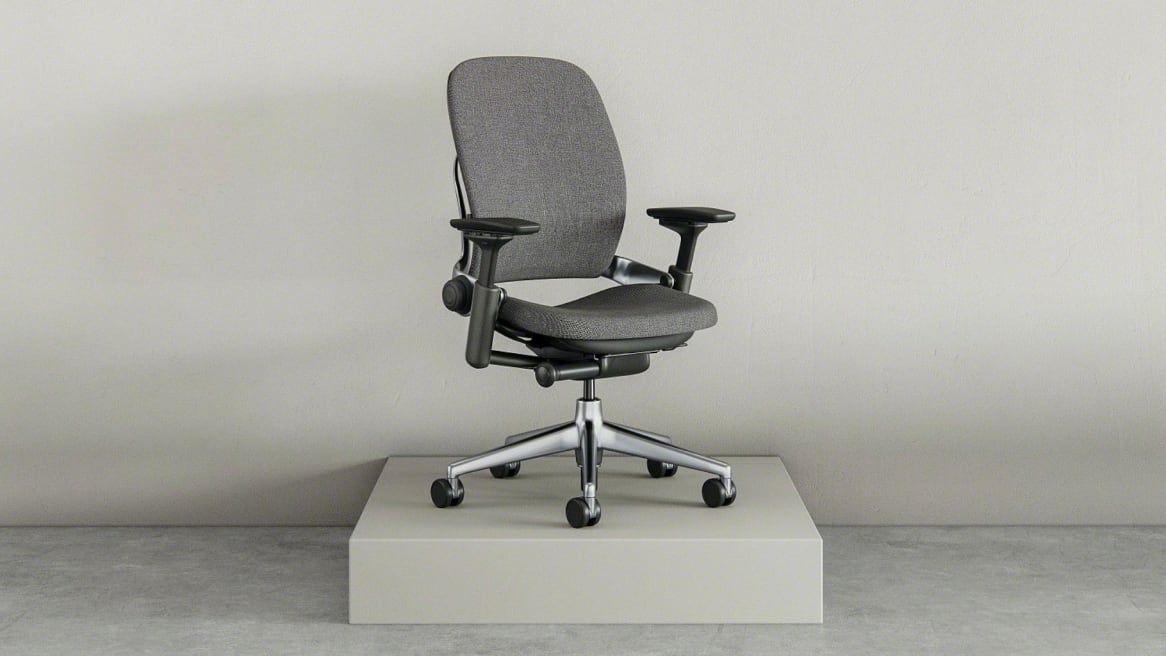
Steelcase describes Leap’s LiveBack as changing shape with spinal movement and pairs it with height-adjustable lumbar and a lower-back firmness dial. Adjustable seat depth and flexible seat edges address thigh position, while four recline stops and an upright lock shape how far the chair moves back.
The arm system is also part of the fitting process: Steelcase describes height, width, depth and pivot adjustment. Those controls are useful only when set for the desk and input devices, so allow time to tune them instead of assuming the factory position represents the chair’s fit.
Pros
- Adjustable seat depth changes thigh support without changing chair size. This is useful when desk users share a chair or when the fixed seat depth of an Aeron size falls between preferences.
- Back support has several independent adjustments. Lumbar height, lower-back firmness, upper-back force and recline stops can be tuned rather than bundled into a single tension control.
- Four-dimensional arms help align with varied desk tasks. Height, width, depth and pivot can move the pads toward a keyboard, mouse or close-in reading position.
Cons and trade-offs
- The standard chair does not offer Aeron’s three shell sizes. Seat-depth adjustment broadens fit, but a buyer who wants a size-specific seat/back structure may prefer Aeron’s approach.
- The upholstered seat creates a different contact feel from suspension. Buyers specifically seeking a taut mesh seat and back should try Leap before assuming its adjustment range answers that preference.
- The number of controls increases setup time. Each user needs to establish seat depth, back force, lower-back firmness, recline stop and arm position; shared users may need to reset several adjustments.
Choose something else if: A size-specific suspension chair is the priority, or you have already found an Aeron A, B or C that fits. Leap’s broad adjustment range does not recreate Aeron’s Pellicle surface.
Our recommendation
We recommend Leap for buyers who will use its seat-depth and back adjustments and prefer upholstery. Set seat depth first, then lumbar/firmness, recline and arms at the actual desk. If those controls cannot produce a stable posture during a trial, more adjustment is not automatically better.
Sources: Steelcase Leap product page and Steelcase configuration example.
Search Amazon US for the Steelcase Leap work chairTagged model search; confirm chair/stool format, upholstery, arms, condition, seller and warranty. No exact Amazon listing or price is asserted.
How to compare the chair you will actually receive
- Measure the sitting fit. Compare seat height range, seat depth, back contact and arm position at the desk rather than using total chair dimensions alone.
- For Aeron, choose size first. Record A, B or C, then support, tilt, arms and casters. A gallery photo does not confirm these options.
- For Leap, test the adjustment sequence. Set seat depth, lumbar height/firmness, back force, recline stop and arms, then use the chair long enough to notice pressure or reach problems.
- Separate new from used or remanufactured. Condition, replaced upholstery, missing labels and altered parts affect what is being compared and which warranty applies.
- Use return terms as part of fit. Specifications cannot prove comfort. Prefer a trial or return policy that lets you evaluate the exact configuration at your desk.
For desk clearance and alternative styles, see our desk-chair comparison and used-chair listing checklist.
Aeron vs. Leap FAQ
Is Aeron Size B the best size for everyone?
No. Herman Miller provides A, B and C size guidance because body dimensions and preferred contact points differ. Verify the size on the actual order.
Does Aeron have adjustable seat depth?
The reviewed Aeron sheet lists different fixed seat depths by size. Leap separately documents a sliding seat-depth adjustment, so this is a real fit-method difference.
Does Leap V2 identify one current configuration?
No. Steelcase’s current product name is Leap, and listings may use “V2” for varied ages, options and conditions. Verify the chair, upholstery, arms, lumbar, casters and warranty.
Is Pellicle cooler than upholstery?
The materials and contact feel differ, but we did not measure temperature or moisture. Try both under similar room and clothing conditions if thermal feel matters.
Which chair is more comfortable?
Neither specification set establishes a universal winner. Aeron offers size-specific suspension; Leap offers adjustable seat depth and upholstered contact. The better fit depends on the person and exact configuration.
Research method, primary sources and limitations
We compared current US manufacturer information for the Aeron work chair family and Steelcase Leap work chair. We evaluated fit approach, seat/back material, published adjustment functions and configuration choices. We did not sit in either chair, measure pressure or temperature, or conduct long-session comfort or durability testing. Manufacturer ergonomic descriptions remain claims; recommendations are editorial judgments about fit and configuration.
Buying-advice update: September 13, 2026. Original specification research: September 9, 2026. The unsupported legacy test narrative and numerical scores remain removed.
Primary sources: Herman Miller Aeron buying guide; Aeron product sheet; Steelcase Leap product page; Steelcase configuration example. Read our research methodology and Home Office guides.
CERTAIN CONTENT THAT APPEARS ON THIS SITE COMES FROM AMAZON. THIS CONTENT IS PROVIDED “AS IS” AND IS SUBJECT TO CHANGE OR REMOVAL AT ANY TIME.
Affiliate disclosure
As an Amazon Associate, The Gear Audit earns from qualifying purchases. We may earn an affiliate commission when you buy through our links, at no extra cost to you. Read our full affiliate disclosure.