How to Choose a Coffee Grinder: Complete Buyer’s Guide (2026)
By The Gear Audit Team · Manufacturer documentation checked September 27, 2026.
Quick answer: buy for the coffee you brew most
Start with your brew method. An unpressurized espresso basket needs a grinder with fine, repeatable adjustments; a filter-only household does not need that range. For several cups every morning, an electric burr grinder reduces work. For one cup, travel, or limited counter space, a manual burr grinder can be sensible if the effort suits you. We would choose the Baratza Encore ESP for a mixed espresso-and-filter routine, or the Fellow Ode Brew Grinder Gen 2 for a dedicated filter routine. Those are examples of two different jobs, not results from our own testing.
Choose the grinder around the brew method
| Your routine | Useful grinder traits | Check before buying |
|---|---|---|
| Unpressurized espresso most days | Fine adjustment with enough usable range to dial in different beans; convenient dosing into your basket. | Confirm the exact model is sold for espresso. The standard Encore and Encore ESP are different grinders. |
| Pour-over, drip, French press or cold brew only | Useful adjustment through the brewed-coffee range, easy cleaning and a workflow suited to your batch size. | Do not pay for espresso claims you will not use. Fellow expressly excludes espresso from Ode Gen 2’s intended use. |
| One cup, limited outlets or travel | A manual burr grinder with sufficient bean capacity and an adjustment system you can repeat. | Consider crank effort, especially for fine espresso settings, before choosing manual grinding every morning. |
| Several people or repeated batches | Electric operation, accessible hopper or dose loading, catch-cup capacity and easy cleanup. | Check noise in your actual home and how much ground coffee remains in the chute. |
The table is editorial buying guidance. It does not rank grind uniformity, noise or cup quality; we have no original measurements for those outcomes. Use the manufacturer’s method range as the first filter, then check independent reviews that test the exact version you intend to order.
Three choices that change daily use
Burr versus blade
A blade grinder gives you limited control over particle size because grinding time, load and shaking all affect the result. A burr grinder has an adjustable gap, making it easier to repeat a setting and change it deliberately when a brew tastes wrong. That does not mean every burr grinder makes equally uniform grounds, or that one burr shape always tastes better. Baratza’s espresso guidance explains how grind adjustment changes extraction and describes flat and conical burrs as different approaches rather than a universal winner.
Espresso adjustment versus filter adjustment
Espresso is sensitive to small changes in grind, dose and the beans used. A grinder with a broad label such as “fine to coarse” may still have steps too large to tune an unpressurized basket comfortably. Baratza assigns the Encore ESP’s settings 1–20 to finer espresso adjustment and 21–40 to larger changes for filter methods. Fellow states that the Ode Gen 2 is for brewed coffee and is not intended for espresso. If you use a pressurized basket, the grinder demands may differ; check your machine’s basket before paying for an espresso-focused grinder.
Manual, single dose or hopper
Manual grinding saves an outlet and may free counter space, but every cup requires turning the handle. We would try a friend’s hand grinder before committing to it for a multi-person espresso routine. Single dosing means weighing beans before each grind, useful when you rotate coffees. A hopper reduces repeated loading when several drinks use the same beans. Neither workflow guarantees zero retained grounds; look for accessible cleaning instructions and a way to inspect the chute. A built-in timer measures time, not coffee mass, so a separate scale is useful when repeatability matters.
Baratza Encore ESP: one grinder for espresso and brewed coffee
Best for: A household that actually prepares both unpressurized espresso and brewed coffee and wants one clearly marked adjustment dial.

Baratza’s US product page names the Encore ESP and its dosing cup. Its operations manual separates the 1–20 espresso range from 21–40 for filter coffee. The adjustment is stepped. The manual is the source for the range, while the recommendation is our interpretation of where that range is useful.
Pros
- The two adjustment zones address a real conflict between fine espresso control and larger filter changes.
- Baratza documents the workflow and publishes a model-specific manual and support hub.
- The included dosing cup can make transfer to a portafilter more convenient when its size fits your setup.
Cons and trade-offs
- Stepped adjustment can leave a desired espresso point between clicks for some coffee and basket combinations.
- Switching repeatedly between espresso and coarse brewing still requires returning the dial and checking the result.
- The Encore ESP name can be confused with the standard Encore or the newer ESP Pro; compare the exact label and manual.
Choose another if: You make only filter coffee, want stepless adjustment for espresso, or need a dedicated travel grinder.
Our recommendation
Choose the Encore ESP when the mixed-method problem is real. Begin with Baratza’s stated ranges, then adjust by brew time and taste with your own beans. Do not treat a dial number as a universal recipe.
Sources: Baratza product page, Encore ESP manual and Baratza adjustment explanation. Recommendation is editorial.
Fellow Ode Brew Grinder Gen 2: a focused filter workflow
Best for: A household making pour-over, drip, AeroPress or immersion coffee that does not need an espresso grinder.
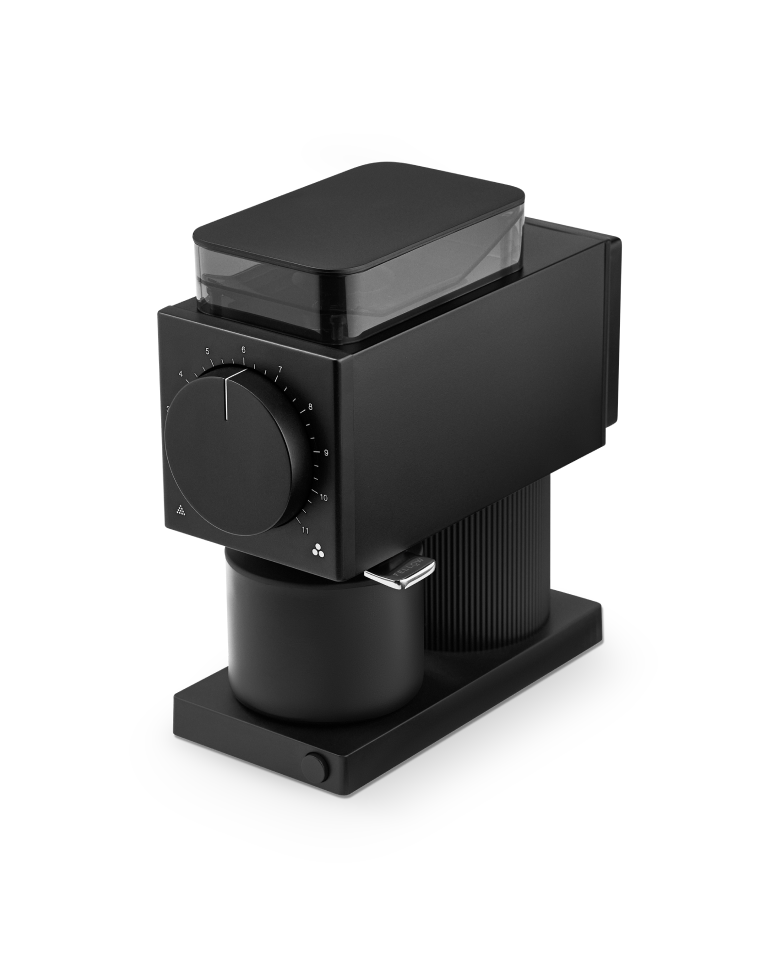
Fellow lists Ode Brew Grinder Gen 2 with 64 mm flat burrs, 31 total steps across 11 marked settings, a 100 g loading capacity, automatic stop and anti-static technology. It explicitly says the grinder is not intended for espresso. Its US page lists 120V input, so confirm the regional variant if ordering outside the US.
Pros
- The manufacturer describes a deliberately focused range for brewed-coffee methods.
- Single-dose loading and automatic stop fit a weigh-then-grind routine.
- Fellow publishes cleaning guidance for the exit chute and anti-static pins.
Cons and trade-offs
- It is the wrong purchase for unpressurized espresso under Fellow’s own stated intended use.
- A 100 g loading capacity does not make it a large bean-storage hopper.
- Anti-static features do not remove the need to clean the chute and pins.
Choose another if: You need espresso, routinely load more than its stated capacity, or want a grinder with a large hopper ready for many drinks.
Our recommendation
Choose Ode Gen 2 when filter coffee is the job and you value a simple single-dose counter setup. Do not infer that its large burr diameter alone makes it better in the cup than a grinder we have not tested against it.
Sources: Fellow product specifications and Fellow cleaning guidance. Recommendation is editorial.
Search Amazon for Fellow Ode Brew Grinder Gen 2 (verify Gen 2 and burr configuration in the listing).
Practical buying and setup checklist
- Identify your basket and brewer. An unpressurized espresso basket needs more fine adjustment than a pressurized one. Filter and immersion methods cover a different range.
- Write down the routine you will repeat. One measured cup favors a different workflow from several drinks made back to back.
- Check the exact version and region. Encore, Encore ESP and Encore ESP Pro differ; Ode Gen 1, Gen 2 and Gen 2 with optional burrs differ. Confirm voltage, plug and included accessories with the seller.
- Look up maintenance before purchase. Check that the maker supplies instructions for cleaning the chute and burr chamber, and whether replacement parts can be bought in your region.
- Budget for a scale if consistency matters. Change one brewing variable at a time; if a cup tastes wrong, adjust grind after holding dose and recipe steady.
Choosing the coffee machine as well? See our coffee maker buying guide. For specific grinders, compare the models in our coffee grinder shortlist and check that each one suits your brewing method.
Coffee grinder questions
Can one grinder handle espresso and French press?
Some makers specify both ranges, including Baratza for the exact Encore ESP. A printed range does not guarantee that switching back and forth will be effortless or that every bean will dial in at an ideal setting. If both methods are daily habits, judge the adjustment workflow as carefully as the range.
Are flat burrs always better than conical burrs?
No. Burr geometry alone cannot establish taste or grind quality across different grinders. Alignment, adjustment, feed and your brewing method also matter. Baratza describes trade-offs between its own designs rather than a universal winner.
Should I buy Ode Gen 2 for espresso because it has 64 mm burrs?
No. Fellow explicitly says Ode Gen 2 is intended for brewed coffee, not espresso. Match the intended grind range before comparing burr diameter.
How often should I clean a grinder?
Follow the manual for the exact model and increase cleaning when grounds build up, coffee oils collect or the chute becomes messy. Fellow specifically instructs Ode Gen 2 owners to brush the exit chute and anti-static pins. Do not pour water into the grinder body.
Research method, sources and limits
We checked current US manufacturer pages and the Encore ESP manual on September 27, 2026. Product features and intended-use limits above are manufacturer statements. The use-case guidance, pros, cons and recommendations are editorial judgments based on those documents. We did not grind coffee, measure particle distribution, noise, retention or heat, or compare cups in a controlled tasting.
Primary sources: Baratza Encore ESP, Encore ESP manual, Baratza adjustment guide, Fellow Ode Gen 2 and Fellow cleaning guide. Read our methodology.
The Encore ESP price card identifies the black US model; the Ode Gen 2 link opens a model search. Confirm model, voltage, burr option, seller, condition and package contents before buying.
Affiliate disclosure
As an Amazon Associate, The Gear Audit earns from qualifying purchases. We may earn an affiliate commission when you buy through our links, at no extra cost to you. Read our full affiliate disclosure.