Best Soundbars by TV Size, Connection and Expansion Plan
By The Gear Audit Team · Original specification research September 9, 2026; manufacturer-source and buying-advice check September 20, 2026.
Quick answer: measure, then choose the system
Sonos Beam (Gen 2) fits a shorter 25.63-inch furniture span and offers an HDMI ARC/eARC, app-based Sonos path. The original 44.96-inch Sonos Arc offers two dedicated height channels and fits a wider placement, but it is an older, distinct model from Arc Ultra. Bose Smart Soundbar 900 adds direct Bluetooth and Chromecast built-in to its network choices and uses the included ADAPTiQ headset for calibration. First confirm the TV port, physical clearance and compatible speakers you might add. These specifications do not rank dialogue or Atmos performance.
Use when the available width is limited and the Sonos app and expansion plan fit your household.
Make room for the bar and its upward-firing drivers; verify original Arc identity against Arc Ultra.
Choose for its Bose app, Bluetooth/Chromecast paths and ADAPTiQ process when those will be used.
Three soundbars by setup requirement
| Decision | Sonos Beam (Gen 2) | Original Sonos Arc | Bose Smart Soundbar 900 |
|---|---|---|---|
| Placement width | 25.63 in; 2.68 in high | 44.96 in; 3.43 in high | Measure exact 900 and furniture; do not borrow Ultra dimensions |
| TV audio | HDMI ARC/eARC; included optical adapter for compatible fallback | HDMI ARC/eARC; included optical adapter | HDMI eARC/ARC or optical; Bose lists both cables |
| Height approach | Dolby Atmos processing with phantom height channels, no dedicated upward drivers listed | Two dedicated height channels | Two upward-firing transducers |
| Calibration and music | Trueplay with supported iOS/iPadOS device; Wi-Fi/AirPlay 2, Sonos app | Trueplay with supported iOS/iPadOS device; Wi-Fi/AirPlay 2, Sonos app | ADAPTiQ headset and Bose app; Wi-Fi, Bluetooth, Chromecast built-in, AirPlay 2, Spotify Connect |
| Expansion | Check exact compatible Sonos Sub and surround pair | Check exact compatible Sonos Sub and surround pair | Check exact compatible Bose bass module and surround speakers |
TV size alone is not a fit measurement. The Sonos screen-size recommendations are rough merchandising guidance; stand width, screen clearance, port support and listening arrangement decide whether a model belongs in your room.
Sonos Beam (Gen 2) in Black: compact Sonos path
Best for: A room with a shorter available stand span and a buyer prepared to use the Sonos app, HDMI TV audio and compatible Sonos expansion.
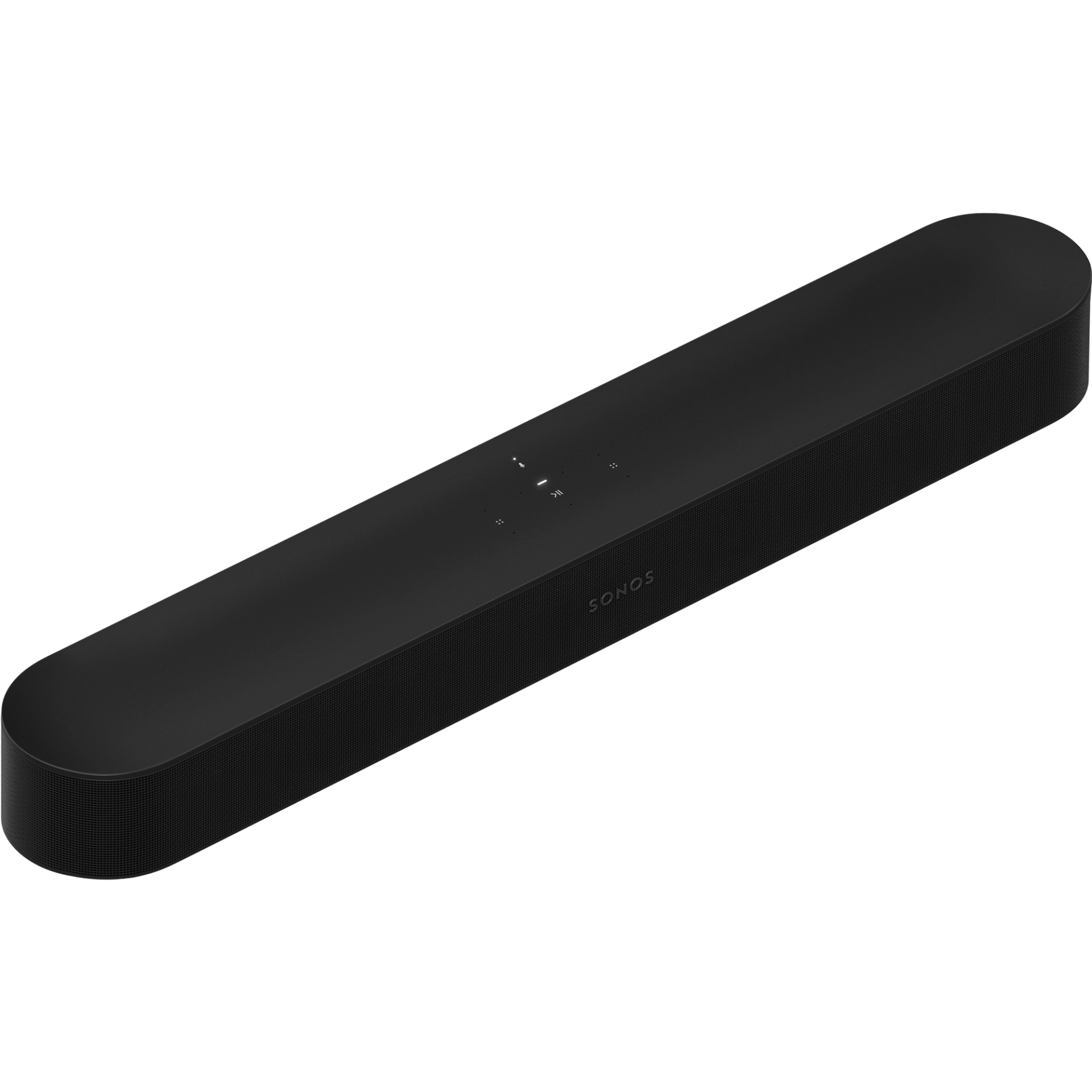
Beam (Gen 2) is 25.63 inches wide and 2.68 inches tall. It connects to the TV by HDMI ARC/eARC and has an included optical adapter for a TV without ARC; optical does not carry the same Atmos path. Sonos describes its Atmos height presentation as processing-created phantom channels. Trueplay for this soundbar requires a supported iOS or iPadOS device, and the Sonos app/Wi-Fi is part of setup.
Pros
- The shorter width eases furniture planning. It leaves more room on a stand that cannot accommodate the original Arc’s 44.96-inch body; still check feet, TV sensors and depth.
- HDMI TV control and Sonos expansion are documented. The app, compatible subwoofer and surround pair can form a system if you intend to grow beyond one bar.
Cons and trade-offs
- Its Atmos height is virtualized. If dedicated upward-firing channels are a purchase requirement, compare original Arc and Bose 900 placement and evidence.
- Trueplay depends on an eligible Apple mobile device. An Android-only household should plan around that limitation rather than assume the newer quick-tuning support applies to Beam Gen 2.
- No direct Bluetooth streaming is listed for Beam Gen 2. Bose 900 is the more direct option if phone-to-bar Bluetooth is part of daily listening.
Choose something else if: You have the space and specifically want dedicated height hardware, or direct Bluetooth playback is non-negotiable.
Our recommendation
Choose Beam (Gen 2) for a compact Sonos-centered HDMI setup. Confirm the current exact generation: Beam Ultra and Beam Gen 1 are different configurations.
Sources: Sonos Beam (Gen 2) Black, setup and Trueplay compatibility. Recommendations are editorial.
Price listing: Sonos Beam (Gen 2) — Black.
Original Sonos Arc in Black: wider bar with dedicated height channels
Best for: A buyer with enough clear space for a 44.96-inch bar who wants to build an original-Arc Sonos home theater and can meet its TV and Trueplay requirements.
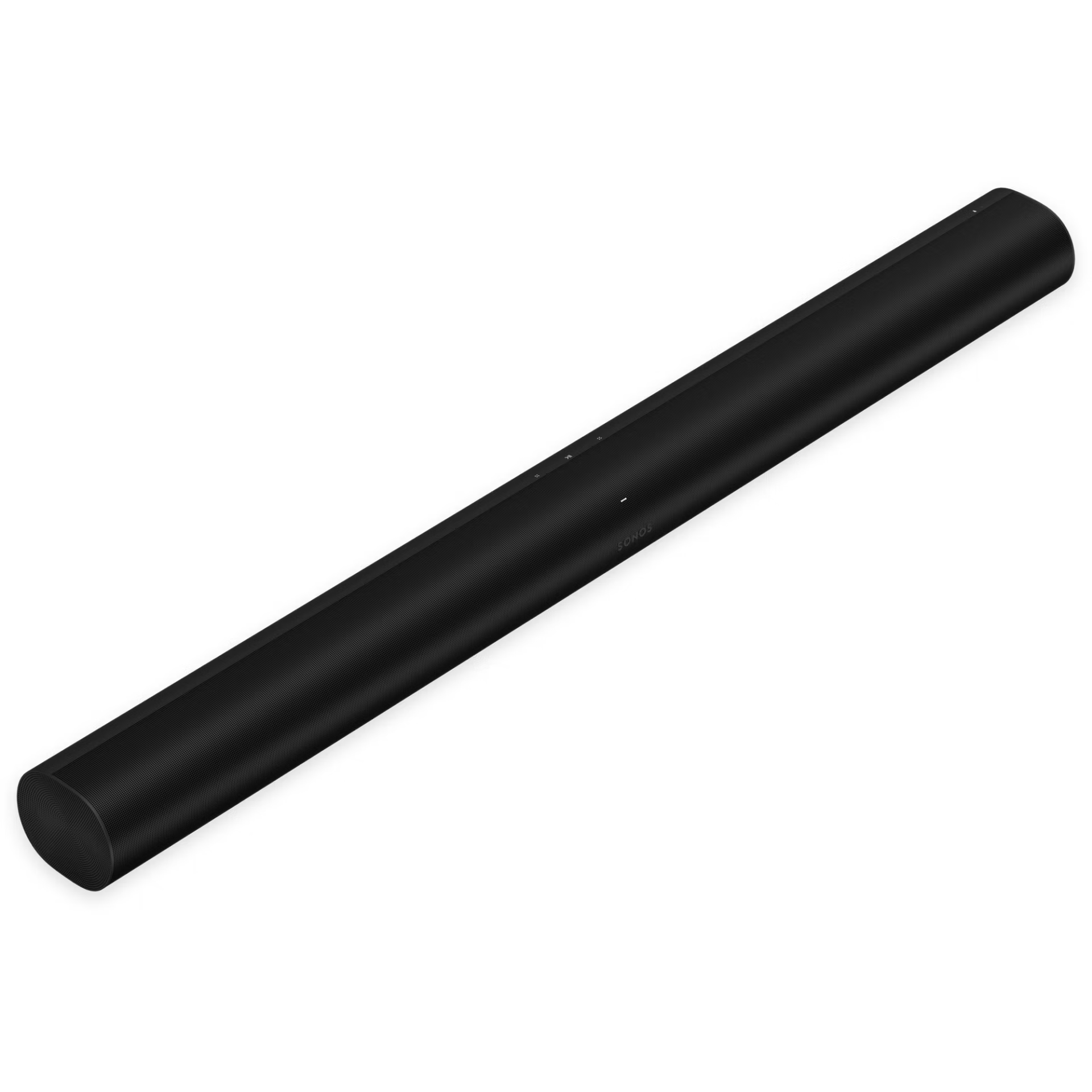
The original Arc lists 11 Class-D amplifiers, eight woofers, three tweeters and two dedicated height channels. It uses HDMI ARC/eARC, Wi-Fi and the Sonos app; supported Apple mobile hardware is required for its Trueplay tuning. Its optical adapter is a fallback for compatible non-Atmos audio. Sonos currently shows the original Arc as a last-chance/out-of-stock item on its own Black page, so examine third-party condition and warranty carefully.
Pros
- Dedicated height channels are part of this exact design. Buyers specifically planning a suitable Atmos TV path can distinguish this physical architecture from Beam Gen 2’s phantom height processing.
- It extends an existing Sonos household. The same app, compatible subwoofer and surround pairing can matter more than a stand-alone feature list.
Cons and trade-offs
- The 44.96-inch width and upward channels constrain placement. Measure the stand and preserve the manufacturer-recommended overhead clearance; a tight cabinet undermines the intended layout.
- No direct Bluetooth audio input is documented. If direct device-to-bar Bluetooth matters, Bose 900 has that route.
- This is an older model with successor overlap. Confirm original Arc, not Arc Ultra, plus seller, included parts, return terms and support status before acting on an offer.
Choose something else if: Your furniture only accepts a shorter bar, or the purchase is motivated by Arc Ultra’s newer features.
Our recommendation
Choose original Arc when its exact identity, dimensions and Sonos system plan align. Its driver count alone cannot prove clearer speech or stronger height effects than another bar.
Sources: Sonos original Arc Black and TV Atmos paths. Recommendations are editorial.
Price listing: Sonos Arc (original) — Black.
Bose Smart Soundbar 900 in Black: Bluetooth and ADAPTiQ route
Best for: A household that wants direct Bluetooth alongside Wi-Fi streaming and is prepared to run Bose’s headset-based room calibration.
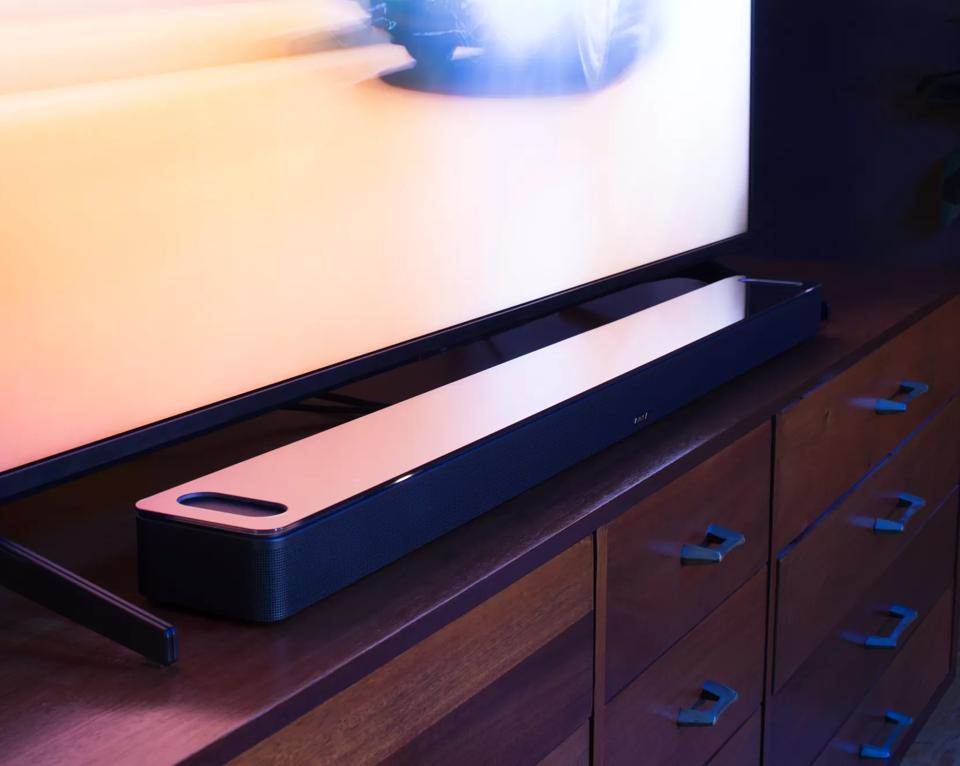
Bose lists nine speakers including two upward-firing transducers, HDMI eARC/ARC or optical, Bluetooth, Wi-Fi, Chromecast built-in, AirPlay 2 and Spotify Connect. Its Bose app guides setup and ADAPTiQ uses the included headset. Bose support dates the 900’s original sales period to 2021–2023; the current showcase still describes it. Do not substitute the Smart Ultra Soundbar or the later unnumbered Smart Soundbar.
Pros
- Bluetooth and Chromecast built-in broaden source habits. If household members frequently send audio directly from a phone or supported app, this is a practical distinction from the two older Sonos bars here.
- ADAPTiQ is a defined calibration path. The included headset and Bose app guide room measurement without needing a Trueplay-compatible iOS device.
Cons and trade-offs
- Its calibration relies on the headset and Bose app. A secondhand or open-box unit missing the ADAPTiQ accessory may frustrate the setup you intended.
- Bose expansion is its own compatibility system. A Sonos subwoofer or rear pair cannot be carried over; confirm exact Bose modules and surrounds rather than matching only a brand label.
- Older-model listings can mix successors and condition. Verify the exact 900 model, full package, seller and warranty before comparing offers.
Choose something else if: You already own compatible Sonos expansion speakers, or need the shorter 25.63-inch Beam footprint.
Our recommendation
Choose the 900 when Bluetooth/Chromecast and its calibration routine are concrete household needs. No manufacturer feature list establishes an in-room dialogue, bass or height winner against Arc.
Sources: Bose 900 showcase, exact-model support specification and ADAPTiQ guide. Recommendations are editorial.
Price listing: Bose Smart Soundbar 900 — Black.
Map the source, TV and audio format
Find the TV’s labeled ARC/eARC port, then check what it passes from its apps, game consoles and disc players. Sonos documents Dolby Atmos over compatible HDMI ARC with Dolby Digital Plus, while TrueHD Atmos requires eARC; optical does not carry Sonos Atmos. A supported streaming title may also depend on a particular subscription tier and playback device. Bose 900 accepts HDMI or optical, but do not infer the same format support over both routes. The soundbar app’s reported input format is a useful post-setup check.
Read our original Arc versus Bose 900 comparison and soundbar setup guide before ordering a larger system.
Measure fit and plan the next speakers
- Measure the actual furniture and screen clearance. Include height, depth, remote sensor, wall bracket, power outlet and overhead space, especially for upward-firing models.
- Choose the everyday control path. Sonos needs its app and Wi-Fi for setup and does not list direct Bluetooth for these bars. Bose 900 offers Bluetooth as well as network routes.
- Check calibration hardware. Trueplay on original Arc and Beam Gen 2 calls for a supported iOS/iPadOS device; Bose 900 calls for its ADAPTiQ headset and app.
- Name every future component. Confirm compatible subwoofer and surround models, power access, mounts, stands and any feature limitations when speakers are bonded.
- Identify the exact retail generation. Original Arc is not Arc Ultra; Beam Gen 2 is not Beam Ultra or Gen 1; Bose 900 is not Smart Ultra Soundbar. Search links do not verify an ASIN, bundle or price.
Buying FAQ
Is a 65-inch TV too large for Beam (Gen 2)?
Sonos lists Beam for TVs up to 65 inches, but this is not a physical rule. Measure the 25.63-inch bar, your stand and TV’s clearance, then decide whether its system features fit the room.
Can I get Atmos through the Sonos optical adapter?
No. Sonos requires HDMI ARC/eARC for Atmos. HDMI eARC is required for TrueHD Atmos; compatible ARC can carry Atmos in Dolby Digital Plus when the TV and source support it.
Do I need an iPhone to use Beam or Arc?
The Sonos app can set up the product on a compatible mobile device, but full Trueplay tuning on these two exact soundbars requires a supported iOS/iPadOS device. Do not import Arc Ultra or newer quick-tuning support into the original Arc.
Does Bose 900 include its calibration headset?
Bose’s exact-model box-contents specification lists an ADAPTiQ headset, HDMI cable and optical cable. Verify these parts in a used, refurbished or open-box offer.
Amazon prices: Cards show the named US configuration and an eligible current new USD offer when available, with its check time. Unavailable or expired offers use a labelled search link. Confirm the model, included parts and final checkout price. Numerical Amazon ratings are omitted when usable review data is unavailable.
Research method, sources and limitations
We compared current manufacturer pages and support guides for the exact named models. Specifications and supported connections are manufacturer claims; the use-case choices are editorial judgments. We did not test dialogue, bass, height effects, latency, room correction or reliability. The original Arc and Bose 900 are older models alongside successors, and retailer inventory can differ from manufacturer pages.
Original specification research: September 9, 2026. Manufacturer-source and buying-advice check: September 20, 2026. This check does not create new hands-on evidence or current retail price verification.
Primary sources: Sonos Beam Gen 2, original Arc, Sonos Atmos requirements, Bose 900 and Bose support specifications. Read our methodology.
CERTAIN CONTENT THAT APPEARS ON THIS SITE COMES FROM AMAZON. THIS CONTENT IS PROVIDED “AS IS” AND IS SUBJECT TO CHANGE OR REMOVAL AT ANY TIME.
Affiliate disclosure
As an Amazon Associate, The Gear Audit earns from qualifying purchases. We may earn an affiliate commission when you buy through our links, at no extra cost to you. Read our full affiliate disclosure.